
Trauma fixation device maker, CurvaFix, Inc. received 510(k) clearance from the FDA back in March for its CurvaFix Intramedullary Rodscrew System. On September 26, 2019, the company announced the completion of the first surgical procedure using the system to repair a pelvic fracture.
FDA Clears Steerable Rodscrew for Pelvic Repair
2 min read Premium comments
Secondary#curvafix#brokenhip#pelvicrepair
Follows Natural Bone Shape
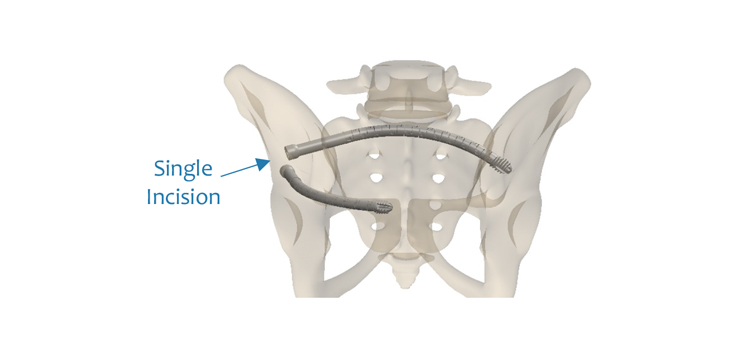
The company announcement stated the rodscrew, “is the only intramedullary implant capable of following the natural bone shape of curved bones such as the pelvis.”
Steve Dimmer, the CEO of the Bellevue, Washington company, said he believes surgeons will “welcome an implantable device that adapts to the patient’s own bone curvature and we anticipate that the CurvaFix Rodscrew will improve fixation, shorten surgeries and reduce care costs.”
In fact, the company believes this “steerable device will enable a quicker recovery (allowing patients to walk sooner); a less invasive procedure with a single small incision; and allow for a shorter surgery, thereby saving greater than $6,000 in operating room costs compared to bone plate procedures.” The company also believes its solution can help the elderly avoid long-term bed confinement.
According to the FDA clearance document, the system is a collection of “flexible intramedullary devices for pelvic fracture fixation. The devices have a threaded, self-tapping distal end and a driving torque interface at the proximal end. An integral shape lock feature changes the Rodscrew from a flexible to rigid state after implantation. The Rodscrew can be returned to a flexible state should explantation be required.”
The implants are available in a single diameter and an assortment of lengths to accommodate a variety of anatomic requirements and are manufactured from stainless steel.
The company says the Rodscrew is a flexible device that is “implanted through a small skin incision into the intramedullary space (center of the bone) and then converted into a rigid state to stabilize and repair a bone fracture.”
Pelvic fractures are among the most serious and technically complex injuries treated by orthopedic surgeons, according to the company. “Utilizing existing pelvic fracture fixation methods can require lengthy, complex surgery and can sometimes result in suboptimal bone stabilization. This can slow recovery, cause ongoing pain, and may contribute to long-term disability.”
The privately held company, founded in 2017, began when the former division head of orthopedic trauma at the University of British Columbia, Professor Robert Meek, M.D., decided there had to be a better way to repair pelvic fractures.
Author
React:
Discussion
This is a fascinating development. In my practice we've seen similar outcomes with the revised protocol. The key differentiator seems to be patient selection criteria. Has anyone else noticed the correlation with BMI thresholds?
Great point. I'd push back slightly on the conclusion, the sample size in the cited study is too small to draw population-level inferences. That said, the directional signal is compelling and worth a larger RCT.
We implemented a similar approach last year. Early results are promising but we're still gathering 12-month follow-up data. Happy to share our protocol if anyone is interested.
Join the conversation
Orthopedic professionals are discussing this. Sign in and upgrade to read every comment and add your voice.