
In 8th grade, New York’s Damon Watson was a rising tennis star, on the court five times a week, dreaming every day of becoming a tennis pro if not, someday, a professional athlete.
Recovering From Sports Injuries Is a (Expletive Deleted) Journey
6 min read Premium comments
#shoulderinjuries#labraltear#tennis
His dreams, however, came crashing down way too early when his shoulder became so painful that he could not raise his arm high enough to serve the tennis ball. It hurt like crazy, but his doctors could NOT find the source of his pain.
And he, his family and an intrepid team of physicians and nurses began the long, tortuous journey to find the pain, understand the problem and treat it.
This is a story about the process and the professionals who, along with their patients and their families, persevere and make it through to the other side.
What’s wrong with Damon’s shoulder?
Damon’s dad, Wade Watson, told OTW that the initial diagnosis they received was Little League Shoulder, an overuse injury that affects the growth plate and causes pain and inflammation at the shoulder.
“They thought the growth plate hadn’t hardened to the shoulder,” he said.
Nope. Wrong diagnosis. Which, itself, is not unusual for young athlete cases like this.
And that set Damon and his father on a long odyssey of doctor’s appointments, MRIs and different types of treatment including bone stimulation, platelet-rich plasma injections and physical therapy.
Through it all, Damon’s pain remained as strong as ever, even after rest and physical therapy.
And, no tennis. Damon had been playing since he was four and a half years of age. It was an understatement to say he was super passionate about it.
This is the crucible of sports injuries which many athletes find themselves in. Do you give up? Or do you find the inner strength to continue despite let down after let down?
As a player, Damon was highly competitive. So, as a patient, he persevered and, in order to get back on the tennis court, he adjusted. He taught himself how to play left-handed and even taught at a tennis camp.
And, in a dramatic move, he put a Plan B in action.
Damon directed his energy into his academics and became really interested in math, physics and anatomy. He even got accepted to the prestigious Beacon School in New York City.
His dad explained, “Damon has a super high IQ and his pediatrician saw him going into medicine. He was obsessed with his rehabilitation, and even interned with and shadowed a doctor. It was the silver lining of the injury.”
Watson said he took Damon to five doctors before being referred to James Gladstone, M.D., chief of orthopedics sports medicine for the Mount Sinai Health System and associate professor of orthopedic surgery at the Icahn School of Medicine at Mount Sinai.
He described it as a very frustrating process going from one doctor’s appointment to the next, from one diagnosis to another, and then of course, there was the expense of it all.
The Eureka Moment!
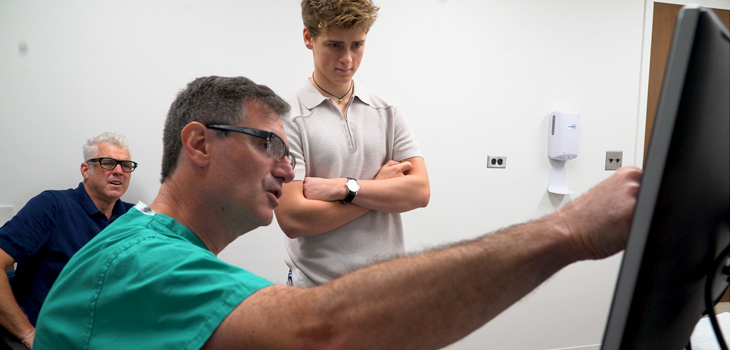
Gladstone was the first doctor to ask for an MRI arthrogram. When the dye was injected, a tear in Damon’s labrum suddenly popped into view.
“Dr. Gladstone is a tremendous doctor. He gave us a lot of comfort,” Watson said. “He knows the anatomy related to tennis and told us the hard truth about what it would take to get Damon back to the game he loved.”
Gladstone told OTW that Damon’s injury was a combination of normal ligaments being stretched out and a posterior labral tear. He performed an arthroscopic procedure to repair the labrum and tighten the surrounding ligaments stabilizing the shoulder.
On the long journey that the Watsons went through just to find the right diagnosis for Damon, Gladstone said, “Shoulder problems in overhead athletes can be confusing. There is a spectrum of problems and multiple diagnoses, so you really need to take the time to rule out all the possibilities.”
Shoulder pain can mean many different conditions like arthritis, rotator cuff disorders, tendonitis, instability in a shoulder, or even a compressed nerve.
Gladstone added, “Some doctors used treatment strategies like platelet-rich plasma injections to help Damon which is not useful for a loose shoulder. We have lots of tools at our disposal, but we need to be judicious and have the right diagnosis, particularly with elite athletes.
“It just takes time, not just in sports medicine, but in every specialty. You can’t always figure out the true extent of the problem in one visit. I even put Damon back into physical therapy before the surgery to make sure we had exhausted everything else first.”
Gladstone explained that in many cases, a labral tear can be treated with more conservative methods, but that with Damon, none of the non-surgical treatment strategies were working. He told Damon that if he wanted to play tennis again, surgery was his best option.
The Road to Recovery
Gladstone performed the labral repair to fix Damon’s shoulder and then it was another long year and a few months of healing and physical therapy before Damon could return to the sport he loved. Gladstone though says this is to be expected after this type of injury.
“You don’t want to stress the shoulder immediately post-surgery and then you need to regain motion and strength in the shoulder.” He explained that after the healing phase, the focus is on rehabilitation. The patient must do physical therapy two to three times a week and perform exercises at home as well.
“There is always a balance about being diligent but not too aggressive. To me, rehabilitation is as important as or more important than the surgery,” Gladstone said.
“What the patient puts in is also crucial. Damon was frustrated with his condition, so he was really committed. He kept pushing; never gave up. He was great to work with.”
A Special Connection
Gladstone and Mount Sinai have a special connection to the sport of tennis. Mount Sinai has been the official medical services provider for the athletes at the U.S. Open for seven years now. This year Gladstone and other Mount Sinai doctors have been on the ground at the United States Tennis Association Billie Jean King National Tennis Center Grounds in Flushing, New York, caring for all the athletes during the tournament and not just the pros, but the juniors and wheelchair tennis players as well.
The radiology department at Mount Sinai also provides diagnostic ultrasound examinations for players at the U.S. Open with the LOGIQ e, a GE Healthcare ultrasound device. It is only the size of a laptop so it can be used right there at the competition. The Mount Sinai radiology team also is able to diagnose injured players with the CARESTREAM DRX-Revolution Mobile X-ray System, which is also portable and easy to use right there on the tennis grounds.
Gladstone himself has been involve with treating tennis players for over 20 years. He is a leading expert in the treatment of sports injuries, in particular rotator cuff injuries, shoulder instability including dislocations and labral tears, ACL and meniscal injuries to the knee, and articular cartilage restoration. And besides being an orthopedic consultant for the U.S. Open tennis tournament he is also medical advisor to the U.S. Men’s Davis Cup tennis team, a team physician for the U.S. Ski Team and serves as team physician for ASA College and a local public high school football team.
His clinical approach is generally conservative always considering non-operative solutions when possible. With elite athletes like Damon though, sometimes surgery is the only chance they have of getting back into the game.
Today Damon is a freshman at Chapman University where he is majoring in math and engineering and is in the process of trying out for their tennis team. He is back to cracking serves at over 100 miles an hour, but his dad says that he still lost a lot of hours of play while waiting for the right diagnosis and then recovering from the surgery.
Having been through the crucible of sports injury, Damon knows what it takes to reach, literally, as high as he can in the sport he loves—if not also life itself.
Author
React:
Discussion
This is a fascinating development. In my practice we've seen similar outcomes with the revised protocol. The key differentiator seems to be patient selection criteria. Has anyone else noticed the correlation with BMI thresholds?
Great point. I'd push back slightly on the conclusion, the sample size in the cited study is too small to draw population-level inferences. That said, the directional signal is compelling and worth a larger RCT.
We implemented a similar approach last year. Early results are promising but we're still gathering 12-month follow-up data. Happy to share our protocol if anyone is interested.
Join the conversation
Orthopedic professionals are discussing this. Sign in and upgrade to read every comment and add your voice.