
Infants born without one or more limbs are “Amelia” patients. A new study from three OrthoCarolina hand surgeons offers good news for Amelia patients born without a hand.
Prosthetics: No Surgery Needed for Amelia Patients?
3 min read Premium comments
Secondary#myoelectricprosthesis#ameliapatients#missinglimb
According to the data collected by Michael Gart, M.D., Bryan Loeffler, M.D., and Glenn Gaston, M.D., both adults and children born without a hand still have the brain functionality needed to operate a myoelectric prosthesis, a prosthetic you control with the electric signals from your muscles, without surgical intervention.
The research was conducted with the help of Brian Kaluf, a prosthetist from Ability Clinic. Together, the four researchers discovered that children born without a hand still have the ability to send signals from the brain to the muscles corresponding to the missing limb—raising the possibility that these patients could eventually control an advanced prosthetic hand.
“We found that patients of all ages born without a hand can be highly functional with a myoelectric prosthetic hand, and don’t require surgery,” said Gart, who underwent his fellowship training in hand surgery at OrthoCarolina.
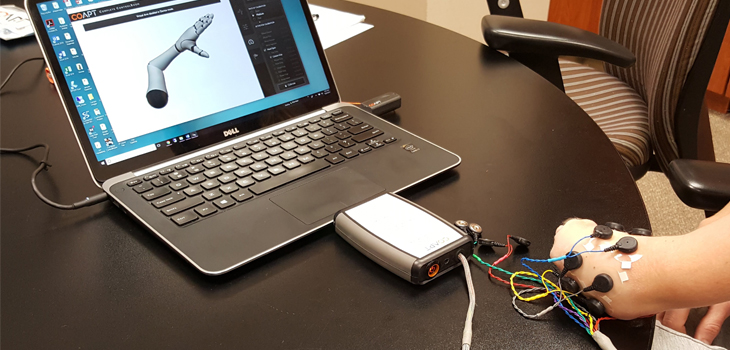
Each child in the study was asked to undergo testing using a digitized virtual reality unit that is used to train amputees how to use a prosthesis. The team collected performance data for both the patient’s normally developed arm and then side missing a hand.
For the side with the missing hand, the patients were asked to think about moving their hand to operate a myoelectric prosthesis. Through the use of sensors, the researchers were able to collect data on muscle activity.
“We asked the patients to open and close their hands, move their wrists, place their hands palm up and palm down, and the computer graded them on how successfully they managed different tasks on each side,” said Gaston.
“In fact, one of the most amazing parts of the study was that not only could all of the children control the prosthetic hand on the limb missing a hand, but almost all of them performed better on the side missing a hand than on the normal side.”
In addition, Gaston, Gart and Loeffler found that unlike traumatic amputees, Amelia patients do not need targeted muscle reinnervation (TMR) surgery where existing nerves are reassigned to better control the myoelectric prosthesis.
Gaston, Gart and Loeffler told OTW that they were looking for more innovative ways to use prosthetics in this patient population because historically patients missing an upper limb didn’t use one.
“The impetus for the study was a patient at OrthoCarolina. We were doing a lot of surgeries for amputees but wondered if they were necessary for patients born without a limb,” they added.
“There have been lot of new surgeries developed for people who lose a limb traumatically, but not enough research has been conducted on people born without one. Could we improve their quality of life with prosthetics?”
“We hope this study will do three things. First, make physicians aware that this population can benefit from prosthetics without surgery, second that there are different surgeries available for traumatic upper limb amputees to help with pain and function, and third, for patients to know that there are a lot of options available to them when they are missing a limb.”
“Now that we know that these patients have the brain functionality to operate a prosthesis on their own, we can figure out what the best one will be for them.”
This research was recently presented at the 2019 American Society for Surgery of the Hand annual meeting in Las Vegas, Nevada. Gaston and Loeffler also lead the OrthoCarolina Reconstructive Center for Lost Limbs, where through the combination of surgical intervention and the latest in prosthetic technology, they help patients regain quality of life. OrthoCarolina is located in Charlotte, North Carolina.
Author
React:
Discussion
This is a fascinating development. In my practice we've seen similar outcomes with the revised protocol. The key differentiator seems to be patient selection criteria. Has anyone else noticed the correlation with BMI thresholds?
Great point. I'd push back slightly on the conclusion, the sample size in the cited study is too small to draw population-level inferences. That said, the directional signal is compelling and worth a larger RCT.
We implemented a similar approach last year. Early results are promising but we're still gathering 12-month follow-up data. Happy to share our protocol if anyone is interested.
Join the conversation
Orthopedic professionals are discussing this. Sign in and upgrade to read every comment and add your voice.