
The FDA just approved the first ever Investigational New Drug (IND) application to evaluate a drug/biologic combination product for lumbar interbody fusion of the spine.
First Ever Drug/Bio Combo IND Approved by FDA for Lumbar Fusion
2 min read Premium comments
#kurosbioscienceSecondary#investigationalnewdrugapplication#rhbmp2
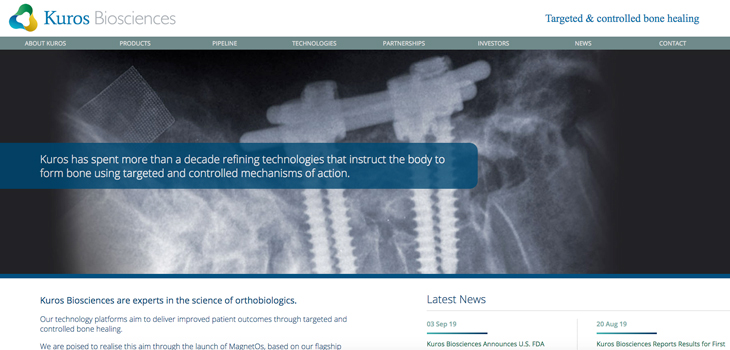
On September 3, 2019, Swiss-based Kuros Biosciences AG, announced the FDA approval its IND application to initiate a Phase 2a clinical trial to “evaluate the use of Fibrin-PTH (KUR-113) in single level transforaminal lumbar interbody fusion (TLIF) procedures in patients with degenerative disc disease, with autograft (patient’s own bone) as comparator.”
Drug/Biologic Combo
Fibrin, according to the company, is formed “by the conversion of a soluble precursor (fibrinogen) to a solid degradable matrix.” Commercially, fibrin sealants (without biologics) have been used for more than 30 years, primarily for the prevention of blood loss during surgical procedures.
The company says Fibrin-PTH consists of a “natural fibrin-based healing matrix with an immobilized targeted bone growth factor (truncated human parathyroid hormone (PTH) analog).”
Kuros has a proprietary technology called TG-Hook Technology, which enables covalent linking of biologics into the fibrin matrix.
“A transglutaminase (TG) enzyme called Factor XIIIa is responsible for cross-linking fibrin molecules, thereby forming a solid matrix, whose normal function is to stop blood loss. Kuros’ products employ this same mechanism to cross-link biologics into fibrin during the formation of the fibrin polymer. The TG-Hook Technology is further designed to release the biologic upon cellular infiltration into the matrix,” according to the company.
Comparable to rhBMP-2
The product is designed to be applied directly into and around an intervertebral body fusion device as a gel, where it polymerizes in situ. The company adds that the product “functions via the well-established mechanism of action of parathyroid hormone; has been demonstrated in animal models of spinal fusion to be comparable to rhBMP-2; and has been shown in preclinical studies to be easy to use and ideal for open or minimally invasive techniques.”
The planned study is a prospective, randomized, controlled, open-label, multi-center, parallel group study with the primary endpoint of radiographic interbody fusion, using CT-scans at 12 months, determined by an independent radiology expert panel.
“Huge Commercial Opportunity”
Company CEO Joost de Bruijn, Ph.D. said if the study is successful, a “huge commercial opportunity” will be opened.
Kuros Biosciences is a spin-off of the Eidgenössische Technische Hochschule Zürich (ETHZ). The company partnered with the University of Zürich and the California Institute of Technology to develop the proprietary TG-Hook Technology. In early 2017 Kuros acquired Xpand Biotechnology, adding the MagnetOs family of bone grafts to the company’s portfolio.
Author
React:
Discussion
This is a fascinating development. In my practice we've seen similar outcomes with the revised protocol. The key differentiator seems to be patient selection criteria. Has anyone else noticed the correlation with BMI thresholds?
Great point. I'd push back slightly on the conclusion, the sample size in the cited study is too small to draw population-level inferences. That said, the directional signal is compelling and worth a larger RCT.
We implemented a similar approach last year. Early results are promising but we're still gathering 12-month follow-up data. Happy to share our protocol if anyone is interested.
Join the conversation
Orthopedic professionals are discussing this. Sign in and upgrade to read every comment and add your voice.