
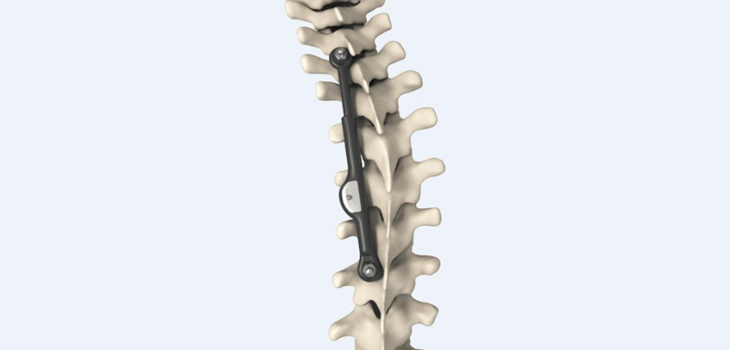
Misgav, Israel-based ApiFix Ltd. has received FDA Humanitarian Device Exemption (HDE) approval for the company’s Minimally Invasive Deformity Correction (MID-C) System for the treatment of progressive adolescent idiopathic scoliosis (AIS).
FDA Approves Novel Dynamic Adolescent Scoliosis Correction System
2 min read Premium comments
#adolescentidiopathicscoliosisSecondary#fdaapproval#humanitariandeviceexemption
The company says the system retains spine flexibility, “all via a less invasive surgical procedure compared to spinal fusion. Patient recovery is relatively pain-free and is measured in days, not months.”
Baron Lonner, M.D., said the approval lets surgeons offer the “first posterior dynamic deformity correction technology for treating Lenke Type 1 and Type 5 curves in patients with progressive AIS.” Lonner is chief of Minimally Invasive Scoliosis Surgery at Mount Sinai Hospital in New York City, and professor of Orthopaedic Surgery at the Icahn School of Medicine. He added, “MID-C is an alternative that fills the significant treatment gap for patients between non-operative therapies and irreversible spinal fusion.”
Indication
According to the FDA approval letter, the device is indicated “for use in patients with adolescent idiopathic scoliosis (AIS) for treatment of single curves classified as Lenke 1 (thoracic major curve) or Lenke 5 (thoracolumbar/lumbar major curve), having a Cobb angle of 45 to 60 degrees which reduces to less than or equal to 30 degrees on lateral side-bending radiographs, and thoracic kyphosis less than 55 degrees as measured from T5 to T12.”
The system “acts as an ‘internal brace’ with a patented unidirectional, self-adjusting rod mechanism and motion-preserving polyaxial joints, allowing additional post-operative correction over time,” according to the company.
Adolescent Idiopathic Scoliosis Curves
AIS is the most common type of scoliosis with no identifiable cause and affects 2%-3% of children between ages 10 to 21.
The AIS curves, according to the company, “progress during an adolescent’s rapid growth period and, while most curves slow their progression significantly at the time of skeletal maturity, some deformities, especially curves greater than 50o, continue to progress during adulthood.”
Humanitarian Device Exemption and Post Approval Study
The company received FDA approval through the agency’s humanitarian device exemption (HDE) application process. The FDA evaluated data from patients treated with the system since 2012.
The agency is requiring the company to set up the MID-C System Registry, “a multi-center, single-arm, prospective post-approval US registry study to provide ongoing safety and probable benefit assessment” of the system. A minimum of 200 patients will be enrolled at 24, 36 and 48-months. The first patients will be followed through 60-months from the time of each patient’s index surgery, with interim visits at immediate post-operative up to 6-weeks, 6-months, 12-months and annually thereafter post-procedure.”
The whole study is estimated to take a total of 84-months.
Uri Arnin, ApiFix co-founder and chief technology officer summed it up. “Since forming the company in 2011, it has been our mission to positively change the lives of scoliosis patients forever. This HDE approval brings us much closer to achieving that goal.”
Author
React:
Discussion
This is a fascinating development. In my practice we've seen similar outcomes with the revised protocol. The key differentiator seems to be patient selection criteria. Has anyone else noticed the correlation with BMI thresholds?
Great point. I'd push back slightly on the conclusion, the sample size in the cited study is too small to draw population-level inferences. That said, the directional signal is compelling and worth a larger RCT.
We implemented a similar approach last year. Early results are promising but we're still gathering 12-month follow-up data. Happy to share our protocol if anyone is interested.
Join the conversation
Orthopedic professionals are discussing this. Sign in and upgrade to read every comment and add your voice.