
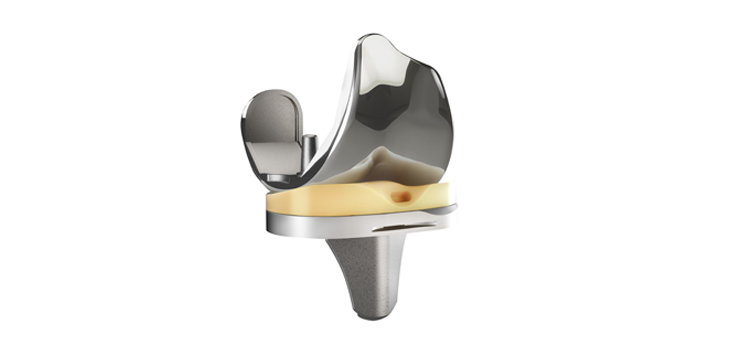
In a study matching 183 dual-pivot total knee arthroplasties (TKAs) with 183 traditional non-conforming TKAs, researchers found that patients with dual-pivot implants reported less pain and more active post-operative lifestyles.
Dual-pivot Bearings Shine in New Study
2 min read Premium comments
#totalkneearthroplastySecondary#nativekneekinematics
Their study, “Dual-pivot bearings improve ambulation and promote increased activity levels in Total knee arthroplasty: A match-controlled retrospective study,” appears in the August 30, 2019 edition of The Knee.
R. Michael Meneghini, M.D., director of the Indiana University Health Hip and Knee Center and associate professor of Orthopaedic Surgery at the Indiana University School of Medicine in Indianapolis explained the purpose of this study to OTW, “This particular total knee arthroplasty bearing articulation is unique in the lateral compartment conformity. While conforming polyethylene bearings, particularly medial congruent, are becoming rapidly adopted for total knee arthroplasty for the benefit of knee stability, the nuances of optimal kinematics demonstrate a theoretical advantage of a more complex conforming bearing surface to replicated native ACL-intact [anterior cruciate ligament] knee motion.”
“This is achieved with conforming bearing that is congruent in the early phase of knee motion (i.e., 0-45 degrees), that guide natural motion and impart optimal stability during the majority of patient activities of walking, climbing stairs and pivoting. This conforming relaxes and releases during greater flexion allowing medial pivot motion that is essential for optimal deeper flexion activities such as squatting and sitting.”
“Prior to 2012 we were classically taught that knees exhibit ‘medial pivot’ motion and kinematics during all flexion activities. With better technology and science, this has been refuted and the modern understanding is that an ACL-intact native knee will exhibit lateral-pivot behavior in early motion, and medial pivot behavior in greater flexion. We need to adapt our total knee arthroplasty designs and innovations accordingly.”
To put numbers behind their hypothesis, the authors cemented and performed all total knee arthroplasties included in the study using identical perioperative protocols in order to ensure that there were no differences among the patients in the study with respect to prevalence of fibromyalgia, depression, preoperative narcotic use, or femoral component alignment.
The team found that dual-pivot TKA patients tended to present preoperatively with a greater prevalence of lumbar spine disease and that more of them self-reported that their knee “never feels normal preoperatively.”
Patients who had received a dual-pivot total knee arthroplasty reported less walking pain at the latest follow-up. Finally, noted the researchers, the dual-pivot patients trended toward greater participation in a variety of activities but, notably, very active activities or impact sports.
Dr. Meneghini summarized the study by saying, “The scientific rigor and methodology are very robust due to matching the comparative groups so tightly and statistically accounting for confounds that would affect outcome. Because of this scientific rigor we are very confident in the data and study conclusions.”
Author
React:
Discussion
This is a fascinating development. In my practice we've seen similar outcomes with the revised protocol. The key differentiator seems to be patient selection criteria. Has anyone else noticed the correlation with BMI thresholds?
Great point. I'd push back slightly on the conclusion, the sample size in the cited study is too small to draw population-level inferences. That said, the directional signal is compelling and worth a larger RCT.
We implemented a similar approach last year. Early results are promising but we're still gathering 12-month follow-up data. Happy to share our protocol if anyone is interested.
Join the conversation
Orthopedic professionals are discussing this. Sign in and upgrade to read every comment and add your voice.