
Dallas-based 4WEB Medical’s cervical fusion device for the treatment of degenerative disc disease (DDD) was 510(k) cleared by the FDA on August 12, 2019. It took the agency a little over four months to clear the device.
Cervical Fusion Device Using Truss Implant Technology™ FDA Cleared
2 min read Premium comments
#fda510kclearanceSecondary#4webmedical#cervicalfusion
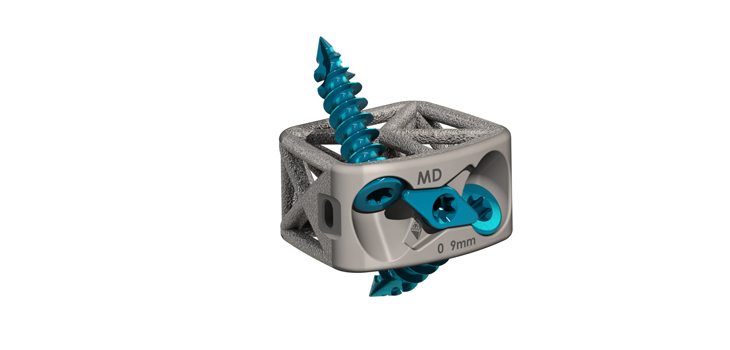
The Cervical Spine Truss System – Stand Alone (CSTS-SA) Interbody Fusion device is for use at one level or two contiguous dics levels. The device is accompanied by two titanium alloy screws and utilizes the company’s Truss Implant Technology.
No Plates and Screws
According to the FDA clearance documents, the device is “used as an adjunct to fusion in the cervical spine and is placed via an anterior approach at the C2 to T1 disc levels using autograft and/or allogenic bone graft comprised of cancellous and/or corticocancellous bone graft.”
The documents state the device is an open architecture truss “design mathematically formulated to provide structural support with open space throughout the implant for bone through growth and fusion. The 4WEB additive manufacturing process provides a hierarchical surface roughness. The implant is made from Ti6Al4V alloy.
The company says having the fixation screws placed through the truss implant and into the adjacent vertebral bodies creates “a zero-profile stand-alone construct that removes the need for traditional plate and screw fixation.”
“The device is available in a variety of sizes to accommodate the patient’s anatomy. Screws are inserted through the anterior portion of the implant into adjacent vertebral bodies for bony fixation.”
Truss Implant Technology
As other 4WEB devices, CSTS-SA has an Advanced Structural Design that incorporates the company’s proprietary Truss Implant Technology™. The company says 30 years of research in topological dimension theory led to the discovery of the technology’s novel geometry.
The technology utilizes the concept of “mechanobiology to simulate cellular activity at the surgical site,” according to the company. The manufacturing process “creates a hierarchical surface roughness with features that span from the macro to nano scale. In-vitro testing has shown that stem cells attached to 4WEB’s titanium implant surface exhibited increased gene expression of certain osteogenic markers when compared to smooth titanium and PEEK.”
The company added that it expects to take the product to market at the beginning of the fourth quarter.
Author
React:
Discussion
This is a fascinating development. In my practice we've seen similar outcomes with the revised protocol. The key differentiator seems to be patient selection criteria. Has anyone else noticed the correlation with BMI thresholds?
Great point. I'd push back slightly on the conclusion, the sample size in the cited study is too small to draw population-level inferences. That said, the directional signal is compelling and worth a larger RCT.
We implemented a similar approach last year. Early results are promising but we're still gathering 12-month follow-up data. Happy to share our protocol if anyone is interested.
Join the conversation
Orthopedic professionals are discussing this. Sign in and upgrade to read every comment and add your voice.