
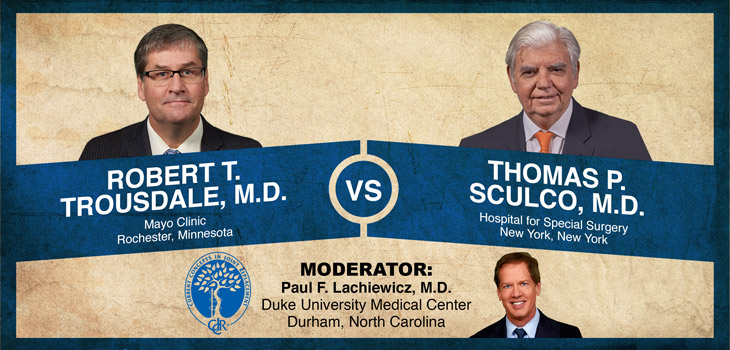
This week’s Orthopaedic Crossfire® debate was part of the 19th Annual Current Concepts in Joint Replacement® (CCJR®), Spring meeting, which took place in Las Vegas. This week’s topic is “Porous Metal Cones: Optimal Solution for Bone Deficiency” For is Robert T. Trousdale, M.D., Mayo Clinic, Rochester, Minnesota. Opposing is Thomas P. Sculco, M.D., Hospital for Special Surgery, New York, New York. Moderating is Paul F. Lachiewicz, M.D., Duke University Medical Center, Durham, North Carolina.
Trousdale v. Sculco: Porous Metal Cones: Optimal Solution for Bone Deficiency
8 min read Premium comments
#thomassculcoGreat Debates#porousmetalcones#roberttrousdale
Dr. Trousdale: When it comes to the question of cones in revision total knee replacement, the answer is “Yes.”
Cones in revision total knees should be utilized because they’re reliable; at mid-term follow-up they’re durable. They’re relatively easy to do. And relatively fast to do compared to allografts. And I think it may solve a major problem in revision knee surgery (fixation).
The rate of revision knee surgeries is increasing and it’s estimated to rise over 600% (Kurtz et al., JBJS 2007) over the next 20 years or so. Aseptic loosening in the revision setting still remains a major, major problem, approximately 1/3 of revision TKAs (Lombardi et al., BJJ 2014).
What are the options for metaphyseal fixation? Do you use cement alone? Do you use cement with allograft? Or you can use metaphyseal sleeves or cones to fill in the defects.
With small defects, anything works. You can cement. You can use graft. You can use sleeves or cones. In small defects, it’s really a chip shot. I choose to use a small chunk of allograft, Steinmann pins, and a cemented stem to bypass small, very manageable defects.
The problem lies with the big defects. Do we use allografts or cones and/or sleeves? Today, the vast majority of my patients are getting either a cone or a sleeve for these big defects.
Traditionally, they’ve been dealt with, with large structural allografts. There are concerns with availability, disease transmission and I’ve found these relatively difficult to prepare and ensure good host contact against the bone. The mid-term results of allografts, both in this series as well as our experience, have been a little bit humbling. Ten years, 72% survivorship of these big, bulk allografts (Clatworthy et al., JBJS Am. 2001). I think we can do better.
Metaphyseal sleeves or cones—they come in a lot of different sizes—are easier than allograft. They allow for immediate weight-bearing if you cement the component around them. You can use cemented or cementless designs if you wish. There are a lot of different surface finishes and companies that make these types of implants.
The cones…I use them in large metaphyseal defects, whether it’s segmental or cavitary, where historically I would have used an allograft.
Highly porous tantalum cones have been very useful in our practice. There’s good biological fixation. The high porosity, the interconnected pore space, the modulus of elasticity, all very close to cancellous bone. (Abdel et al., Op Tech in Ortho 2012; Howard et al., JBJS Am. 2011; Meneghini et al., JBJS Am. 2008)
And the beauty about these cones is that they are completely detached from the implant so you can put the implant in anywhere you wish rotationally. Shift it medially or laterally if there are any overhang issues. They are very easy and facile to use and anyone doing cemented total knees can easily use theses cones. They are very, very simple.
How do they do? Over a decade ago, we reported our early experience with tibial cones. All had radiographic evidence of osseointegration, no revisions of these tibial cones. (Meneghini et al., JBJS 2008).
Matt Abdel just looked up a large series of cones done from 2003-2011. Again, all unrevised knees have radiographic evidence of osseointegration. And the aseptic loosening rate at intermediate follow-up was only 4%—96% durability of these cones.
Similar to attached sleeves. There are some systems that have sleeves you can attach to the femoral and tibial components. We recently looked at our experience with those. Again, very reliable osseointegration into these attached sleeves on the components. (Chalmers, Trousdale, JOA 2017)
So, in summary the restoration of metaphyseal fixation is key during revision surgery. These sleeves, I find, are great for contained defects. For most severe defects, I use attached porous tantalum metaphyseal cones that have several biologic and mechanical advantages. And the mid-term results, at our center and others, are very favorable.
Dr. Sculco: It’s always a great pleasure to debate Rob Trousdale. He’s younger. He’s smarter. Better looking. He’s also from one of the better programs in Rochester, Minnesota.
Cones come in many, many different versions. They tend to be happy things. Ice cream cones. Cones you wear at a birthday party. Tree cones. Cones on a road. But cones can also be injurious to your health.
Let’s talk about bone loss. It’s one of the key problems in revision knee surgery. There are a lot of classifications. The Anderson (AORI) classification is probably the most popular. I like to simplify and have an appropriate solution for each type of bone loss.
Condylar and plateau defects are often handled easily with augmentations on your implant. Segmental defects are usually handled with resection and hinged prostheses. It’s really the cavitary and combined bone loss situations that we’re talking about where cones have played a role.
The central medullary bone loss problems lend themselves both to morselized/structural allograft, as Rob pointed out, or trabecular metal cones. There certainly is place for cones in more complex bone loss problems.
In a patient with fairly significant distal femoral osteolysis I used morselized bone graft. At 1-year follow-up, the patient had reconstitution of the bone and we used stems to transfer the load away from that initially weakened surface.
I think there are great applications for the use of a cone in certain kinds of central cavitary bone loss. In those situations, a cone works very well. Just tap it in and reconstitution. Give yourself a stable platform on which to put your implant. Massive cavitary bone losses on the femoral side also lend themselves to that.
But, in my hands if that bone loss is really bad, I’m going to do to a distal femoral replacement. I think they work certainly as well and give you a lot more options in dealing with significant bone loss, particularly on the femoral side.
Here are my issues with cones. Overall there is a tremendous overuse of cones in bone loss, I think. They are very expensive. They can remove autogenous bone when you’re putting them in. In revision situations they’re very difficult to get out and often require the use of a hinge or some kind of segmental replacement to deal with that. While, the results with our allografts have, in fact, been quite good.
Let’s talk about cost and utilization. The price of a tibial and a femoral cone—this is what we pay at our institution—is $4,000 to $5,000. A tremendous amount of money added to the cost of the procedure. Here’s the utilization of cones at our institution—2015 = 18; 2016 = 66; 2017 = 154.
One of our revision surgeons made a comment in one of our conferences that he uses a cone in every revision knee replacement that he does. The cost was over $800,000. My point is you don’t need to do that.
Removal of these cones is difficult. These cases are complicated. Infection is a problem. Should you have to go back, you’re going to almost always do an osteotomy or significant augmentation techniques to get that cone out and then have to address significant bone loss once you’ve done that.
A study out of Vancouver looked at allografts versus cones, 45 revision knees, allografts in 30, 15 have cones. Average 9-year follow-up. Similar bone loss problems. No difference in the Oxford score or in the infection rate. (Sandiford et al., CORR 2017)
Another study out of the Rush group (Rohl et al., JOA 2017), 49 cones matched against 49 revision knees with hybrid stems. Follow-up at 3.5 years. There is no difference in complications and the Knee Score may be a little bit better in the non-cone group.
In summary, cones are expensive and are being overutilized. When the bone loss is severe, cones can be a very good, useful tool. But you can lose bone in the preparation and they’re hard to remove. Allograft studies that I’ve shown you have really turned out to be quite good.
Moderator Lachiewicz: Rob, I’m going to turn to you. Can you address a couple of questions for me? One is do you think the rate of infection in revisions is less if you use a cone instead of bulk allograft? Do you have any data from the Mayo on that?
Dr. Trousdale: No, I don’t think there is a big difference. I don’t think we can say that one’s got a lower infection rate than other.
Moderator Lachiewicz: And Tom, you talked about the cost of the cones. What about the cost of bulk allograft and the time in the OR to prepare them? Have you looked at that at HSS? Is anyone a big user of bulk allograft at HSS?
Dr. Sculco: Bulk allografts are expensive but they are cheaper than a cone. Our bulk allografts are from roughly $1,000-$1,500. Morselized bone is around $800.
Dr. Trousdale: In defense of the cones and the cost issues—no question the cones are more expensive upfront—but if your revisions from aseptic loosening drop over 10-years from say 20% to 12%, that cost differential goes down dramatically. If you get osteointegration into the cone, over the long-term they can be more durable than allograft.
Dr. Sculco: The cost is really exorbitant. It surely doesn’t cost $5,000 or $6,000 to make a cone. What’s your feeling about that?
Dr. Trousdale: I think it’s New York bankers, Tom, involved in the medical industry. (laughter)
Moderator Lachiewicz: Rob, what about Tom’s suggestion that perhaps these cones are being overused?
Dr. Trousdale: That’s subjective. Certainly, you have to take some bone away because you’ve got apposition of the cone to the bone. I use both sleeves and cones, but I use then in different situations. If I’ve got a purely central defect, the attached sleeves are very easy. If I’ve got a peripheral defect where I need to detach and move the bone around, that’s when I’ll use a detachable cone.
Dr. Sculco: I think there’s a real place for cones. I do 40 to 50 revision knees a year and I use the cone maybe 2-3 times. The results are good. But again, there’s a lot of other options available. In this era of price containment, at least think about those.
Moderator Lachiewicz: Okay. Thank you, gentlemen.
Please visit www.CCJR.com to register for the 2019 CCJR Winter Meeting, – December 11 – 14 in Orlando.
React:
Discussion
This is a fascinating development. In my practice we've seen similar outcomes with the revised protocol. The key differentiator seems to be patient selection criteria. Has anyone else noticed the correlation with BMI thresholds?
Great point. I'd push back slightly on the conclusion, the sample size in the cited study is too small to draw population-level inferences. That said, the directional signal is compelling and worth a larger RCT.
We implemented a similar approach last year. Early results are promising but we're still gathering 12-month follow-up data. Happy to share our protocol if anyone is interested.
Join the conversation
Orthopedic professionals are discussing this. Sign in and upgrade to read every comment and add your voice.