
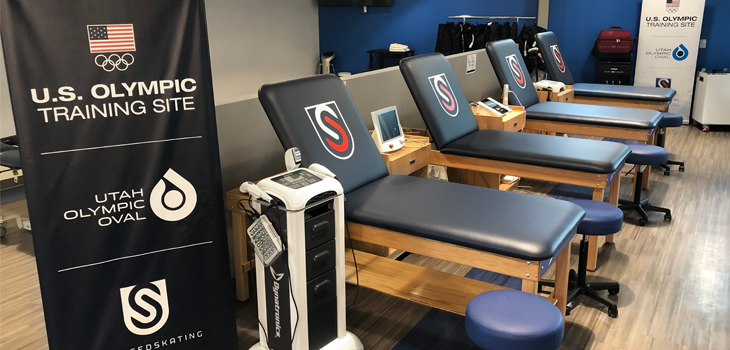
Dynatronics, a manufacturer of athletic training and rehabilitation products, recently partnered with U.S. Speedskating to equip its training facility, The Speed Factory at the Utah Olympic Oval.
Dynatronics Lands US Olympic Speed Skater Deal
1 min read Premium comments
Secondary#dynatronics#speedskating
Jim Ogilvie, vice president of corporate development at Dynatronics, told OTW that the new center features a lot of Dynatronics’ key product offerings including the Solaris Plus modalities with accessories and their line of treatment tables.
He explained that they had partnered with U.S. Speedskating for the 2002 Winter Olympics in Salt Lake City where Dynatronics equipped all the medical stations.
“We have a strong relationship with U.S. Speedskating where we are always bouncing ideas off each other,” he said.
Christopher von Jako, Ph.D., chief executive officer of Dynatronics also said, “We are proud to outfit U.S. Speedskating with our high-quality U.S.-made restorative products.
“We are honored to partner with these outstanding athletes as they represent our nation. With Salt Lake City again being considered for a future Winter Olympics Games, U.S. Speedskating has a premier athletic training facility, which includes our products, to showcase to the world.”
“The new equipment from Dynatronics has been amazing, added Karen Ocwieja, USS Short Track Head Athletic Trainer. “The dedicated treatment and recovery space has allowed our athletes to gain the most from their training each day. I still get a kick out of being able to adjust the table mid-treatment, which allows me to improve my efficacy and ergonomics.”
Dynatronics is headquartered in Salt Lake City, Utah. U.S. Speedskating athletes have won 88 Olympic medals including medals by Olympians Eric Heiden, Bonnie Blair and Apolo Anton Ohno.
Author
React:
Discussion
This is a fascinating development. In my practice we've seen similar outcomes with the revised protocol. The key differentiator seems to be patient selection criteria. Has anyone else noticed the correlation with BMI thresholds?
Great point. I'd push back slightly on the conclusion, the sample size in the cited study is too small to draw population-level inferences. That said, the directional signal is compelling and worth a larger RCT.
We implemented a similar approach last year. Early results are promising but we're still gathering 12-month follow-up data. Happy to share our protocol if anyone is interested.
Join the conversation
Orthopedic professionals are discussing this. Sign in and upgrade to read every comment and add your voice.