
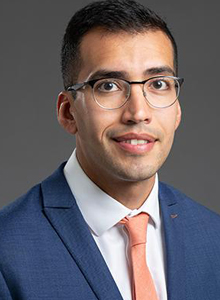
Jorge Chahla, M.D., Ph.D., a sports medicine orthopedic surgeon, recently joined the sports medicine team at Midwest Orthopaedics at Rush (MOR) where he will focus on complex knee, hip and sports-related injuries.
Chahla Joins Sports Med Team at Midwest Orthopaedics at Rush
1 min read Premium comments
#midwestorthopaedicsatrush#jorgechahla
Chahla is also a team physician for the Chicago White Sox, the Chicago Bulls and the Chicago Fire, as well as an assistant professor of orthopedic surgery at Rush University Medical Center. In addition, he is director of biomechanical sports medicine research and director of the international fellowship program at Rush.
He specializes in minimally invasive techniques for reconstruction of multiligament injuries, anterior and posterior cruciate ligament tears, injuries of the posteromedial and posterolateral corner, meniscus and cartilage surgeries and osteotomies around the knee.
He recently was awarded the American Academy for Orthopaedic Surgeons Award of Excellence and the American Orthopedic Society for Sports Medicine Young Investigator Award. He has also been published in more than 250 scientific journals, 30 book chapters and six edited books. Chahla is considered an expert on joint preservation and the use of biologics like platelet-rich plasma, bone marrow aspirate concentrate and stem cells.
Chahla told OTW, “It is an extraordinary honor to join such an accomplished team at Midwest Orthopaedics at Rush. The opportunity to work with world-renowned leaders in the field, not only in the sports medicine division, but in every other section of the department, is a real privilege. The staff at MOR coupled with the research infrastructure and the resources available permit the development of cutting edge techniques and technologies that have truly impacted the lives of millions of patients around the world.
This is an incredibly exciting time where regenerative medicine is providing new avenues to advance the mission of keeping people active. My goal is to continue building on the path that my colleagues have paved, providing world-class patient care with research-based innovative techniques helping patients to get back to their activities.”
Author
React:
Discussion
This is a fascinating development. In my practice we've seen similar outcomes with the revised protocol. The key differentiator seems to be patient selection criteria. Has anyone else noticed the correlation with BMI thresholds?
Great point. I'd push back slightly on the conclusion, the sample size in the cited study is too small to draw population-level inferences. That said, the directional signal is compelling and worth a larger RCT.
We implemented a similar approach last year. Early results are promising but we're still gathering 12-month follow-up data. Happy to share our protocol if anyone is interested.
Join the conversation
Orthopedic professionals are discussing this. Sign in and upgrade to read every comment and add your voice.