
Swiss-based SpineWelding AG now has FDA 510(k) clearance to sell its “bone welding” Elaris Pedicle Screw System in the U.S.
“Bone Welding” Pedicle Screw System Cleared by FDA
2 min read Premium comments
#fda510kclearanceSecondary#pediclescrews#fusionsurgery
According to the August 2, 2019 FDA clearance document, the thoracolumbosacral pedicle screw system is intended to “provide immobilization and stabilization of spinal segments through posterior, non-cervical, pedicle fixation.”
Bone Welding
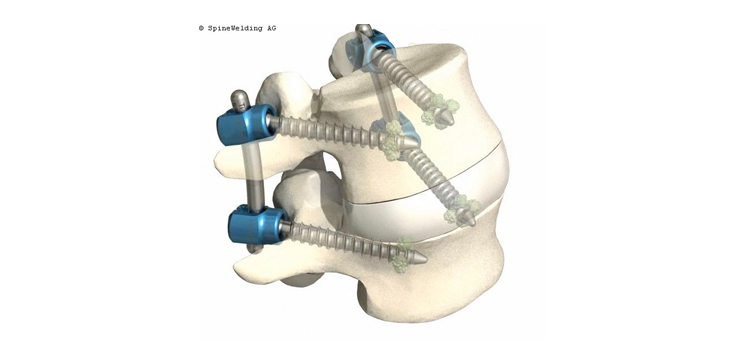
Using its patented BoneWelding process, the company said in an August 8 press release, “mechanical pressure and ultrasonic vibrations are applied during a maximum of 8 seconds to a pin through a handpiece connected to the pedicle screw head resulting in the ultrasonic heating of the polymer so that it melts and is extruded out of the fenestrations of the screw.”
“An automatic spring mechanism in the handpiece supplies consistent force to extrude the polymer from these distal openings into the surrounding cancellous bone.”
“The liquid polymer solidifies immediately upon contact with bone, forming a confined, solid ring around the tip of the screw. The entire process lasts only a few seconds. Because the polymer is bioresorbable, it undergoes the natural physiologic process of hydrolysis, and is gradually metabolized into H2O and CO2.”
Frank Phillips, M.D., spine chief at Rush University and an equity owner in the company, told us the spine welding technology allows for the immediate stabilizing of screws in challenging situations without the difficulties of using bone cement. He added the polymer “stick” is dropped down the cannulated screw and the screw can be ultrasonically “welded” to the vertebra.
“The ability to make an intra-operative decision to ultrasonically provide adjunctive fixation to individual screws with a seamless process, without disrupting the flow of the case is extremely attractive to surgeons,” added Phillips.
Phillips is also listed on the patent assignment and has been involved as a lead advisor to the company since its inception almost ten years ago.
The company says bench and animal testing have “demonstrated that the polymer enhancement provides appropriate dynamic pullout strength for up to 52 weeks as well as improved resistance to toggle loosening compared to screws without additional fixation. Testing also has demonstrated that the pedicle screws can be removed as needed after polymer enhancement.”
The Elaris System
The system, according to the FDA documents, consists of the following components: Elaris Pedicle Screws, Elaris Pins, Elaris Rod, Elaris Set Screw, Dedicated Manual Instruments, and an Ultrasonic System, which includes the ultrasonic generator (BoneWelder 150-W1) with corresponding footswitch and power cord, and the spring loaded Elaris Handpiece with the Elaris Connector, which rigidly couples the housing of the Elaris Handpiece with the Elaris Pedicle Screw.
The company cited Medtronic’s CD Horizon Pedicle Screw System as the primary predicate. While the FDA found the Elaris “substantially equivalent” to the Horizon, the Elaris differs slight in that the Horizon relies solely on threat fixation in the bone. In contrast, states the FDA document, the Elaris “is comprised of a titanium alloy pedicle screw and, optionally, a bioresorbable polymer (PLDLLA) pin in which the simultaneous activation of ultrasonic energy and automated (spring-loaded) axial movement of the handpiece result in the temporary, local, and controlled melting of the polymer at the tip of the Elaris Pedicle Screw.”
Author
React:
Discussion
This is a fascinating development. In my practice we've seen similar outcomes with the revised protocol. The key differentiator seems to be patient selection criteria. Has anyone else noticed the correlation with BMI thresholds?
Great point. I'd push back slightly on the conclusion, the sample size in the cited study is too small to draw population-level inferences. That said, the directional signal is compelling and worth a larger RCT.
We implemented a similar approach last year. Early results are promising but we're still gathering 12-month follow-up data. Happy to share our protocol if anyone is interested.
Join the conversation
Orthopedic professionals are discussing this. Sign in and upgrade to read every comment and add your voice.