
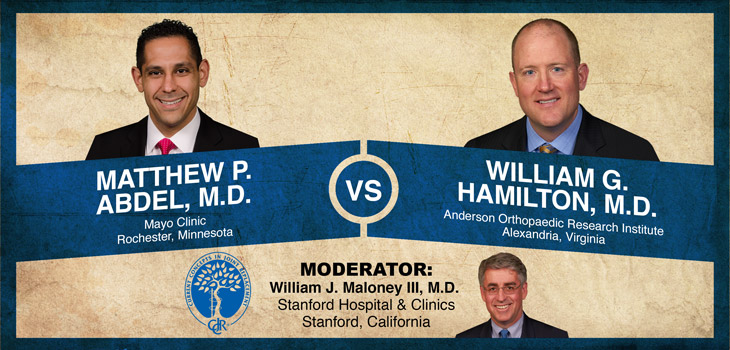
This week’s Orthopaedic Crossfire® debate was part of the 19th Annual Current Concepts in Joint Replacement® (CCJR®), Spring meeting, which took place in Las Vegas. This week’s topic is “Simultaneous Bilateral Anterior Hips: Double Trouble” For is Matthew P. Abdel, M.D. – Mayo Clinic, Rochester, Minnesota. Opposing is William G. Hamilton, M.D. – Anderson Orthopaedic Research Institute, Alexandria, Virginia. Moderating is William J. Maloney III, M.D. – Stanford Hospital & Clinics, Stanford, California.
Abdel v Hamilton: Simultaneous Bilateral Anterior Hips: Double Trouble
9 min read Premium comments
Great Debates#matthewabdel#williamhamilton
Dr. Abdel: Total hip arthroplasty is largely considered one of the most successful procedures in all of medicine. However, many recent advances have actually been regressions in the world of hip arthroplasty. These include metal-on-metal total hip arthroplasty, dual modular necks, and trunnion-related issues.
I contend that simultaneous bilateral anterior total hip arthroplasty will fall into a similar category.
Why do I say that?
There are unique and numerous complications with bilateral procedures. There are also unique and numerous complications with direct anterior total hip arthroplasty. Combining those two, in my hands, creates a risk profile that is too high for me to tolerate.
Let’s look at the risks with simultaneous bilateral total hip arthroplasty. Here are my top 4 reasons for saying “No.”
- Foremost, there is an increased risk of blood transfusion.
- Longer operative times. Longer operative times increase the risk of perioperative morbidity and periprosthetic joint infection. It’s also longer operative times for the surgeon, surgical team and through-put for that particular day.
- What about length of stay? Most of these patients are the youngest, healthiest, most active patients and many of them can have an outpatient procedure. If you could have 2 outpatient procedures, you’d have a length of stay of zero, in contrast to length of stay of 2-3 days for these patients that are often hospitalized after bilateral simultaneous procedures.
- Finally, mortality. There are multiple series that have looked at simultaneous procedures and mortality. What we do know is that in those patients who are 75-years or greater in age, male gender and ASA 3 or 4, [American Society of Anesthesiologists] there is an increased mortality rate in simultaneous bilateral procedures. (Garland et al., BMC 2015)
I would contend to you that if we exclude 75-year-old males or those patients with ASA 3 or 4, we lose a large proportion of our arthroplasty patients.
So now let’s look at it from the side of the direct anterior total hip arthroplasty and why I say this is “Double Trouble” when you combine the two together.
Here are the top 5 reasons why I go against that particular procedure, particularly in the simultaneous setting.
- Increased risk of periprosthetic fracture. Some reporting says that it is 2-4%. That might be overestimated. The fact remains that when they do occur, usually at the trochanter and it’s difficult to salvage. (Hartford et al., JOA, 2018)
- Increased risk of early femoral failure. There are at least 2 papers in the literature recently looking at this. One paper from Meneghini looked at 342 total revision total hip arthroplasties and found that 51% had a direct anterior approach. While this may not be causal, there is association. (Meneghini et al, JBJS AM, 2017)
- Increased risk of impaired wound healing, particularly in those patients that are obese and undergoing a direct anterior approach. (Watts et al., JOA, 2015). A paper published by one of my partners, Michael Taunton, a skilled direct anterior total hip approach surgeon, found that he had a 4-times increased risk of wound issues in obese patients compared to the posterior lateral approach.
- What about the lateral femoral cutaneous nerve that we often blow right by? A recent randomized clinical trial from late 2017, found that 83% of patients at 3 months still had neuropraxia of their lateral femoral cutaneous nerve. (Cheng et al., JOA, 2017)
- Finally, what about traction-related injuries? A recent paper from the Rothman Institute found that their anterior-based approaches had a 14.5-fold increased risk of injury to the femoral nerve. While that number is still low, I would contend to you that I am not willing to take that increased risk for a primary total hip arthroplasty. (Fleischman et al., JOA, 2018)
Finally, the issue of obvious scientific bias. Most of the literature includes people who have simultaneous bilateral total hip arthroplasties that are our youngest, healthiest, most motivated, non-obese patients.
Increased risk of periprosthetic fracture, early femoral failure, potential for increased femoral nerve injury, impaired wound healing, increased blood transfusions and increased mortality in males greater than 75 make this a stop for me.
I’ll stick with my mini-posterior approach in a staged approach. It makes the surgeon happy. Makes my team happy. And most importantly, it makes my patients happy.
Dr. Hamilton: I’m a big fan of this procedure and I’ll explain to you why.
Up to 42% of hip osteoarthritis is bilateral and, in one paper (Sayeed et al., CORR, 2012), one-third of patients at the time of their first surgery had symptoms to justify contralateral total hip arthroplasty.
But only 1% of total hips are bilateral (Rasouli et al., JOA, 2014).
Why is that?
Much of what Matt just said is the common thinking. Greater blood loss, and increased transfusion rate, increased HO [heterotopic ossification]. Some studies show an increased rate of venous thromboembolism. And the other complications that Matt elucidated quite nicely.
But the real reason is that when you do your surgery in the lateral decubitus position, as Matt does from a posterior approach, it’s very cumbersome. If you’re going to do a bilateral surgery, you have to close the wound, you have to dress the wound, you have to flip the patient over. Reprep and redrape.
It’s really a whole second surgery. The time from getting an implant in to the time of the second incision is maybe as much as 45 minutes. It’s costly. Most of us receive 50% reimbursement for the second side. To do an entire second hip, this really doesn’t have as much to do with the patient as much as it has to do with the surgeon. It’s simply not conducive to the flow of our day.
When you put your patient in the supine position it really facilitates bilateral surgery. You can prep and drape both hips simultaneously. You can overlap the surgeries to reduce the total surgery time.
Here’s a demonstration of a patient of mine. He’s a 46-year-old male and he had bilateral hip arthritis. Nearly equal symptoms in both hips. He’s relatively healthy, only a history of medically controlled hypertension. BMI [body mass index} is 28. Pre-op hemoglobin 14.5. He’s very concerned about his total time out of work.
Here’s how we do it. I drape both hips at the same time. We do our standard draping routine. I begin the first hip and, in this case, after 40 minutes, I had the implants in and I started my shuffle to the other side of the patient. It does take a little time. You’ve got to move the fluoroscopy around. You’ve got to move the OR table around. By 46 minutes, I began the second side. It took us about 6 minutes to shift everything around. By this time the closure has begun on the other side. My fellow and the PA [physician’s assistant} are starting to close the other side and we’ll start the second side.
By 64 minutes, the first side was completely closed, so the PA there can start helping me on the second side. And then at 84 minutes the implants were in on the second side and another 14 minutes for closure. In this particular case it was 98 minutes skin-to-skin for both surgeries.
It is very important that you get these implants very stable because when you’re walking on 2 newly replaced hips, I do worry about the risk of fracture.
This patient returned to his office by 3 weeks.
I looked at my own data. I had 105 patients; 210 hips and I matched those to 217 unilateral hips just for comparison sake to equal demographics. For my unilateral hips average skin-to-skin time over this interval was 72 minutes and the bilaterals was 123 minutes. The skin-to-skin bilaterals are 20 minutes less than if you did 2 unilaterals because you can overlap and you don’t need to reposition or redrape.
This is something you wouldn’t be able to do with a posterior approach, and I understand why Matt is so against this.
If you look at complications, they really are quite similar. In fact, hip related complications were lower in the bilateral group. The transfusion rate, although not statistically significant, was higher for the bilaterals. All of my patients went home except for 1 patient in the bilateral group who went to a skilled nursing facility. The average length of stay in the bilateral group was just under 2 days. Many of these patients will leave after 1 night in the hospital.
Looking at Mayo Clinic data—94 simultaneous patients matched to staged—they found that the simultaneous cases had shorter operative times, no different mortality or complications and reduced cost by nearly one-third. (Houdek, et al., JBJS AM, 2017)
In Denmark, very similar, lower rates of readmission, lower length of stay when you do these at the same time compared to staging them. (Lindberg Larsen, et al., Arch Orthop Trauma Surg, 2013)
If you’re going to do the second side, I think you need to wait a little while. The risk of myocardial infarction and complications are higher in the first interval after surgery, so if you’re going to stage them, I think you ought to wait at least 6 weeks.
The problem with all the data is the selection bias because only the youngest, healthiest patients are often offered the simultaneous. I use younger patients. Thinner patients. No active cardiopulmonary disease. And I discuss the risks with the patient and let them choose.
In summary, I think there are significant advantages. Single anesthetic exposure. Shorter length of stay. Less time off from work. And, overall cost savings.
Moderator Maloney: Matt, you have a 1 minute.
Dr. Abdel: I think Bill did a very nice and honest job of presenting it in his skilled hands. And I think there’s a subset of patients that no question would benefit from simultaneous procedures. The fact remains, and I think Bill it highlighted nicely…this is a hyper select group of patients. These are the healthiest, youngest patients. There’s obviously a bias when you look at the literature, but you just want to stratify based on your patients.
Dr. Hamilton: Yes, this surgery is not for everyone. I select them…not the larger patients, not the real difficult cases. And I have a discussion with them so there’s shared decision making here. I go over the fact that the transfusion rate is a little higher. And you explain all that and tell them it’s one exposure to anesthesia. It’s less time off from work. Patients have been very happy with this surgery in my hands.
Dr. Abdel: I suspect if we actually had a randomized clinical trial with less than 50-year-old patients with no more than 1 co-morbidity, and looked at that too, the data would probably not filter out. I bet you probably staging them they would have lower numbers on most of those things. But we just don’t have that data available to us right now.
Moderator Maloney: So Matt. Let’s start with the issue of bilateral simultaneous hip replacement regardless of approach. Do you do it? And if you do it, what are your indications for that?
Dr. Abdel: I do it. It’s quite rare in my practice. If I look at my hip practice, probably 5% of my patients, they’re usually young, active, healthy, non-obese and, as Bill nicely alluded to, they’re usually professionals that are getting back to their careers pretty quick.
Moderator Maloney: There are many patients who have bilateral hip osteoarthritis. But often one is significantly worse than the other. Trying to think back over the years how many say both hips hurt the same? You’re often doing 2 hips—1 of which is a little worse than the other?
Dr. Hamilton: Yes, most often one hip hurts worse than the other. But both hips must meet criteria for surgery. If they say, “My other hip doesn’t hurt at all,” then they get a single hip.
Moderator Maloney: Bill, talk to us a little bit about your post-op protocol. You said they have to be a little careful walking with 2 fresh hips. What do you do differently post-op?
Dr. Hamilton: I waited about a year after starting the anterior approach to do my first bilateral patient. I was quite nervous because of all the reasons…but I think you need to get pretty good at it before you start doing these two at once. I want to make sure the stem goes in very solid. I use a triple taper with a collar. And I typically will have these patients use an assistive device a little bit longer. For a single hip they can get off their device when they’re ready, but for these I typically want them to use something for at least the first 4-6 weeks. Really protecting against that fall or stumble.
Moderator Maloney: Experience definitely matters. Thank you very much gentlemen.
Please visit www.CCJR.com to register for the 2019 CCJR Winter Meeting, – December 11 – 14 in Orlando.
React:
Discussion
This is a fascinating development. In my practice we've seen similar outcomes with the revised protocol. The key differentiator seems to be patient selection criteria. Has anyone else noticed the correlation with BMI thresholds?
Great point. I'd push back slightly on the conclusion, the sample size in the cited study is too small to draw population-level inferences. That said, the directional signal is compelling and worth a larger RCT.
We implemented a similar approach last year. Early results are promising but we're still gathering 12-month follow-up data. Happy to share our protocol if anyone is interested.
Join the conversation
Orthopedic professionals are discussing this. Sign in and upgrade to read every comment and add your voice.