
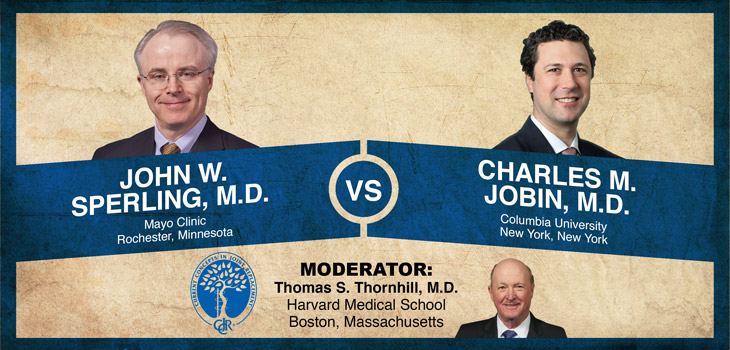
This week’s Orthopaedic Crossfire® debate was part of the 19th Annual Current Concepts in Joint Replacement® (CCJR®), Spring meeting, which took place in Las Vegas. This week’s topic is “Severe Glenoid Bone Loss in a 70-Year-Old: Reverse is the Way to Go.” For is John W. Sperling, M.D., Mayo Clinic, Rochester, Minnesota. Opposing is Charles M. Jobin, M.D., Columbia University, New York, New York. Moderating is Thomas S. Thornhill, M.D., Harvard Medical School, Boston, Massachusetts.
Sperling v Jobin: Severe Glenoid Bone Loss in a 70-Year-Old: Reverse is the Way to Go
8 min read Premium comments
#glenoidbonelossGreat Debates#charlesjobin#johnsperling
Patients over 70 years old are a large and growing patient population and many live alone at home.
For this patient population, what are the potential benefits of an anatomic total shoulder arthroplasty? One benefit comes to the top and that is improved internal rotation compared to reverse shoulder arthroplasty.
What are the challenges of anatomic total shoulder arthroplasty?
Longer operating room time. Longer recovery with the need for assistance to allow the subscapularis to heal.
With the anatomic, it’s critical to get the subscapularis to be able to heal for good function of the implant. There is also a more difficult glenoid exposure compared to reverse shoulder arthroplasty. Additionally, implant position of the glenoid is much less forgiving with an anatomic compared to reverse shoulder arthroplasty. And there is also a concern over a higher rate of glenoid loosening.
Now, what are the benefits of reverse shoulder arthroplasty?
Shorter operating room time. Faster recovery without the need for the subscapularis to heal.
Many U.S. surgeons have abandoned closing the subscapularis at the end of a reverse shoulder arthroplasty. There’s no doubt there’s easier glenoid exposure with a reverse compared to an anatomic. And, the sphere of the glenosphere does provide a more forgiving implant position compared to an anatomic glenoid.
The reverse arthroplasty does give you the ability to better manage joint subluxation. It eliminates the concern over rotator cuff insufficiency as patients age.
We know, of course, that rotator cuff deficiency and insufficiency increases with age and the reverse arthroplasty provides you some assurance that cuff failure will not doom your implant to failure. There is also a lower rate of glenoid loosening when compared to anatomic.
The Australian Joint Registry follows patients very methodically. Reviewing the overall cumulative percent of revision of primary total shoulder arthroplasty and comparing anatomic to reverse, there is a higher rate of revision with reverse in the first six months, but over time the risk of revision is much higher with an anatomic than reverse arthroplasty.
You also have a better ability to manage glenoid bone loss. There is a wide variety of different systems out there that allow you to be able to do that and preserve glenoid bone.
For a recent 72-year-old female patient of mine who lives alone at home and had a longstanding history of shoulder arthritis and significant bone loss, we made up for the missing bone with an augment. We put the pin in and were able to ream the glenoid down to get approximately 50% contact. We prepared the glenoid, reamed the deficient side and were able to place an implant that made up for the missing bone.
So, in conclusion, the increased technical difficulty of an anatomic total shoulder together with concerns of subscapularis insufficiency, glenoid component loosening, and a lack of strong evidence of superiority do not warrant changing from reverse arthroplasty in patients over 70 years old.
Dr. Jobin: We’re going to define osteoarthritis glenoid bone loss and posterior subluxation. We’re going to talk about decades of success with the anatomic total shoulder with retroverted glenoids. And we’re going to show why the reverse is fraught with complications. Reverse has tons of complications. And when you do it correctly, your function is less and your satisfaction is less than with a total shoulder.
So, my opponent, Dr. Sperling, lots of experience, lots of textbooks, etc., but even his own research supports total shoulder over reverse.
So, John, don’t underestimate the new kid on the block.
What do we know about bone loss and osteoarthritis? About 42% of glenoids are B2 and will undergo arthroplasty. There’s posterior bone erosion, humeral subluxation and capsular redundancy (Churchill, JSES 2015).
What about anatomic total shoulder with posteriorly worn glenoids? Patients need surgery to correct and balance the joint. We’re very successful if we can correct within 10 degrees of retroversion. We do know that excessive reaming does cause risk of polyethylene loosening. And if you leave the glenoid in retroversion, and Dr. Iannotti showed this (JBJS 2013), you have five times the chance of developing radiolucent lines.
Can we balance? Of course. There are some great studies showing how we were able to correct subluxation. Gerber (JSES 2009)—91% corrected. Habermeyer (CORR 2007)—80 patients, 2-year follow-up, 100% of his posterior subluxation was corrected. Same thing with Bigliani—41 patients, 3.5 years follow-up, all B glenoids, 100% balanced.
What about retroversion correction? Can we really do this? Hot off the presses this year (Mehta, et al., JSES, 2018) our group demonstrated that about 60% of our patients were corrected to within 10 degrees of retroversion.
What are the limits of high side reaming? Well, some anatomic studies have shown 18 to 15 degrees is probably your limit for reaming the high side (Nowak, JSES, 2009; Calvert, JSES, 2007). If you have pre-operative retroversion greater than 27 degrees—a lot—you do risk glenoid loosening and Walch shows this at 6-year follow-up with about 40% of his glenoids loosening (JSES, 2010).
Aggressive reaming does remove the subchondral bone and we’ve seen in finite element analysis that this does compromise the cement interface (Walch, JSES, 2011).
What about bone grafting? It does not work, failure rates of 30-50%.
How about wedge or augmented glenoid components? Well, here’s an opportunity to restore some balance, restore cuff tension, preserve glenoid vault, and change some of these forces from shear to compression.
What are their clinical outcomes? A 3-year follow-up study, 22 patients, pre-operative retroversion about 24 degrees; 66% had bone ingrowth around the central peg fins, and radiolucent scores were really minimal—0.5 (Favorito, JSES, 2016). This was really encouraging.
How about another one? Different implant, 2-year follow-up, great outcomes. Similar radiolucent scores compared to a non-wedge poly (Bull, HJD, 2015). These are encouraging.
Well, let’s talk about reverse. And John didn’t really touch on reverse for these bad retroversions. He showed us a slide from the Australian Joint Registry that was all comers of reverse. Reverse with posterior glenoid bone loss is a problem. And here’s the expert—Gilles Walch (J Bone Joint Surg Am, 2013)—27 reverses, 32 degrees retroverted; 4.5-year follow-up; 15% complications. Baseplate loosening; neurologic injury, notching.
This has been repeated by another study by another group—McFarland (J Bone Joint Surg Am, 2016)—42 patients. Again, highly retroverted; 32 degrees. He also found baseplates failing, requiring revision.
A case of mine—59-year-old woman; B2 glenoid, 25 degrees retroverted. She is 2-years post-operative and has amazing motion. She wouldn’t have that with a reverse, John.
So, what’s the best study out there comparing things? Well, this is a study from our expert, John Sperling, comparing total shoulders to reverses in exactly the patient cohort we want (J Orthop Surg (Hong Kong), 2018). Those with B2 glenoids. Those with posterior wear. This is hot off the presses, just this year. Here’s what he found. He found that there were zero revisions in his total shoulder patients, and that total shoulder patients had better ASES [American Shoulder and Elbow Surgeons] scores and higher satisfaction than his reverse patients.
In conclusion, total shoulder for B2 with balancing provides better pain relief, motion and strength. Reverse provides worse functional outcomes measured by ASES and satisfaction. So, total shoulder should be considered. It does risk developing radiolucent lines, but it doesn’t burn the bridges like a failed reverse.
There’s a great quote by a Nobel Prize winner, Christian Lange, “Technology is a useful servant, but dangerous master.”
Moderator Thornhill: Charlie used some of your published material in order to make his points. I feel honor-bound to give you a minute to respond.
Dr. Sperling: We’ve learned over time that recovery for the reverse is different than the anatomic. It allows you to accelerate the rehab program. Many patients with bone deficiency are elderly and live alone. The reverse allows you to address that.
Moderator Thornhill: Okay, so Charlie, how much retroversion in the glenoid, based on CT, would you think that you could still grind down the anterior part of the glenoid?
Dr. Jobin: I think that there are a few concepts. One is high side reaming. One is an augmented poly. And a third would be reverse. My sort of cut-off for these high side reaming is the 20-degree mark—15 to 20 degrees—I’m worried about not being able to correct that to neutral or to within 10 degrees. When I’m passed that 20-degree mark, I’m considering augmented polyethylene. And if I’m way outside C glenoid B3 type range, I definitely have reverse as a back-up.
But I can tell you, my reverse patients—while the recovery is faster, they do not have the same satisfaction, the same range of motion. They have trouble going behind their back to use the toilet. They have trouble cutting their steak. They don’t have that internal rotation strength. So, it’s a different type of success and it’s not as good as a total shoulder.
Moderator Thornhill: Same question to you, John. What percentage of retroversion will you tolerate? And does the depth of the glenoid vault have any indication?
Dr. Sperling: I make a lot of intraoperative decisions including to go from the anatomic to reverse. Patients are consented for both. I look at the condition of the rotator cuff with my eyes, how much glenoid bone loss is there and what’s their pre-operative function. If on the pre-operative X-ray the head is subluxed 70 to 80% posteriorly and I have more than 20-25 degrees of retroversion, then reverse arthroplasty.
Moderator Thornhill: Okay, so you’re talking about subluxation, posterior subluxation of the humeral head in association with it. I have a total shoulder. I have a standard. I thought it was a very easy operation to get better from. And you said it was harder than a reverse. I think it really depends on the status of the rotator cuff. My cuff was fine. I found it very easy…why do you say it’s a harder operation?
Dr. Sperling: We used to tell patients, “Don’t come back and have your shoulder replaced until you can’t take it anymore.” I think our mindset on that is shifting. Once I start seeing people with glenoid bone loss, I do tell them to a degree you are starting to burn some bridges that way. We are shifting in how we think and how we counsel our patients. One of the most common problems that I see is really significant glenoid bone loss.
Dr. Jobin: I think with massive bone loss, you have to start thinking outside the box and either you’re structurally grafting or using a special implant that John showed with a metal augmentation to correct version. We don’t know the long-term outcome of putting a reverse baseplate in a retroverted position. And it may be detrimental.
Moderator Thornhill: This was a great debate. Let’s thank our presenters.
Please visit www.CCJR.com to register for the 2019 CCJR Winter Meeting, – December 11 – 14 in Orlando.
React:
Discussion
This is a fascinating development. In my practice we've seen similar outcomes with the revised protocol. The key differentiator seems to be patient selection criteria. Has anyone else noticed the correlation with BMI thresholds?
Great point. I'd push back slightly on the conclusion, the sample size in the cited study is too small to draw population-level inferences. That said, the directional signal is compelling and worth a larger RCT.
We implemented a similar approach last year. Early results are promising but we're still gathering 12-month follow-up data. Happy to share our protocol if anyone is interested.
Join the conversation
Orthopedic professionals are discussing this. Sign in and upgrade to read every comment and add your voice.