
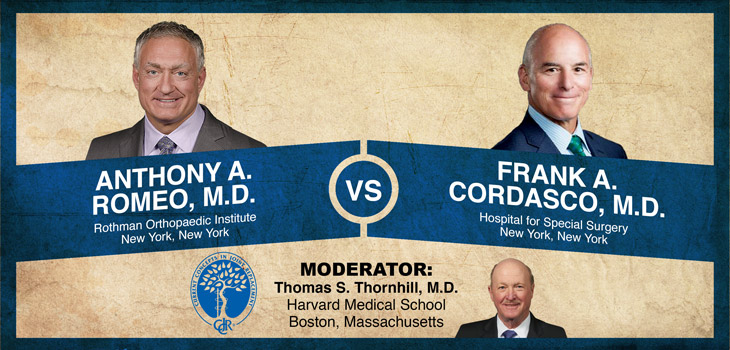
This week’s Orthopaedic Crossfire® debate was part of the 19th Annual Current Concepts in Joint Replacement® (CCJR®), Spring meeting, which took place in Las Vegas. This week’s topic is “OA in a 60-Year-Old: Stemless Trumps Stemmed Implants.” For is Anthony A. Romeo, M.D., Rothman Orthopaedic Institute, New York, New York. Opposing is Frank A. Cordasco, M.D., Hospital for Special Surgery, New York, New York. Moderating is Thomas S. Thornhill, M.D., Harvard Medical School, Boston, Massachusetts.
Romeo v. Cordasco: OA in a 60-Year-Old: Stemless Trumps Stemmed Implants
10 min read Premium comments
Great Debates#anthonyromeo#frankcordasco#stemmedimplants
Dr. Romeo: I’m going to take the side that stemless trumps a stemmed implant. And I want to bring you from where many of you are into where you’re going to be in the next few years.
We know that the goals of shoulder replacement are to alleviate pain, improve motion and improve function. We’ve learned how to do this very effectively with our modern-day concepts of best exposure and anatomic reconstruction (particularly with regards to the humeral head), restore the glenohumeral relationships and then fixation.
Really the break-through for many is when we realize the relationship of head height to radius of curvature is fixed. When we followed that principle, our results improved. We’ve learned what we really need to fix that head in the right spot. Long stem. Short stem and now, stemless.
There is some basic science to suggest that less metal inside of the canal can change the forces around the shoulder and may be able to favorably affect the stress shielding that occurs at the proximal end of the humerus. The smaller or less stem you use the more favorable it is. (Razfar, et al., J Shoulder Elbow Surg 2015).
We’ve seen this when we’ve looked at whether it’s a long stem or a short stem—our longer stem implants typically fit below the metaphysis and therefore they stress-shield the metaphysis whereas the shorter stems seem to be able to maintain that bone. (Denard, et al., J Shoulder Elbow Surg 2018)
There are different short stem designs on the market. We looked at one system with greater than 2-year outcomes, no revision. The radiolucent lines were minimized and we’re very happy with the overall outcomes and the functions that the patients had with this type of implant. (Romeo, et al., J Shoulder Elbow Surg 2018)
But there have been some reports of stress shielding being quite dramatic. In fact, up to 80% have had significant calcar loss of bone. (Schnetzke, et al., J Shoulder Elbow Surg 2015) So, you have to be careful because short stem implants are not all the same and you have to take a careful look at the results that are coming together.
Why would you use a stemless shoulder arthroplasty? To preserve the bone and have an anatomic reconstruction of the head, which is the primary principle to follow through with. Glenoid replacement is easier as opposed to trying to do a surface replacement where the head stays in your way. You don’t have to worry about malalignment of the humeral shaft in a post-traumatic case. There’s decreased blood loss. And probably less pain in many of these patients.
As we start going to outpatient shoulder arthroplasty, we look very carefully at some of the things that will favor this, the loss of blood plays a role so we can minimize that. Reduce their pain. Reduce the amount of dissection or bone injury that we have. All this plays a significant role. (Leroux, et al., J Shoulder Elbow Surg 2016)
George Athwal did a nice study (J Shoulder Elbow Surg 2018) where he showed if you’re going to do an entirely metaphyseal implant, you want to work towards the edges where the bone is a little bit stronger. If you’re going to have something to center, it’s very valuable to use the cortical bone also for your fixation. So, the ideal stemless device is going to have metaphyseal and epiphyseal fixation, anatomic head options and ease of instrumentation. Some devices that have now been out in Europe for many years, much longer than the United States, report results that are equal to the third or fourth generation stems. (Habermeyer, et al., J Shoulder Elbow Surg 2015) They are particularly useful in post-traumatic cases.
What about long-term outcomes? In the United States we’ve had these devices for less than two years. In Europe they’ve had them for more than ten years. Nine-year outcomes on a stemless device and the results are outstanding. (Hawl, et al., J Shoulder Elbow Surg 2017)
You have to careful with these stemless devices. It’s sold as an easier operation, but surgeons have a tendency when they are first using it to overstuff the joint. You have to be careful of your subscapularis repair. And you have to have a short stem available when you’re first learning in case you mess things up. Be careful about cutting in too much varus. That creates problems. (Collin, et al., International Orthopaedics 2017)
So, in summary, correct head size and position is critical. Short stems may lead to some stress shielding. Stemless may have less of that. Good outcomes are seen in both. Stemless—less bone removal, less blood loss, less pain, probably a better outpatient procedure. Revision from stemless is easiest. The key principle is put the head in the right spot. Why do you need all that extra metal to keep it there?
Dr. Cordasco: I would say that the short-stem implants are the way to go.
So, we’ll start with a paper from Mike Worth and colleagues, which was published last year in JBJS 2017 (“Complications of Shoulder Arthroplasty”). Glenoid wear and loosening remains a common cause of anatomic shoulder arthroplasty failure, followed by instability, rotator cuff tear, periprosthetic fracture, neural injury, infection, hematoma, deltoid injury and deep venous thrombosis. Humeral loosening is quite rare.
Neer first reported the outcomes of total shoulder over 45 years ago in 1974. And at the time, if you think about those first ten years, most initial implant designs had few variables of key features. Over the subsequent 20-25 years there’s been a slow but steady shortening of the humeral stem. Currently we can get as short as 55mm, with convertible platforms added most recently.
The latest generation of short-stem components can accommodate the variability of the proximal humerus with respect to head size, version, offset, and inclination. The humeral canal also facilitates proper component positioning. We can recreate pre-morbid anatomy, improve fixation, preserve bone, and also provide convertible options.
Churchill and Athwal (Curr Rev Musculoskelet Med 2016) reviewed the history of the stemless shoulder arthroplasty. It developed in 2004, some 30 years after the first anatomic reports. And it’s often referred to as canal sparing. It’s not to be confused with humeral resurfacing, such as the Copeland CTA. A standard humeral neck cut is performed with stemless total shoulders. They were designed to avoid stem-related complications including intraoperative humeral fractures, postoperative periprosthetic fractures—again unusual—proximal humeral bone loss with stress shielding, loosening—which is rare—and osteolysis. And to provide ease of revision and maintain optimum bone quality.
There are contraindications. Clearly, the proximal humeral bone has to be substantive enough to warrant this. Metabolic bone disease, inflammatory arthritis, and acute fractures are contraindications.
The stemless implant designs have four variables regarding these key features. The first is insertion technique. Most require some type of impaction, but one does have a threaded post with a screw-in application. The presence or absence of a collar is a variable. The surface coating, whether it’s ingrowth or ongrowth, is also a variable. And finally, the degree to which the metaphysis bone is contacted is an issue.
A paper from Kadum and colleagues (Int Orthop 2016) demonstrated 70 TESS arthroplasties and they reviewed, particularly the radiographs, center of rotation, humeral head height, neck shaft angle. They concluded that this is a challenging operation. It is important to determine the correct level of the humeral head cuts to avoid varus or valgus inclination; and to obtain the correct head size.
Another multi-centered study paper from Giles Walch, Pascal Boileau and others, (Collin, et al., Int Orthop. 2017)—47 stemless arthroplasties—2 revisions. But note that 17 of 47 or 36% had superior and lateral radiolucent lines. The authors concluded that radiographic lucent lines require continued observation and remain a concern in this population.
Another paper out of Germany (Beck et al., Int Orthop 2018) 51 stemless arthroplasties; 31 follow-ups (61%), revision rate 9.7%. Note that 29 of the 51 or 39% were lost to follow-up.
Another paper out of Vienna (Heuberer, et al., BMC Musculoskelet Disord. 2018) compared 73 stemless and 110 stemmed arthroplasties. They reviewed radiographs for humeral radiolucency, osteolysis or stress shielding. There were no clinical differences between the groups. But radiologic changes were noted in 37%, both superiorly and at the calcar.
Habermeyer and colleagues have published extensively in this area (J Shoulder Elbow Surg 2015). They first reviewed 78 stemless Eclipse shoulder reconstructions with a follow-up of 72 months. Complication rate 13%; revision rate 9%. The bone density decreased close to 35% over the course of this time. Two years later he published with co-authors and a multi-centered group (Habermeyer, et al., J Shoulder Elbow Surg 2017). A fewer number of stemless Eclipse—49 with 88% follow-up at 9 years. This group began in 2005 and yet they had a revision rate of 0% and one radiolucency. It’s not clear how many of the patients from the first group were in the second group.
So, why do I prefer short-stemmed implants?
There’s no difference in clinical outcomes between stemless and stemmed designs. Stemless implants are designed for problems that are rarely clinically relevant. Stemless implants have high numbers of radiolucencies in the literature, yet no long-term data. All stemless designs are not created equal. There are differences with respect to insertion technique, the presence of a collar, the type of surface coating and the bone contact surface area. And the question is will there be higher failure rates and less successful long-term outcomes as a result of these differences.
For now, stemless implants are a triumph of technology over reason.
Moderator Thornhill: Let me ask you a question—and this is for my own edification. Let’s define stemless. I think what you’re talking about is something that removes the humeral head and has some fixation in the metaphysis, but nothing in the diaphysis. Is that correct?
Dr. Romeo: Yes, that’s correct. What we’re calling stemless is where the head is removed and there is minimal preparation of the metaphyseal bone; no preparation of the diaphyseal bone. The stemless devices are really limited by predicate. And Frank mentioned 55mm…the predicate on U.S. market is you have to have a 7cm stem on the lateral aspect. So, if you try to make it shorter than that, you have to prove to the FDA that it adds value. And then the long stems are anything beyond that.
Moderator Thornhill: So, it’s important to remember that you’re talking about a little short something on the metaphyseal side, but not just an onlay surface.
Frank, you’re saying that a short-stemmed implant is more predictable. The data are better. Why not do what Tony does?
Dr. Cordasco: I think the humeral side of a total shoulder replacement has not generally been a problem in the last 40-some-odd years. We’ve, again, begun to shorten the stem over the course of time because it’s pretty clear that it’s not necessary to have a very long stem. Even in periprosthetic fractures some people are talking about not necessarily bypassing that with a longer stemmed implant. So, my concern about this particular device is that there are multiple devices…we’re not sure which one is the best. One of the goals is to prevent stress shielding and yet many of the outcomes in the European literature demonstrate just that in the proximal humerus. The big concern is we try to fix a small problem to develop an implant that will provide longer term…much more significant I should say…problems going forward. In my view, the devil’s in the details.
Moderator Thornhill: There are different implants that have different offsets. If you have a screw-in you pretty much are given a precise position. Are you losing anything by having that? You can’t change the anatomy to reproduce normal anatomy.
Dr. Romeo: One of the principles of anatomic shoulder reconstruction is that if you make your anatomic neck cut in the right position, then you know how much head height you need based on the diameter of the cut surface. While some people like to have variability in that head height, the reality is that in a normal shoulder that ratio is 0.75. If you decide to make it a longer head, you are making a two-dimensional compensation and not really following the three-dimensional anatomy of the shoulder. Once we’ve been comfortable with these head sizes, then basically it’s getting the cut in the right spot and getting the right head in the right spot.
Moderator Thornhill: Frank, Tony said that one of the maybe downsides is the ease of glenoid replacement but if he’s taking the anatomic head off, is it harder for him to do a glenoid than you doing one with the short stem?
Dr. Cordasco: I think the ease of exposure to the glenoid is probably equal. I would say that the biggest downside in my view is the fixation of the stemless implants. If the fixation is so good, by definition, you’re going to have stress shielding to the rest of the metaphysis and that’s been borne out by the European literature. The other issue is revising these stemless implants may not be as easy as discussed. So, if you have a cage-type of implant with bone ingrowth, removing that may actually result in more bone loss at the time of the revision than a stemmed implant.
Moderator Thornhill: Last question, Tony. Would you do this in a rheumatoid who has osteopenia, serum positivity, and maybe a humeral head cyst?
Dr. Romeo: No, if there are large cystic changes and there’s osteopenia, you really would prefer having a stemmed device to maintain the stability of the humeral head over the lifetime of the implant.
Moderator Thornhill: Thank you gentlemen. Great discussion.
Please visit www.CCJR.com to register for the 2019 CCJR Winter Meeting, – December 11 – 14 in Orlando.
React:
Discussion
This is a fascinating development. In my practice we've seen similar outcomes with the revised protocol. The key differentiator seems to be patient selection criteria. Has anyone else noticed the correlation with BMI thresholds?
Great point. I'd push back slightly on the conclusion, the sample size in the cited study is too small to draw population-level inferences. That said, the directional signal is compelling and worth a larger RCT.
We implemented a similar approach last year. Early results are promising but we're still gathering 12-month follow-up data. Happy to share our protocol if anyone is interested.
Join the conversation
Orthopedic professionals are discussing this. Sign in and upgrade to read every comment and add your voice.