
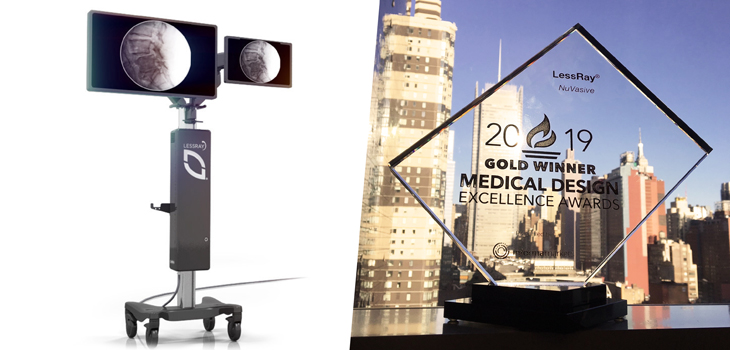
San Diego, California-based NuVasive, Inc. announced that its LessRay radiation reduction and workflow enhancement platform was voted a gold winner in the Radiological, Imaging and Electromechanical Devices category at the 2019 Medical Design Excellence Awards (MDEA) held in New York City on June 11, 2019.
NuVasive’s LessRay Wins Medical Design Award
1 min read Premium comments
#nuvasive#spinesurgerySecondary#lessrayplatform
“We are honored to be recognized by the MDEA for the LessRay platform and our ongoing commitment to delivering better clinical outcomes in spine surgery,” said Matt Link, president of NuVasive. “Studies show surgeons can receive their lifetime occupational radiation limit within the first decade of their career, and NuVasive is proud to play an integral role in building a safer OR experience for patients, surgeons and staff.”
LessRay, which won the Orthopedics This Week Best Technology in Spine Award a few years back, achieves reduced radiation by capturing and enhancing low-dose, low-quality images and converting them (using a proprietary algorithm) to images that are comparable to conventional full-dose images.
According to NuVasive, LessRay can reduce radiation emissions to the operating room (OR) staff and patient by as much as 75% compared to standard fluoroscopy.
In addition to reduced radiation risk, Peter Klemm, NuVasive’s VP of surgical intelligence, pointed out that the system can do much, much more, “LessRay’s built in tracking, image stitching and angle finder tools are designed to increase OR efficiency through streamlined surgical workflow and anatomical visualization.”
“LessRay’s tracking feature helps navigate to the targeted anatomy quickly and accurately, reducing the number of unnecessary scouting images, fluoro time and radiation. Image stitching allows OR staff to quickly stitch together fluoroscopic images of any spine segment, replacing traditional long film imaging which often interrupts surgical workflow and results in unnecessary OR time.”
Finally, according to NuVasive, “LessRay contains a number of surgical efficiency features designed to save time during spine surgery, which can decrease time under anesthesia for the patient. In the newest software upgrade, LessRay showcases Integrated Global Alignment (iGA) measurements on a stitched image which furthers workflow efficiencies for surgeons and OR staff. Also included, compatibility with picture archiving and communications system (PACS) enables seamless information transfer between LessRay and a hospital’s network.”
Author
React:
Discussion
This is a fascinating development. In my practice we've seen similar outcomes with the revised protocol. The key differentiator seems to be patient selection criteria. Has anyone else noticed the correlation with BMI thresholds?
Great point. I'd push back slightly on the conclusion, the sample size in the cited study is too small to draw population-level inferences. That said, the directional signal is compelling and worth a larger RCT.
We implemented a similar approach last year. Early results are promising but we're still gathering 12-month follow-up data. Happy to share our protocol if anyone is interested.
Join the conversation
Orthopedic professionals are discussing this. Sign in and upgrade to read every comment and add your voice.