
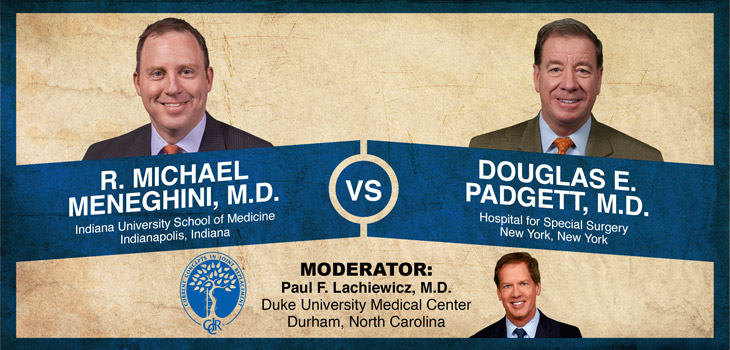
This week’s Orthopaedic Crossfire® debate was part of the 19th Annual Current Concepts in Joint Replacement® (CCJR®), Spring meeting, which took place in Las Vegas. This week’s topic is “Posterior Stabilized Knee Designs: Vestigial Organs” For is R. Michael Meneghini, M.D., Indiana University School of Medicine, Indianapolis, Indiana. Opposing is Douglas E. Padgett, M.D., Hospital for Special Surgery, New York, New York. Moderating is Paul F. Lachiewicz, M.D., Duke University Medical Center, Durham, North Carolina.
Meneghini v. Padgett: Posterior Stabilized Knee Designs: Vestigial Organs
9 min read Premium comments
#michaelmeneghini#douglaspadgettGreat Debates#posteriorstabilizedknee
Dr. Meneghini: It is my pleasure to debate my esteemed colleague Doug Padgett on this topic about the merits of a posterior stabilized knee design.
The topic is whether or not it’s a vestigial organ. The cam-post is obsolete in modern knee replacement. I’m going to describe why I think that’s the truth.
I would argue that newer tibial inserts have enhanced sagittal geometry and conformity, such as an anterior-lipped design, which is designed to substitute for the posterior cruciate ligament (PCL), rendering the cam and post obsolete in modern knee replacement. I’ll go through why that is.
First, what is a vestigial organ? It is a structure in an organism that has lost all or most of its original function throughout the course of evolution. I would argue that we have evolved in total knee replacement.
The normal knee is smooth. It has very fluid motion, so it’s really not intuitive to think that patients would like a cam-post in their knee replacement. Why would anybody want anything to slam into a post? I would say probably not.
In addition, the cam-post mechanism is not benign. Post wear and impingement have been seen in multiple studies. Post fatigue fractures occur in multiple designs. Patella clunk has been an issue over time. Admittedly it has improved with newer designs. Then you have to remove bone. And there is the potential for condyle fractures. All of which have been reported in the literature.
So, let’s look at the science. We’re going to look at four different types of literature: retrospective, matched cohort studies; randomized prospective studies; large institution registry data, and then national registry data. So, the first is a retrospective, matched cohort from my institution (Biyani et al., Surg Technol Int, 2017). My partner resected the PCL in all of his knees. We compared a cam-post mechanism to an anterior-lipped insert. No difference in any of the functional outcomes at a minimum 1-year follow-up.
Another, similar type of study (Parsely et al. JOA, 2006), — 209 total knee replacements; 121 with a cam-post and 88 with an ultra-congruent sagittal confirming bearing. Again, no functional outcome differences at 1 year.
A prospective randomized controlled trial by David Scott was presented at AAHKS and published initially in 2014 (JOA) and in that study the PCL was resected in all cases and, again, cam-post in one arm and then an anterior-lipped device designed to substitute for the PCL in the other arm. No functional outcome difference at 2 years. He just published the 5-year minimum follow-up (JOA, 2018). Same conclusions. Statistically significant. Not surprising.
You see a consistent message through all these studies.
Mayo Clinic registry data (Abdel et al., JBJS-Am, 2011). Over 8,000 total knee replacements. Fifteen-year survivorship—90% for cruciate retaining; 77% for posterior stabilized; and a lower risk of revision for cruciate retaining. Makes sense when you have a less mechanically designed mechanism inside your knee that you’ll get a longer survivorship.
That’s also supported in the Australian Registry data (2016). Out to 14 years, the posterior stabilized knees clearly have a greater risk of revision and the lowest rate of revision is cruciate retaining knees where you resurface the patella.
It’s also something to consider that cam-post mechanisms may render technological advancements such as highly cross-linked polyethylene and cementless knee replacement less than advantageous.
For example, fatigue failure is the Achilles heel of highly cross-linked polyethylene. I would argue that a cam-post mechanism could put that at risk. And in cementless knees, if you look historically, cruciate retaining knees have the longest survivorship and best outcomes. There are few modern PS knee designs that have shown to be viable with cementless, but not many. So, I would argue that’s probably a good avenue to continue doing cruciate retaining knees as we advance technology.
In summary, we have the emergence of anterior-lipped cruciate retaining inserts, which I believe obviate the need for a cam-post mechanism in modern total knee replacement. Surgical technique remains critical. You still must be balancing in flexion no matter whether you use a cam-post or an anterior-lipped. And healthcare reform mandates that we control cost and reduced inventory is a big part of that. I would argue we probably don’t need all these bearings anymore and there’s no scientific evidence to support that a cam-post mechanism is appropriate to replace the posterior cruciate ligament in total knee replacement.
Dr. Padgett:
Michael and I are very good friends and we respect one another, and I think he’s a great scientist and great clinician.
But on this Michael, you are absolutely wrong.
First generation total knees are plagued by a number of issues. Fixation. Alignment. But with total condylar designs we knew that there was limited range of motion and difficulty with stairs. We recognized the impact of rollback allowing increased range of motion and an increase in the mechanical advantage of the quadriceps. I don’t think there’s any question.
Let’s agree that the natural knee is the bomb. It’s the number 1. It’s what we all strive for.
The problem is that every single study that we’ve looked at for the most part has all been in ACL deficient knees. I think we can agree on that. If you go back to the original Cloutier gait lab analysis the winner, without a doubt, was the bicruciate retaining knee. But we realized it was technically difficult. And while gait data supports its normalcy, clinical results demonstrate no advantage, quite frankly, over CR or even PS designs.
So, modern day total knee, step 1 resect the ACL. What happens with that? You get a wide variability in the kinematics of the knee and I think that goes without any question. Michael, I think you would agree on that.
But we want to drive the contact posteriorly, so how do you do this? Perhaps with articular geometry. Perhaps reliance on the PCL. Or perhaps driven by the post-cam interaction.
What about the PCL? In most cases it’s degenerative. And it’s a little bit of the Goldilocks effect. It’s either too loose, too tight, or just right. Despite that there is this banner, “Let’s save the PCL.”
Let’s go to some of the assessments of TKR kinematics. Fluoroscopic studies, and in fact Michael, your own intraoperative sensor studies. Fluoroscopic assessment is used because it is a loaded environment that reproducibly follows the contact point through motion and assesses the impact of design variables on rollback. Scott Banks, Rich Komistek, Doug Dennis and Jim Stiehl won the Coventry Award for their work looking at the determinants of in vivo kinematics.
The most consistent with the least variability in rollback was the PS design. This was confirmed by Banks, et al., in 2003 (CORR) where they looked again to determine which design produced the most femoral rollback and predictably it was, in fact, the PS design.
We looked at some prospective randomized outcome studies, looking at CR versus PS knees (Victor et al., JBJS-Br 2005). Forty-four knees randomized to a CR or PS knee design. At 5 years, 15 patients were taken through image intensifier and they found greater rollback medially and laterally during lunge activity in the PS knee. Greater amount of posterior rollback. Decrease in the anterior displacement of the tibiofemoral contact was seen in the PS, but was increased in the CR. I will admit, Michael, that the clinical results in this randomized study were the same.
There are newer novel ways to asses. Intraoperative sensing. This is with OrthoSensor. Michael and his colleagues have actually published nicely on these particular devices.
Same implant, CR design, with or without a lip. They looked at determining target ligament balance, dual pivot patterns, as well as dual medial pivot kinematics, and correlated them with patient-reported outcomes.
Let’s summarize their work. The early phenomenon of lateral rollback seemed to be associated with better clinical scores. However, getting tighter grouping between the medial and lateral pressures yielded better UCLA activity scores. And the medial pivot phenomenon was more common in the CR and the CR lipped compared to the PS design, however, there was no difference in the clinical outcome.
Certainly, there are some limitations with these types of studies with the OrthoSensor. Passive motion. There are no muscular forces. And really no compressive loads. And previous work from our lab confirmed that articular geometry with compressive load really was one of the primary stabilizers.
So, my problems with the CR knee with or without the lip, are the kinematics are unpredictabe, and the risk for later dysfunction due to wear, stretching out, are real.
What do you get with a PS post? A durable post-cam mechanism. A post-cam mechanism that is predictable. And a post-cam that is, in fact, reliable.
We started this topic on the subject of vestigial structures. It is my suggestion that, frankly, in the current era the PCL is, in fact, the vestigial structure. Long live the post.
Moderator Lachiewicz: I’d like to start off with a question for both of you. What do you think is the influence of training and the use of either the PS or a lipped component? So, for example, if there’s a surgeon in the audience and he was trained to do a PS implant, Michael, do you think he should switch now? He’s getting good results. Should he just stay with what he’s successful at doing?
Dr. Meneghini: The direct answer to your question is no. But does that mean that we shouldn’t move things forward in our profession? If you’re going to transition to something it needs to be done wisely and, in a step-wise approach. I do think there are advantages to having a non-articulated post-type bearing.
Dr. Padgett: I agree with Michael. One needs to be careful of changing for change’s sake. If you’re getting predictable results using a type of articular geometry that you are comfortable with, then there’s really no need to change.
Moderator Lachiewicz: Mike, you said one of the issues is post fracture. Do you think that really is a serious problem?
Dr. Meneghini: If it’s your knee I think it’s probably a problem. If you don’t have a post, then by definition you don’t have that problem.
Moderator Lachiewicz: And let me ask Doug. How often do you see posterior instability or flexion instability in knees that have kept their posterior cruciate or have a deep-dish design?
Dr. Padgett: I think it’s less common, but I think it’s a real phenomenon. To the original question of switching from one design to the other, I think you need to be familiar with a little bit of nuances right there – not just blindly adopting a new surgical technique without understanding the nuances of what happens with soft tissue balance.
Moderator Lachiewicz: Mike, any patient factors to consider in terms of demographics, or weight, or diagnosis for a design with a PS post? Or is that never a consideration?
Dr. Meneghini: In my hands, I am either going to use a conforming polyethylene or a varus/valgus constrained design. A post, a regular post that’s not varus/valgus, does one thing—it just stops the femur from sliding forward. I think when you do that through conformity, with sagittal or anterior-lipped geometry, if I have a complex anatomy that needs constraint, I’m going to a varus/valgus constrained design. That’s what I’m going to use that post for in that particular patient.
Moderator Lachiewicz: Doug, do you think there are any demographic factors that would influence your decision to not do a PS post? Say a 300-pound man as he seems to be the one that might have a post fracture.
Dr. Padgett: No, I don’t think there are any weight limitations.
Dr. Meneghini: I think post-patellectomy patients need to be reevaluated in a modern era with additional conforming poly and knowing that we balance the flexion gap much better than we did in the past. That’s a big part of this equation that has been a focus in the last 10 years.
Moderator Lachiewicz: Thank you gentlemen.
Please visit www.CCJR.com to register for the 2019 CCJR Winter Meeting, – December 11 – 14 in Orlando.
React:
Discussion
This is a fascinating development. In my practice we've seen similar outcomes with the revised protocol. The key differentiator seems to be patient selection criteria. Has anyone else noticed the correlation with BMI thresholds?
Great point. I'd push back slightly on the conclusion, the sample size in the cited study is too small to draw population-level inferences. That said, the directional signal is compelling and worth a larger RCT.
We implemented a similar approach last year. Early results are promising but we're still gathering 12-month follow-up data. Happy to share our protocol if anyone is interested.
Join the conversation
Orthopedic professionals are discussing this. Sign in and upgrade to read every comment and add your voice.