
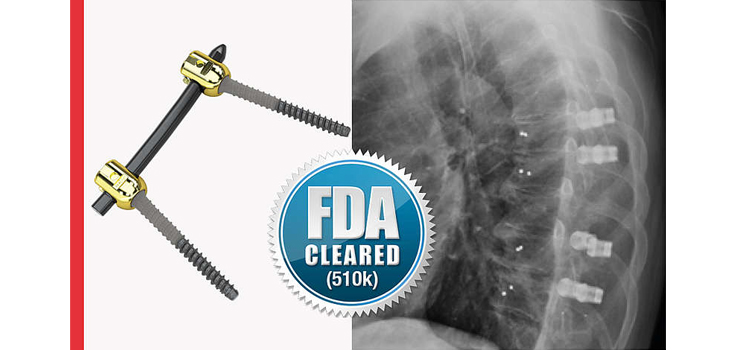
Swiss-based icotec AG’s Carbon/PEEK minimally invasive and open spine pedicle systems have been granted FDA 510(k) clearance.
icotec AG’s Pedicle Systems for Spine Tumor Patients Cleared
2 min read Premium comments
Secondary
According to FDA documents, the systems, called VADER®one Pedicle System MIS and LightMore® Pedicle System 6.0, are intended to “restore the integrity of the spinal column even in the absence of fusion for a limited time period in patients with advanced stage tumors involving the thoracic and lumbar spine in whom life expectancy is of insufficient duration to permit achievement of fusion.”
Both systems are manufactured using the company’s proprietary BlackArmor® Carbon/PEEK manufacturing process and are comprised of polyaxial pedicle screws and curved, straight and J-rods. Both can be used for single or multiple level fixations in the non-cervical spine. Carbon/PEEK is identical to CFRP (carbon fiber-reinforced polyetheretherketone).
In a July 8, 2019 press release, the company noted a recently published study by the neurosurgery and radiation oncology group from Technical University of Munich, Germany, stated, “In terms of postoperative evaluation of residual or recurrent tumor within the periphery of the spinal canal and column and for accurate radiation planning, CFRP implants hold major advantages when compared with standard titanium implants by generating significantly fewer image artifacts.”
The company says its material is produced using icotec’s injection molding CFM (composite flow molding) manufacturing technology. “This process allows for 3-dimensionally reinforced, nonmetallic implants providing both, the strength and radiolucency needed for oncology patients and their treatment.”
Radiolucent CFRP Composite
According to the company, it is the only company manufacturing spinal implants made of radiolucent CFRP composite material. The implants are “biocompatible and have been successfully implanted for over 15 years. Their X-ray, CT and MRI translucency makes a significant difference during the surgical procedure, and postoperatively in assessing the site of care. In patients with spinal tumors, optimal delineation of the tumor from healthy tissue can facilitate radiotherapy planning, improve radiosurgery treatment and allow immediate and precise monitoring of possible relapses (tumor recurrence).”
Company CEO Roger Stadler said the ability to use icotec’s material for stabilizing the spine, “offers advanced-stage tumor patients the ability to consider a larger variety of treatment options with improved therapy planning, dose delivery and follow-up evaluation.”
It took the FDA about four months to clear the devices.
Author
React:
Discussion
This is a fascinating development. In my practice we've seen similar outcomes with the revised protocol. The key differentiator seems to be patient selection criteria. Has anyone else noticed the correlation with BMI thresholds?
Great point. I'd push back slightly on the conclusion, the sample size in the cited study is too small to draw population-level inferences. That said, the directional signal is compelling and worth a larger RCT.
We implemented a similar approach last year. Early results are promising but we're still gathering 12-month follow-up data. Happy to share our protocol if anyone is interested.
Join the conversation
Orthopedic professionals are discussing this. Sign in and upgrade to read every comment and add your voice.