
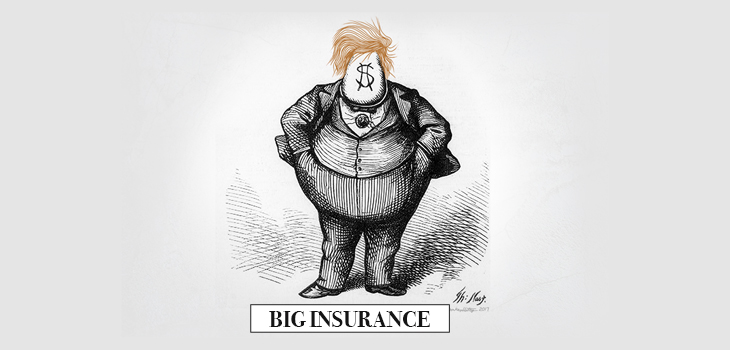
Big insurance flexed its political muscles July 11 on legislation to deal with surprise medical billing (which was called “balance billing” until it became a hot political potato), persuading the Health Subcommittee of House Energy and Commerce to issue a bill which would take money out of the pockets of non-network physicians, especially surgeons and emergency physicians, and stuff most of it into the pockets of health insurers.
Big Insurance 1, Surgeons 0 in Legislation Fight
3 min read Premium comments
#aaosSecondary#insurance#legislationmedical billing
They did so over the strong objections of the American Association of Orthopaedic Surgeons (AAOS) and the American Medical Association (AMA).
The action sets up a showdown this week. The full House Energy and Commerce Committee is expected to consider the bill on July 17.
The bill sent to the full committee, HR 3630, the “No Surprises act,” sponsored by Rep. Frank Pallone, the full committee chairman, forces out-of-network physicians whose services are offered at in-network settings to accept payments at the median rates and copays for private insurance in their markets.
The Blue Cross-Blue Shield Association loves the Pallone bill, saying, “The Committee’s draft legislation will go a long way towards protecting patients from surprise medical bills [and] will help ensure that providers are paid fairly while not enabling specific medical specialists to remain out-of-network, which has led to the challenges the healthcare system faces today around surprise billing.”
Not surprisingly, physician representatives disagree that forcing doctors to accept low-paying network reimbursements solves anything.
The situation doesn’t look good in the full Energy and Commerce Committee for the AAOS- and AMA-backed alternative solution to surprise billing, which would set up state arbitration panels to decide on fair total payments and copays for surprise bills.
Pallone was quoted as saying the physician-backed alternative is a “non-starter.”
However, the arbitration model has proved to be popular in some states. New York, the first state to set up a surprise billing adjudication system, uses the arbitration model. Texas became the latest when Gov. Greg Abbott signed a bill June 14 creating a similar arbitration approach.
Surprise medical bills—the phrase itself hints that physicians, rather than the insurance system, are to blame—have become a political whipping-boy, covering up the broader issue of health insurers pulling out of market after market, leaving only the lowest-paying networks in many parts of the nation. Medicare Advantage plans, popular with the Trump Administration, have also had a role in reducing physician pay; their low fee schedules have caused some hospitals and big physician practices to recruit offshore physicians.
The AMA and AAOS have tried to raise the argument of insurers pulling out of markets in the debate over surprise medical bills.
However, the political wind for most politicians, both Republicans and Democrats, see it this way: fixing insurance markets (a problem arising out of the insurance industry’s response to former President Obama’s Affordable Care Act, which Republicans want to repeal entirely rather than fix) is a complex issue which is not going to be solved quickly. However, forcing physicians to accept low in-network pay is a quick-and-dirty change which can be done to please voters before the 2020 election.
From here, the path for the legislation is complicated, giving physician advocates more than one shot at getting it changed. The bill was also sent to the House Education and Labor Committee as well. It must be voted out to the floor by both committees, and amendments are possible at any stage (although difficult on the floor under House rules). The full House isn’t expected to take it up until September, after the summer congressional recess.
A Senate companion bill, S.1895, sponsored by Sen Lamar Alexander, R-Tenn., which was reported to the full Senate floor on July 8, essentially divides the baby in half. It mirrors the House committee bill, requiring that physicians accept the median in-network payment rate—except that individual states can establish or continue existing alternatives methods. The Alexander bill specifically mentions arbitration as one of the possible alternatives to forced acceptance of in-network rates.
AAOS Council on Advocacy Chair Wilford Gibson, M.D., said in a statement after the House subcommittee markup:
“AAOS was encouraged to hear subcommittee members recognize the threat benchmarking poses to patient access, market consolidation, and good faith negotiations—a critical component to offering high-quality, high-value care. Arbitration is the only surprise billing solution that protects both patients and the free market, and we will continue working with Congress to make changes to include an independent dispute resolution process in any legislation addressing unexpected bills resulting from out-of-network medical care.”
The AMA issued a statement July 11 urging that surprise billing legislation:
- “Establish benchmark rates that are fair to all stakeholders in the private market; benchmark rates should include actual local charges as determined through an independent claims data base.
- Establish a fair and independent dispute resolution (IDR) process to resolve disputes about payments from insurers to unaffiliated providers of out-of-network services.
Protect patients from out-of-network billing and preserve patient access to care by holding insurers accountable for addressing their own contributions to the problem.”
Author
React:
Discussion
This is a fascinating development. In my practice we've seen similar outcomes with the revised protocol. The key differentiator seems to be patient selection criteria. Has anyone else noticed the correlation with BMI thresholds?
Great point. I'd push back slightly on the conclusion, the sample size in the cited study is too small to draw population-level inferences. That said, the directional signal is compelling and worth a larger RCT.
We implemented a similar approach last year. Early results are promising but we're still gathering 12-month follow-up data. Happy to share our protocol if anyone is interested.
Join the conversation
Orthopedic professionals are discussing this. Sign in and upgrade to read every comment and add your voice.