
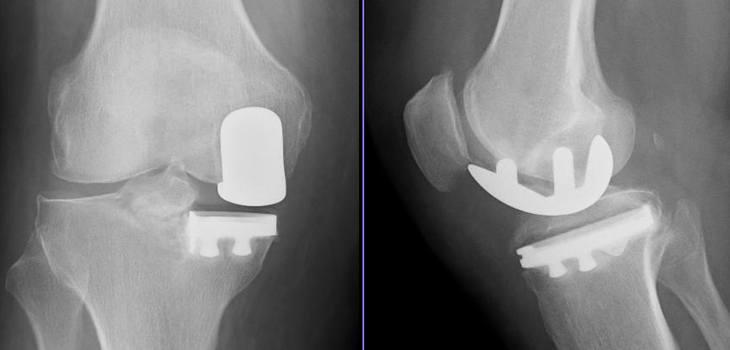
A team of researchers has examined postoperative complications and readmissions for patients receiving a unicondylar knee arthroplasty (UKA) procedure and compared those outcomes to patients who received a total knew arthroplasty (TKA).
UNIs: Fewer Complications But Higher Revision Rates
2 min read Premium comments
#totalkneearthroplastySecondary#unicompartmentalkneearthroplasty
Their work, “Unicondylar Knee Arthroplasty Has Fewer Complications but Higher Revision Rates Than Total Knee Arthroplasty in a Study of Large United States Databases,” appears in the April 8, 2019 edition of The Journal of Arthroplasty.
Jess Lonner, M.D., associate professor of Orthopaedic Surgery at Rothman Orthopaedic Institute, Thomas Jefferson University Medical School in Philadelphia and study co-author explained the rationale behind the study to OTW, “While the published and unpublished collective experiences of high-volume skilled UNI surgeons have suggested long-term outcomes that rival or surpass those of total knees, international registries have found higher short- and mid-term failure rates of UNIs compared to total knees.”
“Additionally, several small series, again by high-volume surgeons, have found lower rates of complications and mortality after UNIs compared to total knees.”
According to the authors, to conduct the study they “identified UKA and TKA patients from the 2002-2011, 5% sample of Medicare data and the 2004-2012 (June) MarketScan Commercial and Medicare Supplemental Databases. They then mined that patient data looking for complications, hospital re-admissions for any reason, and mortality within 90 days of surgery.”
According to Dr. Lonner, “Our study shows that throughout all age groups, UNIs are revised with greater frequency than TKAs. When considering both UNIs and TKAs, younger patients are at greater risk for failure and complications than older patients.”
“The risk of UNI failure and the need for revision is significantly lower when performed by high-volume UNI surgeons. Unlike the risk of revision among lower volume surgeons, the 90-day complication rates—even among low volume UNI surgeons—remains significantly lower after UNIs compared to TKAs.”
“The revision data is comparable to that which we see in the international registries—higher failure rates in general after UNIs compared to TKAs, although the failure rates are lower when performed by higher volume UNI surgeons. We were satisfied to find that even though outcomes (durability) will be optimized when UNIs are performed by higher volume UNI surgeons, the risk of complications through 90 days are low, even in the hands of lower volume or less experienced UNI surgeons.
“Careful patient selection is step one in optimizing outcomes.”
“For those interested in performing UNIs, surgeons will beget better outcomes for their patients and greater implant durability if they perform greater volumes of the procedure.”
“Outcomes are compromised when components are poorly aligned and soft tissues imbalanced. Those elements are improved with experience and critical evaluation.”
“Strategizing with partners and referring doctors to become a point of referral within your practice, regionally and beyond, will help an interested surgeon grow their UNI volumes.”
“Finally, when considering the functional benefits and lower postoperative opiate requirements of UNIs compared to TKAs that has been borne out in other studies, patients who are candidates for UNIs should be advised that there is a lower risk of complications and readmission within 3 months of surgery if they opt for a well-done UNI compared to a TKA.”
Author
React:
Discussion
This is a fascinating development. In my practice we've seen similar outcomes with the revised protocol. The key differentiator seems to be patient selection criteria. Has anyone else noticed the correlation with BMI thresholds?
Great point. I'd push back slightly on the conclusion, the sample size in the cited study is too small to draw population-level inferences. That said, the directional signal is compelling and worth a larger RCT.
We implemented a similar approach last year. Early results are promising but we're still gathering 12-month follow-up data. Happy to share our protocol if anyone is interested.
Join the conversation
Orthopedic professionals are discussing this. Sign in and upgrade to read every comment and add your voice.