
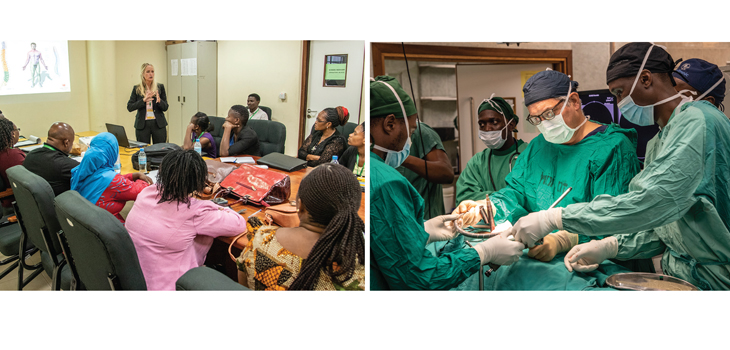
In what is truly a first for East Africa, a team of intrepid researchers has set out to assess the demographics, management, costs of surgery and implants, treatment decision factors, and outcomes of patients with spine trauma in Tanzania.
Spinal Trauma Management and Outcomes in East Africa
1 min read Premium comments
Secondary#eastafrica#weillcornellmedicinebrainandspinecenter
The researchers were from the Weill Cornell Brain and Spine Center, NewYork-Presbyterian Hospital and the Muhimbili Orthopaedic Institute in Dar es Salaam, Tanzania.
Their study, “Spinal trauma in Tanzania: current management and outcomes,” appears in the April 5, 2019 edition of the Journal of Neurosurgery Spine.
Co-author Franziska Schmidt, M.D, a research fellow at the Weill Cornell Brain and Spine Center, told OTW, “We have been working since 2008 on a neurosurgical/orthopedic initiative in Tanzania, with the goal of training local health care providers to treat a variety of brain and spine conditions. We are especially focused on trauma, which is the leading cause of death and disability in this East African nation, as well as on dire conditions that affect infants and children.”
The team retrospectively reviewed data on spinal trauma patients in a single surgical referral center in Tanzania (Muhimbili Orthopaedic Institute [MOI]) from October 2016 to December 2017.
“Like much of the developing world,” Dr. Schmidt said to OTW, “Tanzania is vastly under-served when it comes to basic neurosurgical/orthopedic care, a situation the Neurosurgical Mission in Tanzania is striving to rectify.”
“Our investigation shows that surgical treatment of spinal trauma is currently based on access to implants and not driven by medical needs or guidelines. For example, patients with incomplete deficits who may benefit most from surgery are not prioritized.”
“We were able to show that surgery had a positive impact on patient outcome. These data will be used to design and implement an evidence-based spinal trauma treatment protocol based on the specific needs and the infrastructure available.”
Author
React:
Discussion
This is a fascinating development. In my practice we've seen similar outcomes with the revised protocol. The key differentiator seems to be patient selection criteria. Has anyone else noticed the correlation with BMI thresholds?
Great point. I'd push back slightly on the conclusion, the sample size in the cited study is too small to draw population-level inferences. That said, the directional signal is compelling and worth a larger RCT.
We implemented a similar approach last year. Early results are promising but we're still gathering 12-month follow-up data. Happy to share our protocol if anyone is interested.
Join the conversation
Orthopedic professionals are discussing this. Sign in and upgrade to read every comment and add your voice.