
Beam me up Scotty.
Medivis Holographic Visualization Technology Cleared by FDA
2 min read Premium comments
#fda510kclearanceSecondary#surgicalimaging#augmentedreality#surgery
Osama Choudhry, M.D., a neurosurgeon and CEO of Medivis says the surgical world continues to primarily rely on two-dimensional imaging technology “to understand and operate on incredibly complex patient pathology.”
He adds, “Holographic visualization is the final frontier of surgical imaging and navigation.”
The FDA is now on board by giving 510(k) clearance for Medivis’s Surgical AR software device “for display of medical images and other healthcare data. It includes functions for image review image manipulation, basic measurements and 3D visualization (Multiplanar reconstructions and 3D volume rendering).”
The company states that most medical procedures “are performed relatively blindly,” with surgeons having to reconstruct slices of 2D imaging data in the “mind’s eye” to make it actionable.
“Surgical AR is the first end-to-end surgical imaging solution leveraging the latest breakthroughs in augmented reality (AR) and artificial intelligence (AI)—allowing operators to have superior understanding, confidence, efficiency, and precision for every patient.”
Microsoft HoloLens Technology
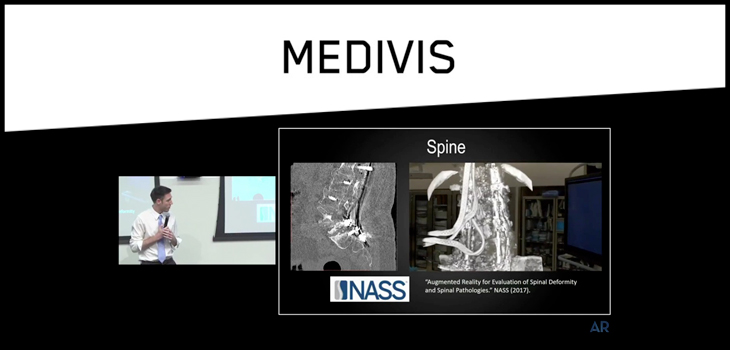
Using Microsoft’s HoloLens technology, the Surgical AR software maps medical imaging onto a surgeon’s view of a patient, giving surgeons a three-dimensional view of the data. With gesture recognition and voice commands, the software also gives surgeons access to imaging data while keeping their hands free (and sterilized).
Techcrunch.com reported that the company sells a touchscreen monitor, display and a headset. The device plugs into a hospital network and extracts medical imaging to display from their servers in about 30 seconds,
Christopher Morley, M.D., a radiologist and president of the company, said, “Medivis introduces advancements in holographic visualization and navigation to fundamentally advance surgical intervention, and revolutionize how surgeons safely operate on their patients.”
Surgical AR Platform
The FDA clearance document says the software platform is to be used by clinicians for the “visualization of medical images in 3D to allow for surgical planning activities. The device takes pre-acquired 2D medical images and reconstructs 3D models that a clinician can then view on a stereoscopic, holographic display.”
The software application is used to:
- Load patient CT/MR DICOM (Digital Imaging and Communications) data
- View DICOM data using a traditional computer monitor or in Augmented Reality (AR) using a head-mounted display, HMD.
“We see this immediately being useful in that pre-surgical planning stage,” Choudhry says. “The use in surgical planning and being able to extend this through surgical navigation… Streamline the process that requires a large amount of pieces and components and setups, so you only need an AR headset to localize pathology and make decisions off of that.”
The New York City-based medical technology company recently announced strategic partnerships with Verizon and Microsoft. To watch a video of Drs. Choudhry and Morley discuss and demonstrate the technology, click here.
Author
React:
Discussion
This is a fascinating development. In my practice we've seen similar outcomes with the revised protocol. The key differentiator seems to be patient selection criteria. Has anyone else noticed the correlation with BMI thresholds?
Great point. I'd push back slightly on the conclusion, the sample size in the cited study is too small to draw population-level inferences. That said, the directional signal is compelling and worth a larger RCT.
We implemented a similar approach last year. Early results are promising but we're still gathering 12-month follow-up data. Happy to share our protocol if anyone is interested.
Join the conversation
Orthopedic professionals are discussing this. Sign in and upgrade to read every comment and add your voice.