
Medacta International’s MySpine® MC platform is the winner of the MedTech Breakthrough “Best Healthcare Navigation/Robotics Solution” award for 2019. MedTech Breakthrough is an independent organization that recognizes the top companies and solutions in the global health and medical technology market.
Medacta’s MySpine Wins Best Healthcare Solution Award
3 min read Premium comments
#medactaSecondary#medtechbreakthroughawards#myspinemcplatform
“Medacta is an international orthopaedics company specializing in the design and production of innovative orthopaedic products and the development of accompanying surgical techniques. Medacta is a pioneer in developing new offerings on the basis of minimally invasive surgical techniques, offering surgeons highly personalized pre-operative planning and implant placement methodologies by creating advanced personalized kinematic models and 3D planning tools for use in hip, knee, shoulder and spine procedures.”
“Medacta’s 3D-printed patient-specific solutions are not just displaying an impressive high level of technical innovation, they are delivering proven benefits to both surgeons and the patients,” said James Johnson, managing director, MedTech Breakthrough. “We are proud to recognize Medacta’s ‘breakthrough’ innovation in pioneering and engineering joint and spine surgery platforms to accommodate the demand for outpatient and same-day surgery. Congratulations to the entire Medacta team for their success and well-deserved 2019 MedTech Breakthrough Award.”
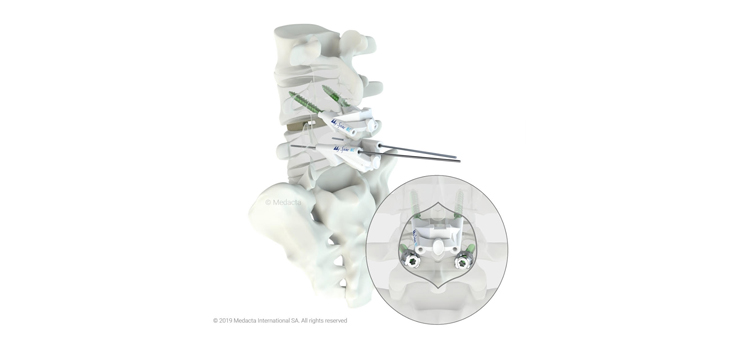
“Medacta’s MySpine MC platform is a patient-matched, 3D-printed technology that helps facilitate improved accuracy in pedicle screw position for posterior lumbar surgeries….”
“With Medacta’s MySpine solutions, surgeons gain invaluable insight into each patient’s unique anatomy via 3D pre-operative planning using CT images of the patient’s spine, so they can prepare accordingly. Once the procedure has begun, the 3D printed patient-specific pedicle screw guides provide guidance to the surgeon and can enhance accuracy and promote efficiency over traditional screw placements.”
MySpine MC enables surgeons to optimize procedures for both outpatient and inpatient settings and foster more rapid patient recovery through an accurate and reliable muscle-sparing approach to posterior lumbar surgery. This technology, unveiled in May 2018, guides the screw to a trajectory in the pedicle that evolved from the well-established cortical bone trajectory (CBT). Through accurate CT-based preoperative planning of a more caudomedial entry point than traditional pedicle screw trajectories and a less extreme caudal-cranial angle than CBT, the MySpine MC technique avoids interference with the cranial facet joints and accommodates larger screw diameters and lengths, with four points of cortical bone purchase for enhanced biomechanical fixation.
“Achieving this improved screw trajectory through a small, midline incision with a patient-matched guide may bring speed and reliability to the operating room, while potentially accelerating patient recovery and decreasing the risk of pedicle fractures, facet joint violation and nerve root injury. The intraoperative utilization of 3D-printed guides for pedicle screw placement facilitates accurate replication of pre-surgical planning to achieve the fine-tuned screw trajectory and may further reduce radiation exposure, muscular dissection and operative time.”
“The mission of the MedTech Breakthrough Awards is to honor excellence and recognize the innovation, hard work and success in a range of health and medical technology categories, including Robotics, Clinical Administration, Telehealth, Patient Engagement, Electronic Health Records (EHR), mHealth, Medical Devices, Medical Data and many more. This year’s program attracted more than 3,500 nominations from over 15 different countries throughout the world.”
Francesco Siccardi, Medacta CEO, told OTW, ”MySpine is incredibly user-friendly, designed to provide high accuracy in screw positioning, while limiting risk of pedicles violation. Before each surgery, the surgeon conducts 3D pre-operative planning using CT low dose scan images of the patient’s spine and works directly with Medacta’s MySpine engineers to perfect the guide.”
“Based on this surgeon- and patient-specific pre-operative plan, the MySpine engineering team designs and manufactures the 3D-printed MySpine placement guides. During surgery, the surgeon is able to insert surgical implants guided by a planned optimized trajectory utilizing the control of the MySpine guides and sizing using the insights of the MySpine pre-operative plan. With MySpine, the entire surgical process becomes highly personalized to both the surgeon and patient.”
“The MySpine platform is a breakthrough medical innovation that is driving patient-specific surgical approaches in the orthopedic and spine surgery industries. Surgeons using MySpine can promote their expertise in personalized spine surgery, as they play a lead role in the design and planning process.”
Author
React:
Discussion
This is a fascinating development. In my practice we've seen similar outcomes with the revised protocol. The key differentiator seems to be patient selection criteria. Has anyone else noticed the correlation with BMI thresholds?
Great point. I'd push back slightly on the conclusion, the sample size in the cited study is too small to draw population-level inferences. That said, the directional signal is compelling and worth a larger RCT.
We implemented a similar approach last year. Early results are promising but we're still gathering 12-month follow-up data. Happy to share our protocol if anyone is interested.
Join the conversation
Orthopedic professionals are discussing this. Sign in and upgrade to read every comment and add your voice.