
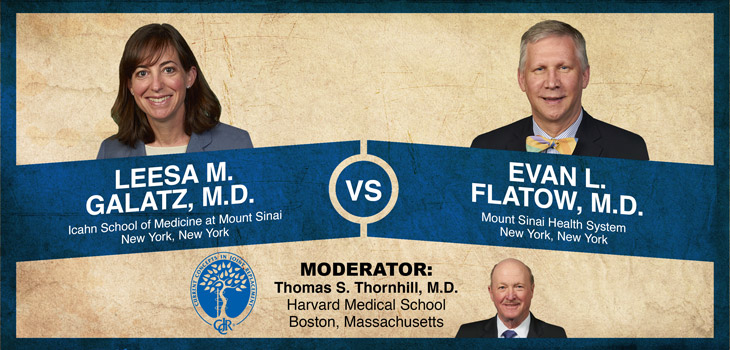
This week’s Orthopaedic Crossfire® debate was part of the 19th Annual Current Concepts in Joint Replacement® (CCJR®), Spring meeting, which took place in Las Vegas. This week’s topic is “Four-Part Fx’s in an Active 65-Year-Old: Reverse is the Preferred Treatment.” For is Leesa M. Galatz, M.D., Icahn School of Medicine at Mount Sinai, New York, New York. Opposing is Evan L. Flatow, M.D., Mount Sinai Health System, New York, New York. Moderating is Thomas S. Thornhill, M.D., Harvard Medical School, Boston, Massachusetts.
Galatz v. Flatow: Four-Part Fx’s in an Active 65-Year-Old: Reverse is the Preferred Treatment
9 min read Premium comments
#hemiarthroplasty#leesagalazGreat Debates#evanflatow#reversedshoulder#tuberosity
Dr. Galatz: It’s a pleasure to come and debate my friend, colleague and co-worker Evan Flatow. Proximal humerus fractures are a challenge. They are technically difficult. They’re one of the few fractures we fix where we can’t actually see the bone fragments because they’re covered in soft tissue. We want to reconstruct normal anatomy but often we are reconstructing poor quality bone fragments. Everything that we do in the proximal humerus depends largely on tuberosity healing—which is absolutely critical in order to make sure we have proper rotator cuff function.
Failure of tuberosity healing is the most common indication for revision of a hemi-arthroplasty as well as a revision to a reverse. What happens when you don’t have proper rotator cuff function, you get a prominent humeral head, superior instability and significant pain.
Looking at the results of hemi-arthroplasty, outcome scores, elevation and satisfaction are very good if the tuberosity healed. However, this has a very high failure rate.
Is a reverse a better option? It solves the problem, allowing immediate reconstruction. It can stabilize the shoulder. And, importantly, you don’t have to wait for tuberosity healing. In fact, there are two recent studies showing that tuberosity healing does not have a significant impact on outcome with a reverse as it does in a hemi-arthroplasty.
It’s an operation where we can tolerate some imperfection because we’re medializing the center of rotation, maximizing deltoid function.
It is important though to know that this is not a “throw the tuberosities in the bucket” operation. There is still tuberosity repair—a very important part of the operation to avoid instability and allow overhead elevation and external rotation. The tuberosities can rotate posteriorly a little bit and still, if they heal, be functional.
A reverse shoulder arthroplasty is a solution for a failed hemi-arthroplasty. So, in talking about our 65-year-old wanting to have one operation and be done with it, is a good argument for a reverse. We use a reverse for fracture sequelae, both non-unions, malunions and also AVN [avascular necrosis]. AVN is a risk for a 4-part fracture in any age group.
In looking at a reverse versus a hemi-arthroplasty, there’s a study (Cuff et al, JBJS, 2014)…patients over 70 reported better satisfaction with a reverse. And in talking about activity level, our patients golf, swim and do other things. Hemi-arthroplasty, again, is dependent on tuberosity healing and if you get that, you’ll get good external rotation. However, in most studies you get more patients with less than 90 degrees of elevation.
So, the reverse seems to find this middle ground. In other words, a reverse can tolerate some imperfection and the hemi-arthroplasty has disparate results. It’s either win or lose.
You have to have a stomach for the complications. We worry about scapula notching, but this problem is solved by some of the more modern prostheses.
In a case of a 4-part fracture, we did a reverse. I like to use heavy suture or a wire. Wire holds very well, but it does break around 2-3 years after the tuberosities are healed. Some patients don’t like seeing that.
In conclusion, 4-part fractures have a very high risk of avascular necrosis and in a 65-year-old active person, return to activity is very important. Most importantly, we want to avoid the need for a second surgery or revision and a reverse shoulder arthroplasty is coming along in terms of our techniques.
And if you ask a patient, or if a patient asks you, “What is the procedure with the greatest chance of getting me back to my life with the least concern of revision?” the answer is a reverse shoulder arthroplasty.
Dr. Flatow: It’s a pleasure to discuss this with my colleague. She’s also the chair of our department, so I have to be careful what I say. I may get my privileges reviewed when I get back.
I’m going to argue that reverse is not always the answer.
There’s certainly been a recent shift in practice. Fewer hemis are done for proximal humeral fractures, but not just because we’re doing reverses, many can be managed non-operatively. There’s a renaissance of internal fixation with the advent of percutaneous repair, of which Dr. Galatz is a pioneer, MIS approaches, improved plates, methods to include sutures for the cuff, and better IM nails. And, of course, the emergence of reverse total shoulders as an option.
My problem with this is that now every fracture needs a reverse. And I don’t understand why Dr. Galatz is getting on this bandwagon.
There is an evidence basis for non-operative treatment of proximal humerus fractures. A meta-analysis showing good results even with 4-part fractures (Iyengar et al, J of Trauma, 2011). A prospective randomized study of 3- and 4-part fractures versus non-operative with no functional difference (Zyto, et al, JBJS-Br, 1997). Non-operative treatment versus reverse shoulder arthroplasty is a lot cheaper in this age of value-based orthopedics. And the conclusion that non-operative and reverse produce similar outcomes, AND delayed reverse has as good an outcome as primary reverse (Roberson et al, JSES, 2017).
So instead of going right to this expensive, difficult technology…and now running a hospital…I don’t want those expensive implants in our patients. I want a sheet of exercises and go right home.
A 2015 Cochrane Review of interventions with high or moderate quality evidence showed that surgery is not better in these patients.
Also, percutaneous fixation is very useful for impacted valgus fractures and others. We pin many more cases, including 4-part than we used to. And we’ve also discovered that even if they get AVN…when you have a plate and all the screws into the glenoid it was hard, but with percutaneous fixation you can just pull the pins out.
People tolerate the AVN. So why rush to a prosthesis because they might get AVN. Even if they get AVN, many tolerate it and if they don’t tolerate it you can do your replacement later and still get a good result because of these minimally invasive approaches.
We have better locking plates. Dr. Galatz and my partner, Brad Parsons, have been pioneers in plate fixation. Done some very interesting cases.
Again, studies show that there are similar outcomes between primary and salvage reverses (Shannon et al, JSES, 2016). Pointing out that the wonderful, forgiving nature of reverse also argues against having to rush in and having to do it initially; you can get by later because it isn’t as dependent on the cuff or the tuberosity positioning.
It used to be if you fixed the fracture and the tuberosities didn’t heal, then it was hard to do anything, although now with reverse you have that option.
You still have some cases where, perhaps, an arthroplasty is needed and in some of them still a hemi is a good option. A reverse is more predictable, but a hemi really gets some of those excellent results in the younger patient…and this is a 65-year-old we’re debating about…if there’s good bone and good motivation.
There are better stems made for fracture cases to allow ingrowth of the tuberosities and healing and for bone graft. And tuberosity reconstruction, we’ve learned from Pascal Boileau and others how to reconstruct them with sutures; how to have better materials.
In a study from Brown and Mount Sinai with a tantalum ingrowth prosthesis, 93% had healed tuberosities, but it was a very limited series (16 shoulders). Admittedly, highly selective for some of these younger patients—50s and 60s with good bone.
I think non-operative treatment for most fractures is still a very reasonable option. ORIF, either percutaneous or with plates, for younger patients. Hemi for some active patients with good bone.
Moderator Thornhill: This is a very interesting talk. Leesa, you suggested that some people are thinking about doing reverse even if the cuff is intact. Do you take time in these patients preoperatively to evaluate the cuff and if so by what means?
Dr. Galatz: Absolutely. So, not necessarily for fractures because they can’t move anyway, but in patients with arthritis, absolutely. I think knowing how their cuff is functioning is very, very important. Not only do I exam them to determine if the rotator cuff is functional, but then we have radiographic studies to look at that as well. Function has a significant impact on decision making.
Moderator Thornhill: Evan, same question.
Dr. Flatow: Absolutely. And I think in the early days of shoulder arthroplasty we didn’t have MRIs and didn’t really know what the rotator cuff looked like. We now have much more information. We also had a lot of patients who did okay with a total shoulder replacement, but if you medialize them by lowering the high side and they had weak rotator cuff, a lot of them were sort of weak and they didn’t have very good function.
I think reverse has given those patients who had a lot of bone loss or atrophied muscles better outcome.
In the beginning, when the reverse shoulder was cleared for clinical use in the United States, we read papers about 30% complication rates, 10% infection rates, dislocation rates that were through the roof…we were scared. We did these in people who had pseudoparalysis and no other option available. But we have had the benefit of the learning curve of Europe. We started with better technology, newer prostheses…and these have been very durable, and very, very solid. So, we’re beginning to wonder actually if they are more durable than a regular polyethylene total shoulder.
Moderator Thornhill: List for me what goes through your mind in the case of a 65-year-old person —open reduction internal fixation [ORIF] by any of a number of newer means or hemi, shoulder, reverse, or just watchful neglect. How does that pare down for you?
Dr. Flatow: I think if you have an older patient, 70s or 80s with poor bone and little tiny shelves of tuberosities, those we go for reverse and I think that’s pretty clear from the record. I think if you have a 4-part impacted valgus fracture that has the medial hinge, I’ll pin everyone of those no matter what the age is. I think those do very well. The few that get AVN, you can always go back and do a hemi. I think if there is a younger patient with good bone, I’ll debate between a hemi and internal fixation. And that’s individualized in each case.
Moderator Thornhill: Leesa, it’s interesting the incidence of reverse shoulder has really skyrocketed. What do you think is driving that? Is it because it’s better, it’s more available, it’s more reimbursed, it’s a quicker fix in a short period of time?
Dr. Galatz: I think it’s a couple of things. Number 1 is that when you have an older person with a problem—let’s say a fracture—and you try to fix it, it is a long rehabilitation. With a reverse you can stabilize a shoulder enabling elderly patients to mobilize very quickly. We know that elderly patients need a lot of rehabilitation and that just kind of sucks the energy out of them and they develop other problems. We want to fix them and get them back up. A reverse allows us to do that.
I also think the techniques are getting easier. We’re better at teaching people how to do it. It offers a solution where we didn’t have one for some very, very difficult problems. Again, just like fixing a hip fracture in an elderly person, we can stabilize a shoulder, and allow them to weight bear on a walker, a cane or whatever they have. It’s an important thing.
Moderator Thornhill: Well, it’s a wonderful debate. Let’s thank our debaters.
Please visit www.CCJR.com to register for the 2019 CCJR Winter Meeting, – December 11 – 14 in Orlando.
React:
Discussion
This is a fascinating development. In my practice we've seen similar outcomes with the revised protocol. The key differentiator seems to be patient selection criteria. Has anyone else noticed the correlation with BMI thresholds?
Great point. I'd push back slightly on the conclusion, the sample size in the cited study is too small to draw population-level inferences. That said, the directional signal is compelling and worth a larger RCT.
We implemented a similar approach last year. Early results are promising but we're still gathering 12-month follow-up data. Happy to share our protocol if anyone is interested.
Join the conversation
Orthopedic professionals are discussing this. Sign in and upgrade to read every comment and add your voice.