
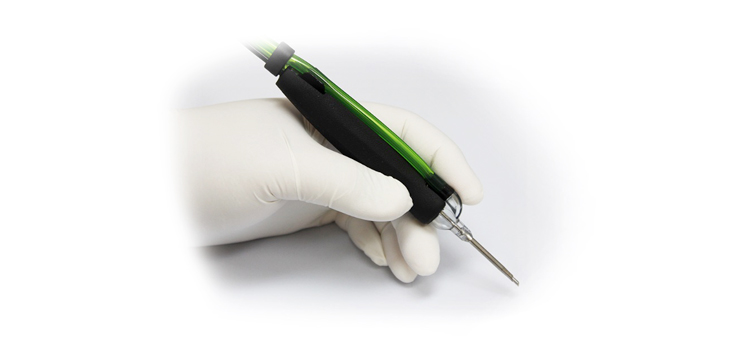
The FDA has cleared Tenex Health, Inc.’s, TX-Bone, an ultrasonic surgical instrument that fragments, emulsifies and aspirates soft and hard tissue.
FDA Clears Ultrasonic Device From Tenex Health
2 min read Premium comments
#fdaSecondary#tenexhealth#txplus
The minimally invasive technology, according to a May 13, 2019 company announcement, is specifically designed to “treat chronic pain in soft and hard tissue…and allow physicians to identify and simultaneously perform selective cutting and debriding of pain-generating bone and calcific tissue, with optimized ultrasonic energy.”
The device was cleared in August 2018, but a spokesperson told OTW that the company first wanted to conduct a Limited Use Release with select users before releasing to market and then choosing to do the press release.
The spokesperson also noted the device was initially named the TX-Plus (aka TXP) throughout the Limited Use Release, but, has now been re-named the TX-Bone (aka TXB) for the widespread release.
Bernard Morrey, M.D. of the Mayo Clinic, said the device “is extremely efficient for treating soft tissue, but also very effective at removing pain-causing bone and calcific tissue. He added that the clearance “represents a major advancement in the management of patients with tendinopathy, including those who suffer from bony spurs.”
Indication
The FDA clearance document states the “Tenex Health TX System with the TXP MicroTip is indicated for use in surgical procedures where fragmentation, emulsification, and aspiration of both soft and hard (e.g.: bone) tissue are desirable, including General Surgery, Orthopedic Surgery, Laparoscopic Surgery and Plastic and Reconstructive Surgery.”
It is also indicated for use in the “debridement of wounds, such as, but not limited to diabetic ulcers, in application, in which, in the physician’s judgement would require the use of an ultrasonic aspirator with sharp debridement.”
System With TXP MicroTip
The system, according to the FDA documents, consists of a non-sterile console, ultrasonic MicroTip, inflation cuff, foot pedal and supply kit. “The console provides power and control for the user functions including irrigation, aspiration, and ultrasonic fragmentation/emulsification. It has a large, color LCD and employs a touch-screen with a graphical user interface for selection of required settings. The console provides audible tones for confirmation of selections. The console also houses the irrigation valve, the irrigation pump and the aspiration pump.”
The company says the technology has been used successfully in over 90,000 cases.
Author
React:
Discussion
This is a fascinating development. In my practice we've seen similar outcomes with the revised protocol. The key differentiator seems to be patient selection criteria. Has anyone else noticed the correlation with BMI thresholds?
Great point. I'd push back slightly on the conclusion, the sample size in the cited study is too small to draw population-level inferences. That said, the directional signal is compelling and worth a larger RCT.
We implemented a similar approach last year. Early results are promising but we're still gathering 12-month follow-up data. Happy to share our protocol if anyone is interested.
Join the conversation
Orthopedic professionals are discussing this. Sign in and upgrade to read every comment and add your voice.