
Salt Lake City, Utah-based Innovasis, Inc. has received FDA 510(k) clearance for its next-generation intervertebral body fusion system.
FDA Clears Innovasis’ “Next Generation” Lumbar Fusion System
1 min read Premium comments
#fda510kclearanceSecondary#spinefusion#innovasis
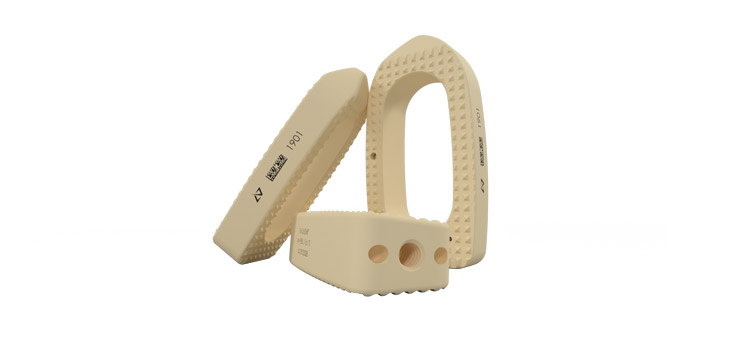
On June 25, 2019, the company announced that the FDA had cleared its LxHA™ Lateral Interbody Fusion Device, which according to FDA documents, “is intended to stabilize a spinal segment to promote fusion using bone graft, in order to restrict motion and decrease pain.”
The FDA found the device substantially equivalent to the company’s Box PEEK IBF System, which was cleared by the agency in 2012.
The System
The company states the system features a bullet shape nose, “for ease of insertion, a large central graft window for maximum graft packing capabilities, and pyramid shaped teeth that resist migration.”
FDA documents state the implant “features an open cavity in the interior geometry to accommodate bone graft and maximize bone through-growth, with anti-migration teeth to engage the vertebral endplates and prevent expulsion. The implants are offered in a variety of different sizes to fit the anatomical needs of a wide variety of patients, including 0°, 8°, 12°, and 16° of lordosis.”
The implant has a tapered leading edge, “which aids in implant insertion due to limited anatomical space. Reusable instruments to support Lateral Lumbar Interbody Fusion (LLIF) surgeries are provided with the implants in sterilization trays.”
The implants are manufactured using Invibio PEEK-Optima HA Enhanced. In this material, hydroxyapatite (HA) is integrated with Invibio’s PEEK-OPTIMA Natural. The LxHA implants are manufactured using HA PEEK and are to be sold sterile.
Company Sales VP Mike Wheelock said the system combined with the company’s new next generation retractor system launched later in 2019, “will provide the next disruptive clinically beneficial technology to the market.”
The company anticipates full commercialization later in Q3 2019.
Author
React:
Discussion
This is a fascinating development. In my practice we've seen similar outcomes with the revised protocol. The key differentiator seems to be patient selection criteria. Has anyone else noticed the correlation with BMI thresholds?
Great point. I'd push back slightly on the conclusion, the sample size in the cited study is too small to draw population-level inferences. That said, the directional signal is compelling and worth a larger RCT.
We implemented a similar approach last year. Early results are promising but we're still gathering 12-month follow-up data. Happy to share our protocol if anyone is interested.
Join the conversation
Orthopedic professionals are discussing this. Sign in and upgrade to read every comment and add your voice.