
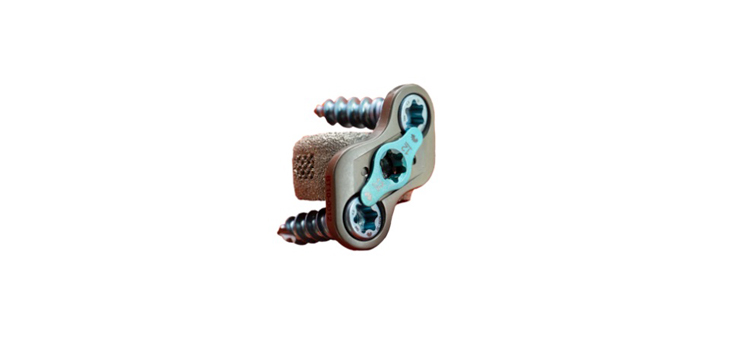
Knoxville, Tennessee-based ChoiceSpine LLC, has been given 510(k) clearance by the FDA to market its Tiger Shark C interbody device and the Boomerang Anterior Cervical Plate for use together or separately in cervical spinal fusion procedures.
FDA Clears ChoiceSpine Cervical Fusion System
2 min read Premium comments
#fda510kclearanceSecondary#choicespine#cervicalfusion
The company says the Boomerang is a “single-step screw blocking mechanism for fast insertion and fixation to the anterior cervical spine. The low-profile, offset design allows for stackability at adjacent levels and enhances visual confirmation of the cervical graft in the disc space. The system’s streamlined instrumentation facilitates a simplified surgical approach while providing excellent control during the procedure.”
The Tiger Shark, according to the company, “is a 3D manufactured, titanium alloy, cervical interbody device created with the trademarked BioBond technology. BioBond is an organic, porous interbody architecture designed for continuous porosity with an osteoconductive, hydrophilic surface.” The device is available in an assortment of heights with 6° of lordosis to accommodate different cervical anatomical requirements.
It took the agency a little over 3 months to determine the Boomerang was substantially equivalent to previously approved devices.
Eliminating Steps, Reducing OR Time
KC Gilbert, the company’s marketing and education vice president, said the instrumentation allows spine surgeons to simultaneously insert the Boomerang plate with the company’s cervical interbody devices, such as the Tiger Shark C or Stealth, “mimicking a stand-alone ACDF concept, eliminating surgical steps and reducing time in the operating room.”
Indications
According to FDA documents, the Boomerang is intended “for anterior fixation (C2-T1) for…degenerative disc disease, spondylolisthesis, trauma, spinal stenosis, deformities or curvature, tumor, pseudoarthrosis, and failed previous fusion.”
There is a warning that the device is not intended for screw attachment or fixation to the pedicles of the cervical, thoracic or lumbar spine.
The system consists of a variety of bone plates and screws made from stainless steels. The components are provided non-sterile and must be steam sterilized prior to use.
Mechanical testing was performed to demonstrate substantial equivalency to its predicate device, the DePuy Synthes Anterior CSLP System. The only noted difference to the predicate is that “only one screw is required to be placed in each adjacent vertebral body as opposed to two.”
ChoiceSpine is privately held by Altus Capital Partners.
Author
React:
Discussion
This is a fascinating development. In my practice we've seen similar outcomes with the revised protocol. The key differentiator seems to be patient selection criteria. Has anyone else noticed the correlation with BMI thresholds?
Great point. I'd push back slightly on the conclusion, the sample size in the cited study is too small to draw population-level inferences. That said, the directional signal is compelling and worth a larger RCT.
We implemented a similar approach last year. Early results are promising but we're still gathering 12-month follow-up data. Happy to share our protocol if anyone is interested.
Join the conversation
Orthopedic professionals are discussing this. Sign in and upgrade to read every comment and add your voice.