
“Detecting spine fractures is difficult due to the variability by which they present,” says Michael Braginsky, co-founder and CTO of Israeli-based Aidoc Medical, Ltd. The incidence of delayed or missed diagnosis of cervical spinal fractures (CSFs) has reportedly been found at between 5 and 20%.
FDA Clears 1st Artificial Intelligence System to Flag CT Images
2 min read Premium comments
#artificialintelligenceSecondary#neckpain#cervicalspinefractures
First AI System Flags Suspect CT Images of the Spine
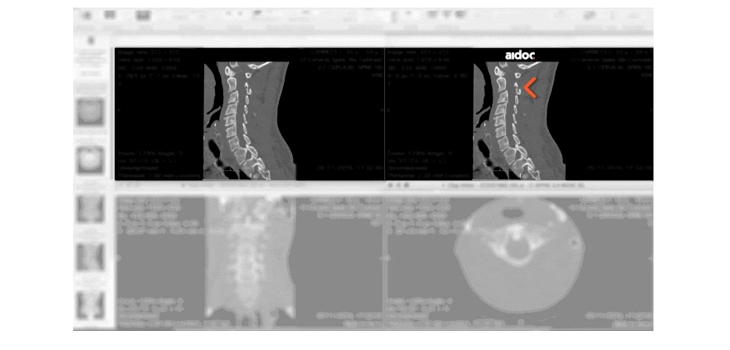
Braginsky said the company has created the world’s first AI (artificial intelligence) system to read and triage CT images of the spine in order to more accurately identify CSFs. On June 11, 2019, the company announced that it had received FDA 510(k) clearance for its AI engine, called BriefCase.
The company explained that radiologists are expected to interpret one image every 3-4 seconds just to keep up with their workloads. “By prioritizing suspected C-spine fracture cases in a radiologist’s worklist, Aidoc’s AI-powered triage automatically prioritizes critical cases, ensuring that they are diagnosed by a radiologist in the most timely manner,” stated the company’s press release.
According to the FDA filing documents, the device is intended “to assist hospital networks and trained radiologists in workflow triage by flagging and communication of suspected positive findings of linear lucencies in the cervical spine bone in patterns compatible with fractures. BriefCase uses an artificial intelligence algorithm to analyses images and highlight cases with detected findings on a standalone desktop application in parallel to the ongoing standard of care image interpretation.”
BriefCase
BriefCase’s “software system is based on an algorithm programmed component and is comprised of a standard off-the-shelf operating system, the Microsoft Windows server 2012 64bit, and additional applications, which include PostgreSQL, DICOM module and the BriefCase Image Processing Application. The device consists of the following three modules: (1) Aidoc Hospital Server(AHS); (2) Aidoc Cloud Server(ACS); and (3) Aidoc Worklist Application that is installed on the radiologist’ desktop “and provides the user interface in which notifications from the BriefCase software are received.”
“DICOM images are received, saved, filtered and de-identified before processing.”
The small black and white, unmarked images in the worklist have a caption that states, “not for diagnostic use” and is displayed as a preview function. The notification results in earlier triage by prompting the user to assess the relevant original images. “Thus, the suspect case receives attention earlier than would have been the case in the standard of care practice alone.”
Study Results
The company “conducted a retrospective, blinded, multicenter, multinational study with the primary endpoint to evaluate the software’s performance in identifying CTs containing cervical spine fracture in 186 cases from 3 clinical sites…” FDA documents note that “sensitivity and specificity exceeded the 80% performance goal. Specifically, sensitivity was 91.7% (95% CI: 82.7%, 96.9%) and specificity was 88.6% (95% CI: 81.2%, 93.8%).”
“The BriefCase time-to-notification for CSF was 3.9 minutes (95% CI: 3.8-4.1). In contrast, standard of care time-to-exam-open was much longer (58.4minutes: 95% CI 45.3-71.4).”
Author
React:
Discussion
This is a fascinating development. In my practice we've seen similar outcomes with the revised protocol. The key differentiator seems to be patient selection criteria. Has anyone else noticed the correlation with BMI thresholds?
Great point. I'd push back slightly on the conclusion, the sample size in the cited study is too small to draw population-level inferences. That said, the directional signal is compelling and worth a larger RCT.
We implemented a similar approach last year. Early results are promising but we're still gathering 12-month follow-up data. Happy to share our protocol if anyone is interested.
Join the conversation
Orthopedic professionals are discussing this. Sign in and upgrade to read every comment and add your voice.