
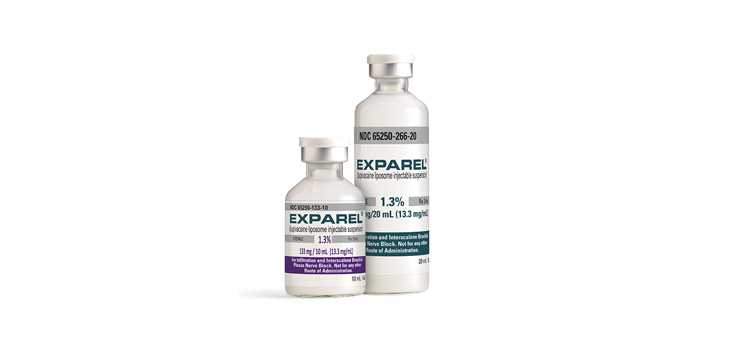
Pacira Biosciences, Inc., the producer of EXPAREL, recently released data from its Phase 3 study, “Brachial Plexus Block with Liposomal Bupivacaine for Shoulder Surgery Improves Analgesia and Reduces Opioid Consumption: Results from a Multicenter, Randomized, Double-Blind, Controlled Trial” which examined the efficacy and safety of EXPAREL (bupivacaine liposome injectable suspension) as a single-injection interscalene brachial plexus nerve block (ISNB) in patients undergoing total shoulder arthroplasty or rotator cuff repair.
EXPAREL in Shoulder Arthroplasty Patients: New Data
2 min read Premium comments
Secondary#totalshoulderarthroplasty#exparel#opioidconsumption
The data, which found that EXPAREL administered as an ISNB reduced pain and opioid use through 48 hours after surgery, was published in Pain Medicine on May 31, 2019.
EXPAREL uses DepoFoam technology to deliver bupivacaine over a certain period of time. The primary endpoint of the study was pain intensity scores through 48 hours; while, secondary endpoints included total postsurgical opioid consumption, percentage of opioid-free patients; and time to first opioid rescue.
One hundred and forty patients at 16 surgical centers in the U.S., Belgium and Denmark were included in the study. They were randomized to receive 133 mg of EXPAREL (n = 69) or a saline placebo (n = 71). Compared to the placebo group, the patients who were administered EXPAREL had lower pain scores and less need for postsurgical opioids (p < 0.0001).
There was also more opioid-free patients at both 24 hours (23% vs 1%, respectively; p < 0.0001) and 48 hours (13% vs 1%, respectively; p = 0.008) in the EXPAREL group, and the first use of rescue opioid was given at a median time of 4.2 hours with EXPAREL compared to 0.6 hours with placebo (p < 0.0001).
Manish Patel, M.D., FAAOS, orthopedic surgeon at Eastern Virginia Medical School in Franklin, Virginia, told OTW, “In this particular study we analyzed adults undergoing total shoulder arthroplasty or rotator cuff repair, and saw excellent safety and efficacy results. However, because this type of administration provides regional pain control only to the upper extremity of the body, a single-dose ISB is only effective for patients having upper arm surgeries. Further, EXPAREL is only approved for use in patients 18 years of age or older.”
He added, “Historically, clinicians seeking to provide their patients with regional pain control have been forced to choose between single-injection nerve blocks that do not last long enough to treat the first few days of postsurgical pain, or with longer-lasting continuous blocks that hinder patient mobility due to cumbersome catheters and pumps. The findings from this research demonstrate that a single-dose interscalene brachial plexus nerve block with EXPAREL can effectively treat postsurgical pain for several days without the need for any additional equipment that can slow patients down. Additionally, patients who received EXPAREL in this study saw a 78 percent decrease in their opioid requirements, meaning they were less likely to be overexposed to opioids and their unwanted and potentially severe side effects, which can also delay recovery.”
Pacira Biosciences, Inc., headquartered in Parsippany-Troy Hills, New Jersey, specializes in non-opioid pain management and regenerative health solutions.
Author
React:
Discussion
This is a fascinating development. In my practice we've seen similar outcomes with the revised protocol. The key differentiator seems to be patient selection criteria. Has anyone else noticed the correlation with BMI thresholds?
Great point. I'd push back slightly on the conclusion, the sample size in the cited study is too small to draw population-level inferences. That said, the directional signal is compelling and worth a larger RCT.
We implemented a similar approach last year. Early results are promising but we're still gathering 12-month follow-up data. Happy to share our protocol if anyone is interested.
Join the conversation
Orthopedic professionals are discussing this. Sign in and upgrade to read every comment and add your voice.