
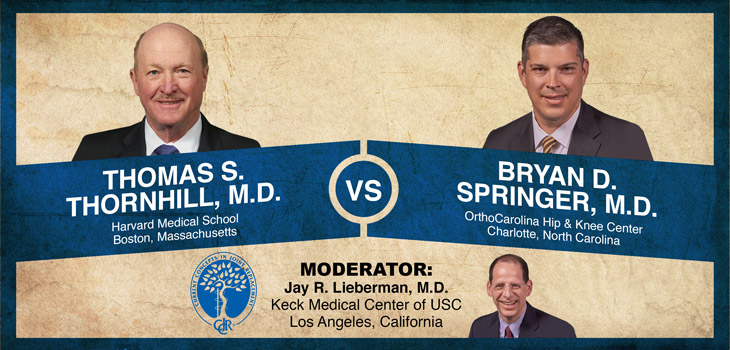
This week’s Orthopaedic Crossfire® debate was part of the 34th Annual Current Concepts in Joint Replacement® (CCJR®), Winter meeting, which took place in Orlando. This week’s topic is “Measured Resection Trumps Gap Balancing in TKA.” For is Thomas S. Thornhill, M.D., Harvard Medical School, Boston, Massachusetts. Opposing is Bryan D. Springer, M.D., OrthoCarolina Hip & Knee Center, Charlotte, North Carolina. Moderating is Jay R. Lieberman, M.D., Keck Medical Center of USC, Los Angeles, California.
Thornhill v. Springer: Measured Resection Trumps Gap Balancing in TKA
9 min read Premium comments
#gapbalancingGreat Debates#thomasthornhill#bryanspringer#measuredresection
Dr. Thornhill: Let me just tell you, it doesn’t really matter whether you do gap balance or measured resection. The techniques are often combined.
Bryan Springer is a former fellow, he’s a colleague, he’s a friend, he’s got a West Virginia connection, but Bryan, I am going to beat you like a rented mule. Because there’s not much difference between the two.
Measured resection, you’re doing the distal femur, the chamfers, the proximal tibia and the patella. The only real difference is determining femoral rotation. I use measured resection for doing that and part of it is the fact that I am a cruciate retainer. So, I maintain the joint line, reproduce more normal kinematics, easier soft tissue balance and, to me, it’s an easier workflow.
Gap balancing has a different work sequence. You have to remember when you cut the cruciate, you open up the flexion space and it needs to be 2mm smaller. And the extension mechanism plays a very key role in flexion. But I use gap balancing in almost every revision situation.
The first thing you need to do in measured resection is to assess the character of the knee. Is it tight? Is it loose? Does it have a flexion contracture? Is it varus, valgus, correctible or over correctible?
In a valgus knee, relatively loose, almost comes into a full extension, but if it’s got laxity on the medial side, you don’t do a big medial resection…in fact, I’ll leave a little bit of the meniscus just to get into the right arena.
I then do the preliminary soft tissue balance based on the resection I made, the soft tissues, and I cut the femur by measured resection.
And yes, you do tend to take off less so you don’t elevate the joint line because you’ve maintained the flexion space with the PCL [posterior cruciate ligament].
Now rotation. This is where the difference is. I do it based on landmarks. And I’ve used a posterior axis—doesn’t work very well on valgus knees—I’ll use the epicondyle…sometimes hard to find…I tend to use the transtrochlear line, or Whiteside’s line, but it’s not always from the top of the notch to the bottom of the trochlea, but rather a combination.
All component systems have different sizers. If I have a varus knee and I’ve done my cut, if I put a spacer in there, I am still way too tight on the medial side of the knee because I haven’t cleared everything out. What I will then do is look at the posterior cruciate, which is the lateral ligament of the medial side of the knee, where rotation occurs.
But remember the lateral space in flexion is looser so you never truly get a flexion space that’s equal.
The tibial cut is a measured resection cut. The patella cut is a measured resection cut. I do a final soft tissue balance. You can do it with the trial components, which I do. You can, if you want, look at spacers as long as you have a check.
I don’t think they’re that much different. You check the flexion. You must get into full extension and then flexion to gravity will tell you, once the capsule is closed, that the extension mechanism is clearly back in place. This will now tell you roughly what you’re going to aim for for post-operative flexion.
So, I use measured resection in primary total knee because I am a cruciate retainer. I think it’s easier for me. I think it actually helps balance the flexion space and it’s an easier workflow.
Bryan, there’s a movie coming out, in which I starred, called Total Kneecall and it will be coming to a theater in Charlotte within the next several years and I will get you a free ticket.
Dr. Springer: I do have to admit this is a really difficult, intimidating situation to have to come up and debate one of the most influential mentors in your career. It always leaves me with a little bit of a lump in my throat to try to figure out how to approach that.
We had many long conversations when I was a fellow about the wisdom of measured resection and he was such an influential mentor that as soon as I left the Brigham, I immediately started doing gap balancing as my preferred technique for total knee arthroplasty.
But, I think he’s right. I think our goals are really aligned in what we’re trying to achieve with total knee arthroplasty, but I think the technique remains controversial and I think it’s interesting for debate to be a pure gap balancing side and a pure measured resection side.
But I think we all kind of blend somewhere in the middle.
I think that’s what is appealing to me about gap balancing, it’s really a step-wise sequential approach. I tend to put my underwear on before I put my pants on.
Where we’ve really differed though is how we look at, evaluate and set femoral component rotation.
In gap balancing, we’re going to do this based on ligament tension to create a symmetric flexion gap.
In measured resection the rotation is really based on your ability to accurately locate those bony landmarks.
I contend this makes the difference between an A student and a C student.
So, again it’s a step-wise approach. We cut the distal femur. We cut the proximal tibia and we balance the knee in extension. Once we’ve achieved that balance in extension, our goal is creating that rectangle through a series of releases in extension.
Then we want to match that in flexion. You can use a tensioner. You can use lamina spreaders. You can use spacer blocks. The concept is still the same. You put symmetric tension on your ligaments in flexion. That you rotate the femoral component to create that symmetric flexion gap and then you match your extension gap.
One of the biggest issues you have to understand with this technique, no matter which technique you do, is that those releases that you do in extension very clearly have an effect on the medial side of the knee in flexion. That’s particularly true depending on what and when you release.
You can release in extension if we’re tight on the medial side. Our releases are mainly going to focus on bone, osteophyte and the posterior medial corner of the knee. If you aggressively release down into that superficial MCL [medial cruciate ligament] you’re going to create medial-sided laxity on the knee. This is not an uncommon scenario that oftentimes you will find when you over-release the superficial MCL.
I think there are issues with using fixed bony landmarks for femoral rotation. There’s significant difficulty in accurately and reproducingly finding them every single time. This leads to substantial variations in rotation, sizing and gap symmetry, and oftentimes can lead to arguments in the operating room.
Let’s just look at those landmarks from studies.
Transepicondylar axis…remember these are all ranges and averages based off of studies. Within 3 degrees only 75% of the time. The AP axis, up to a 32-degree range of error in femoral component rotation.
Using solely the posterior condylar axis, particularly in the valgus knee. Inaccurate 30-45% of the time. And what you gain from all of these curves is that using bony landmarks generally gets it right about 70% of the time in most knees. And that’s why really the bible of measured resection is the bell-shaped curve.
In West Virginia or at Harvard, that is still a C in my book.
If we look at just a couple of studies that are out there…this is one from our group (Fehring et al, CORR 2000)…100 consecutive posterior stabilized total knees, two techniques compared, measured resection and gap balancing. Rotational errors greater than 3 degrees were present almost half the time when bone landmarks were utilized.
And then Doug Dennis’ work (CORR 209) looking at femoral condylar lift-off—and I do agree with what Dr. Thornhill said about the differences between PS and CR for the most part—that a PS gap balanced total knee results in less condylar lift-off when you’re using a gap balancing technique.
I think our goals are the same regardless of the technique that you use. But the surgeon’s ability to accurately locate important bony landmarks still remains limited and can lead to rotational errors and imbalance in flexion. And that gap balancing, at least in my hands, can reliably and reproducibly produce a more balanced knee.
And there is also another movie that was just released. The most recent “Star Wars” and it addresses the issue of gap balancing. I think you’ll see that the force is strong with gap balancing.
Moderator Lieberman: Tom, let’s say a bad rheumatoid or a patient just has PCL insufficiency and so, you have to use a PCL sacrificing knee. What technique do you use when you do that? Similar techniques, similar flow?
Dr. Thornhill: Oh yeah, no, no, no, no. Yes. My increase in PS knees from the past year has actually doubled. I’ve done two this year. (laughter) The one thing that we didn’t talk about…the PCL, the ACL. I know Adolph said 65% of the people with total knees have an intact ACL. That’s not been my experience. ACL’s intrasynovial. The PCL is extrasynovial. It’s even intact in rheumatoids because it’s outside the synovium. So, yes, I use the same gap balancing technique because you can do it in a PCL sacrificing…
Moderator Lieberman: You mean measured resection technique.
Dr. Thornhill: No, no. I do gap balancing if I do a PS. And I do the same with revision. You can’t do it in a CR like in a tight varus knee as I demonstrated. And by the way, when Bryan left, we did tell him to look for some other way to do a total knee. (laughter) He’s a terrific surgeon. He’s a great guy and he had the foresight to marry a wonderful woman from West Virginia, so that’s our connection.
Moderator Lieberman: Bryan, one of the issues when you’re doing the gap balancing technique is that sometimes, let’s say, you have a bad varus knee. The lateral soft tissues are really stretched out, and so it seems like when you put the lamina spreader in there you can spread it out. How do you manage that? I think that’s one of toughest things when you’re doing the gap balancing technique. Because you’re really not gap balancing completely. You want to go through that because I think that’s important for the audience.
Dr. Springer: Sure. The issue is how far do you take your medial release until you get to the point where you’ve made the medial side of the knee incompetent. Even in most bad varus knees, you can release the posterior medial corner. You can medially reduce the tibia. You can remove all the osteophytes. And in the majority of cases you are able to catch up in that situation. I think that the issue you get into is when you over-release, people immediately go for the superficial MCL and then they create that medial-sided laxity.
The unanswered question is how much laxity you will accept on the lateral side of the knee. I think as Dr. Thornhill mentioned there is some inherent lateral laxity that’s more than the medial side of the knee and maybe one of the disadvantages of gap balancing is you tend to probably over-release trying to create that symmetry that you want. I like to put my knees in very tight, so I don’t like to see a lot of laxity on the medial or the lateral side. And I tend to try and shy away from techniques like aggressively pie-crusting and things like that. It gets to the issue of how much laxity you’ll allow on the lateral side of the knee.
Moderator Lieberman: Thank you very much. Superb job gentlemen.
Please visit www.CCJR.com to register for the 2019 CCJR Winter Meeting, – December 11 – 14 in Orlando.
React:
Discussion
This is a fascinating development. In my practice we've seen similar outcomes with the revised protocol. The key differentiator seems to be patient selection criteria. Has anyone else noticed the correlation with BMI thresholds?
Great point. I'd push back slightly on the conclusion, the sample size in the cited study is too small to draw population-level inferences. That said, the directional signal is compelling and worth a larger RCT.
We implemented a similar approach last year. Early results are promising but we're still gathering 12-month follow-up data. Happy to share our protocol if anyone is interested.
Join the conversation
Orthopedic professionals are discussing this. Sign in and upgrade to read every comment and add your voice.