
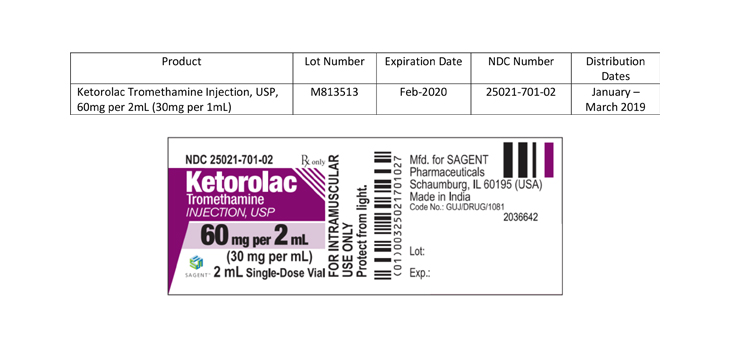
The Food and Drug Administration (FDA) announced May 1 that one lot of the injected form of the analgesic Ketorolac Tromethamine, in 60mg/2mL (30mg per mL) being recalled nationwide by Sagent Pharmaceuticals, Inc. because of heightened concerns of the risk of blood infections which could cause septic shock and possible death.
Single Lot of Injectable NSAID Recalled
2 min read Premium comments
#fdaSecondary#ketoroiactromethamine#recall
The affected lot number, M813513, dated February 2020, NDC number 25021-701-02, was distributed by Sagent from January to March 2019.
“This product was manufactured by Zydus (Cadila Healthcare Limited) and distributed by Sagent Pharmaceuticals, Inc. Sagent has initiated this voluntary recall of Ketorolac Tromethamine Injection, USP to the to the user level due to microbial growth detected during a routine simulation of the manufacturing process, which represents the potential introduction of microorganisms into the products,” FDA said.
“Adult patients administered the product intravenously are at most risk of a serious bloodstream infection of sepsis.”
“Ketorolac Tromethamine Injection, USP, is a nonsteroidal anti-inflammatory drug (NSAID), is indicated for the short-term (up to 5 days in adults), management of moderately severe acute pain that requires analgesia at the opioid level.”
Sagent Pharmaceuticals said customers “have been instructed to examine their inventory immediately and to quarantine, discontinue distribution of and return the recalled lot of product.”
Any wholesaler or bulk buyer, such as a hospital, which has further distributed the affected lot product should immediately notify their customers of the product recall, and any provider with the product should cease its use immediately and return it, Sagent said.
“Consumers/distributors/retailers that have product which is being recalled should stop using product and return the recalled product. The necessary form by which to document this information as well as other information regarding this recall is available at www.Sagentpharma.com.
Buyers with questions about returning unused product, contact the Sagent customer call center at (866) 625-1618 M-F, 8am-7pm CST.
“Healthcare workers who have medical questions about Ketorolac Tromethamine Injection, USP, may contact Medical Affairs (866-625-1618, Option 3) M-F, 8am-5pm CST. Consumers should contact their physician or healthcare provider if they have experienced any problems that may be related to taking or using this product,” the company said.
Adverse reactions or quality problems experienced with the use of this product may be reported to the FDA’s MedWatch Adverse Event Reporting with the form available at this page or by calling 1-800-332-1088 to make a report by phone or to request a reporting form, then returning the form to the address on the pre-addressed form, or by fax to 1-800-332-0178.
Sagent Gives Wrong Web Address to Report Adverse Events
The Sagent Pharmaceuticals announcement gave incorrect information on where to report problems. The release said xxx.fda.gov/medwatch/report.htm is an online reporting form and that mail or fax forms can be downloaded at xxx.fda.gov/MedWatch/getforms.htm. Both are nonexistent pages (Note: the “xxx” was inserted in place of “www” so that word processing wouldn’t automatically turn them into live URLs).
The Sagent form does give the correct telephone numbers; we called and listened to the recording for this news report.
Ketorolac Tromethamine is used as an adult-only postoperative injection, sometimes followed by the pill form for up to five days, as an alternative to opioids. The pill form and other lots of the injectable are not affected by the recall.
The full text of the recall is available at this web page. But again, please note that the reporting web pages are incorrect.
Author
React:
Discussion
This is a fascinating development. In my practice we've seen similar outcomes with the revised protocol. The key differentiator seems to be patient selection criteria. Has anyone else noticed the correlation with BMI thresholds?
Great point. I'd push back slightly on the conclusion, the sample size in the cited study is too small to draw population-level inferences. That said, the directional signal is compelling and worth a larger RCT.
We implemented a similar approach last year. Early results are promising but we're still gathering 12-month follow-up data. Happy to share our protocol if anyone is interested.
Join the conversation
Orthopedic professionals are discussing this. Sign in and upgrade to read every comment and add your voice.