
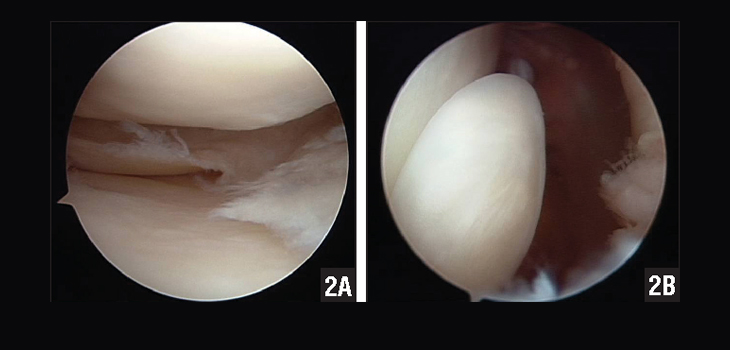
A team of researchers from Rush University Medical Center and Loma Linda University Medical Center analyzed data from 269 patients who’d been treated with arthroscopic partial meniscectomy and collated the outcome results at 6-7 months after surgery.
Only 50-68% of Partial Meniscectomy Patients Satisfied
1 min read Premium comments
Secondary#arthroscopicpartialmeniscectomy#pass#patientacceptab lesymptomaticstate
Their work, “Factors Associated With Clinically Significant Patient-Reported Outcomes After Primary Arthroscopic Partial Meniscectomy,” appears in the May 2019 edition of Arthroscopy.
Nikhil Verma, M.D., an orthopedic surgeon at Midwest Orthopaedics at Rush in Chicago and study co-author explained the rationale for the study to OTW, “In the era of value-based care, one critical component is to establish how long patients should be followed after surgery to determine their outcome. This study sought to look at how long it takes for patients to demonstrate clinically meaningful improvement after partial meniscectomy.”
To tease out the answer, the study investigators tapped into an institutional patient registry and reviewed retrospective data for all patients who were being treated with isolated arthroscopic partial meniscectomy from 2014 through 2017. The investigators than calculated for each patient the minimal clinically important difference, the substantial clinical benefit and patient acceptable symptomatic state using International Knee Documentation Committee (IKDC) and Knee Injury and Osteoarthritis Outcome Score (KOOS) scoring systems.
The investigators concluded that: “Practical findings include the fact that 2/3 of patients who will achieve a clinically significant outcome will do so by 6 months, 95% by one year.”
“For orthopedic surgeons, one important take-home message is that only 50-68% of patients reach a patient acceptable symptomatic state after partial menisectomy and as a field we need to continue to evaluate the appropriate indications for this procedure.”
Author
React:
Discussion
This is a fascinating development. In my practice we've seen similar outcomes with the revised protocol. The key differentiator seems to be patient selection criteria. Has anyone else noticed the correlation with BMI thresholds?
Great point. I'd push back slightly on the conclusion, the sample size in the cited study is too small to draw population-level inferences. That said, the directional signal is compelling and worth a larger RCT.
We implemented a similar approach last year. Early results are promising but we're still gathering 12-month follow-up data. Happy to share our protocol if anyone is interested.
Join the conversation
Orthopedic professionals are discussing this. Sign in and upgrade to read every comment and add your voice.