
Retired Navy Captain Dana C. Covey, M.D. was recently presented with the 2019 William W. Tipton, Jr., M.D., Leadership Award from the American Academy of Orthopaedic Surgeons (AAOS) at the organization’s annual meeting. The award honors the late William W. Tipton, Jr., M.D., an orthopaedic surgeon, educator and former AAOS chief executive officer.
Navy Captain Dana C. Covey, M.D. Wins Tipton Leadership Award
2 min read Premium comments
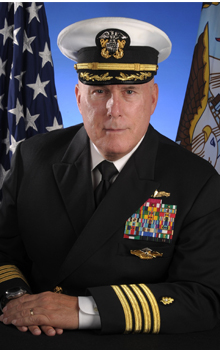
A 40-year veteran of the U.S. Navy, Dr. Covey is the former chairman of the Department of Orthopaedic Surgery at Naval Medical Center, San Diego and is currently Clinical Professor at the University of California San Diego.
Captain Matthew T. Provencher, M.D., an orthopedic surgeon and professor at the Uniformed Services University of the Health Sciences who calls Dr. Covey his mentor, colleague and leader, explained: “Captain Covey’s contributions have had a profound long-term and impactful effect on the science and art of military and trauma orthopaedics. He has dedicated a lifetime to transcending the international borders of military and civilian trauma care. His work has saved many lives.”
According to AAOS, “Dr. Covey pioneered changes in orthopaedic care delivered in war and disaster zones, pioneering life-saving orthopaedic trauma principles and sparing patients from amputation. He conceived, developed and fielded a transportable surgical suite that is used at sea in the Navy today.”
“He played a crucial role in developing a process to treat the wounded closer to the front lines, increasing the odds of receiving care during the ‘golden hour’—the window after a traumatic injury when getting treatment is most likely to prevent death. He also personally helped create a portable external fixator device for use in austere environments that has been adopted by both wartime orthopaedics and disaster relief/humanitarian assistance worldwide.”
Regarding how the process of improving wounded soldier treatment evolved during his career, Dr. Covey told OTW, “It began to evolve in 2003 during the initial stage of the Iraq War when military surgeons documented that the survival rate for wounded service members who reached far forward surgery teams was very high, and that most ultimately survived their wounds.”
“Relative miniaturization of medical and surgical equipment for field use allowed tent-based forward surgical teams to move and set up more quickly than was the case in the first Gulf War (Operation Desert Storm). The evolution in far forward emergent care of injured service members continues to this date with new treatment protocols, equipment and training.”
Dr. Covey led the effort to build the Department of Defense’s most advanced medical training facility.
“Training and education to enhance orthopaedic surgeons’ readiness to treat combat casualties has been multifaceted. As the Orthopaedic Consultant to the Navy Surgeon General, I was part of a team effort to establish training for Navy orthopaedic surgeons at a designated civilian Level I trauma center.”
“Also, as a member of the board of directors of the Society of Military Orthopaedic Surgeons, I worked with others to develop a military extremity trauma course to enhance the training of battlefield deployers from all services. Furthermore, we were awarded a multi-million-dollar grant to re-engineer a large space at Naval Medical Center, San Diego into a state-of-the-art surgical training lab that is used by surgeons to refresh their damage-control orthopaedic skills prior to deployment.”
Author
React:
Discussion
This is a fascinating development. In my practice we've seen similar outcomes with the revised protocol. The key differentiator seems to be patient selection criteria. Has anyone else noticed the correlation with BMI thresholds?
Great point. I'd push back slightly on the conclusion, the sample size in the cited study is too small to draw population-level inferences. That said, the directional signal is compelling and worth a larger RCT.
We implemented a similar approach last year. Early results are promising but we're still gathering 12-month follow-up data. Happy to share our protocol if anyone is interested.
Join the conversation
Orthopedic professionals are discussing this. Sign in and upgrade to read every comment and add your voice.