
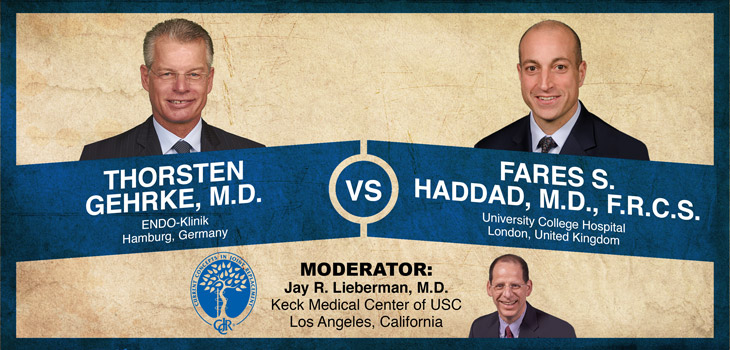
This week’s Orthopaedic Crossfire® debate was part of the 34th Annual Current Concepts in Joint Replacement® (CCJR®), Winter meeting, which took place in Orlando. This week’s topic is “The Hinge: Prerequisite Solution for the Infected TKA.” For is Thorsten Gehrke, M.D., ENDO-Klinik, Hamburg, Germany. Opposing is Fares S. Haddad, M.D., F.R.C.S., University College Hospital, London, United Kingdom. Moderating is Jay R. Lieberman, M.D., Keck Medical Center of USC, Los Angeles, California.
Gehrke v Haddad: The Hinge: Prerequisite Solution for the Infected TKA
8 min read Premium comments
Great Debates#fareshaddadmd#thorstengehrke
Dr. Gehrke: Let’s bring Fares, let’s bring Brexit negotiations to the next and hopefully a better level, a good end and a good result that means that you pay the bill for your crazy decision.
Periprosthetic joint infection (PJI) in total knee arthroplasty [TKA] as we all know is probably the most serious complication and it’s always, almost always associated with really severe soft tissue involvement. To treat this kind of complication, we have to be radical. Radical in our debridement. That’s rule number 1 in septic surgery. We have to be radical, very similar to an oncologic surgeon.
The choice of our implant. The re-implant, it’s all depending on the stabilizing structures—I mean ligaments mainly. According to Adolph Lombardi’s algorithm if the MCL is gone, we should think about a hinge knee. Also, if you have non-correctable varus/valgus instability or flexion/extension gap mismatch, the recommendation is to use a hinge.
In a quite simple 1-stage case. There wasn’t a severe infection…not very viral. Even so, during debridement you have to harm it quite radically and it ends up in a situation with the loss of the medial collateral ligament. You address the infection radically, the collateral ligaments are involved, and when you look at the debridement of the posterior capsule, you see that there is an absolute mismatch between the extension and flexion gaps.
We cannot correct this flexion gap without using a hinge knee.
Even in a 2-stage revision, we have the same situation. There is no difference in the infection and the involvement of the soft tissue. Where are the ligaments that are stabilizing the knee? They are all gone. The solution, in my opinion, is…and we do it at the ENDO-Klinik almost exclusively…. implantation of a hinge knee. Because we have no ability to stabilize the knee otherwise.
Another argument for a hinge knee—a strong argument—is it’s easy. It’s a very simple procedure. You don’t need so many instrument trays as with a CCK design. Just one tray is enough. And with only one tray I can solve with a hinge knee all the infections that I showed you—even the 2-stage. It’s an easy procedure that everybody can perform quite simply.
And to cite only one paper in this talk. And this is Fares’ paper (CORR 2010), where he compared the outcome of revisions using a Posterior Stabilized design, a condylar constrained design, and a rotating hinge design. For me, not surprising, the results were that the rotating hinge group had the highest satisfaction rates. The overall 10-year survivorship was 90.6% with the highest survivorship seen in the rotating hinge group. And then they analyzed the complications. In the hinge group they had much less complications.
I like to implant a hinge if I have an infection. For me it’s logical and the patients are really satisfied with this solution.
Mr. Haddad: Thanks again to Seth for a great meeting and the opportunity to reawaken European debate.
Now you all understand what brings this all about. The Germans have made a rule that we have to put hinges in everyone. And as a result of that, we being rational Brits, have worked out that that is not necessary and therefore we will exit Europe at any cost. (laughter)
The reality is that we are not radical. We are rational. Seth, I knew Thorsten would quote this paper and, of course, we use hinges, but we use hinges in selected patients where appropriate and because we’ve learned from Thorsten and others we can make them work extremely well.
Don’t get me wrong. Thorsten’s a charming, good-looking, impressive man. How many people have a gym in their office? There are women queuing up to have their picture taken with Thorsten. But there was a day when Thorsten realized that the knee is not a hinge. It has condyles. And you can balance it.
So, the principles of revision are straightforward. We definitely have to be surgically radical and there is no doubt the ENDO-Klinik led the way by being very aggressive and using hinge implants.
But the reality is that hinges don’t always go well, and the salvage is very difficult to come back from. We have a very established infection service doing a large number of single-stage revisions, but we use hinges less than 25% of the time. And we’re not crazy.
The reality is, it’s all about the debridement. And I have to keep telling Thorsten, debridement is not ablation. Looking at the MCL doesn’t mean you have to remove it. It’s nice to have a cancer analogy, but that principle is to debride what you need to debride and then let somebody else reconstruct and it doesn’t stop you from debriding too much. You must really debride well and try to preserve knee balance.
Because there are several phases to debridement and it’s not just a question of cutting everything that you can see. It’s surgical. It’s mechanical. It’s chemical. And there are other methods.
Of course, we expose, we explant, we excise the membrane very much as Thorsten showed you, and there are occasions when you just have to take it all out and some kind of hinge or tumor implant is needed. But if you correct and ream properly; if you use pulse lavage effectively; use hydrogen peroxide to really clean those surfaces and then add in chemical debridement, you’ve got every chance of retaining tissues that give you a knee that you can reconstruct.
We do this effectively and we try and retain some of the soft tissue envelope and preserve the collaterals so we can reconstruct a knee that looks like a knee replacement.
The other concern that people cite for using hinges is bony deficiency. We now have zonal fixation particularly with cones, which means we can reconstruct without having to go to a long-stemmed hinge. So, we’ve got different, varying, evolving forms of metaphyseal fixation that really allow us to take difficult situations and reconstruct without having to rely on long stems. Because a knee is not a hip and if you just use stems for fixation as we do the hinge, you will occasionally run into trouble.
So, we reconstruct rather than replacing. We try and fill the bone. Here’s a scenario where you might be really tempted to think that a hinge would work in an infected knee with a periprosthetic fracture, a collapsed tibia…all sorts of reasons just to bail out and do a radical solution.
But the reality is if you debride; if you clean, you can come back and then reconstruct the metaphysis and you can get to a stage where you can reconstruct with a stabilized condylar knee without necessarily having to apply a radical solution.
Some basic principles: preserve the epicondyles, where you can—of course, if they are infected you take them away. Cones to improve zone 2 fixation. Cemented stems with antibiotic-loaded cement. That way you get a better joint line restitution. We think we improve function. We avoid burning bridges. And I suspect in the long run, it’s cheaper.
Of course, we use hinges, but they are a salvage device. Because hinges have problems. It’s tough to control the patellofemoral joint and get tracking so we base our choice on collaterals and balancing rather than going to one solution for everybody. That probably gives us more options in terms of biomechanics and functions.
Moderator Lieberman: Thorsten, I’ll start with you. Does everybody get a hinge for infection?
Dr. Gehrke: Almost everybody. We have our standards and our debridement is also standardized. Of course, Fares is right when he says that not every infection needs a hinge knee, but I love standards in our hospital, and this is one of the reasons why we put it in because our debridement is so radical.
Moderator Lieberman: Just to clarify…all age groups, even if you have a 45- or 50-year-old, they’d still get a hinge?
Dr. Gehrke: Yes.
Moderator Lieberman: And when that patient asks; “How long do you think this knee is going to last?” What do you tell them?
Dr. Gehrke: Nobody can estimate. I would say 15-20 years.
Moderator Lieberman: Fares, can you go into a little bit of more detail about what a chemical debridement is?
Mr. Haddad: Absolutely. The one that we tend to use is acetic acid. The idea being to put something in there chemically that is also removing biofilm, that is also reducing the bioburden during your treatment. Because the reality is none of us know how much to take. What is a radical debridement? Where the hell do you stop? So, we try and stop the vascularized tissue, we then go through repeated washout and curettage process. We then put whatever chemicals we can, starting with Betadine and acetic acid, to reduce the bioburden to a point where we are safe to reconstruct.
Moderator Lieberman: What’s the acetic acid concoction?
Mr. Haddad: It’s Surgihoney.
Moderator Lieberman: Then you use the diluted Betadine?
Mr. Haddad: We use diluted Betadine routinely anyway.
Moderator Lieberman: Thorsten, you have tremendous experience with managing these patients with a hinge. Any pearls with respect to post-operative management after they put the implant in?
Dr. Gehrke: The course of management is easy. We allow them full weight bearing and they can flex as much as they can. But regarding bony deficiencies, we are doing the same, even when we use the hinge knee we reconstruct, even in the 1-stage, with trabecular metal cones. But this is more…bony deficiencies is, for me, an argument for hinges because if you see the very fragile condyles after the removal of the former prosthesis, then the danger that the collaterals are gone is quite high.
Moderator Lieberman: Finally, Fares, very quickly, how about prolonged oral antibiotics after reimplantation. Where are we with that?
Mr. Haddad: Typically, we are going to 3 months after reimplantation. It’s generally monitored by our I&D guys and it’s based on nutritional markers and the general response of the patient. I think the times are getting longer and longer, partly based on Craig Della Valle’s multi-center data. But I can tell you that we are going a minimum of 3 months now.
Moderator Lieberman: Thank you gentlemen for a terrific session.
Please visit www.CCJR.com to register for the 2019 CCJR Winter Meeting, – December 11 – 14 in Orlando.
React:
Discussion
This is a fascinating development. In my practice we've seen similar outcomes with the revised protocol. The key differentiator seems to be patient selection criteria. Has anyone else noticed the correlation with BMI thresholds?
Great point. I'd push back slightly on the conclusion, the sample size in the cited study is too small to draw population-level inferences. That said, the directional signal is compelling and worth a larger RCT.
We implemented a similar approach last year. Early results are promising but we're still gathering 12-month follow-up data. Happy to share our protocol if anyone is interested.
Join the conversation
Orthopedic professionals are discussing this. Sign in and upgrade to read every comment and add your voice.