
Boston, Massachusetts and Misgav, Israel-based scoliosis correction company, ApiFix Ltd. has announced the completion of its Series B equity financing which will allow it to prepare for commercial efforts in the United States.
Deformity Implant Mfg ApiFix Closes 2nd Round of Funding
1 min read Premium comments
Secondary#scoliosis#apifix#minimallyinvasivedeformitycorrection
The financing was led by Palm Tree IV, a United States investor. Paul Mraz, CEO for ApiFix Ltd., said, “We are extremely pleased to have Palm Tree IV as our new partner leading this round of financing as we work toward FDA approval this year and prepare for U.S. commercialization of our MID-C System [minimally invasive deformity correction]. It allows us to stay focused on our mission, which is to ‘change the lives of scoliosis patients forever.’”
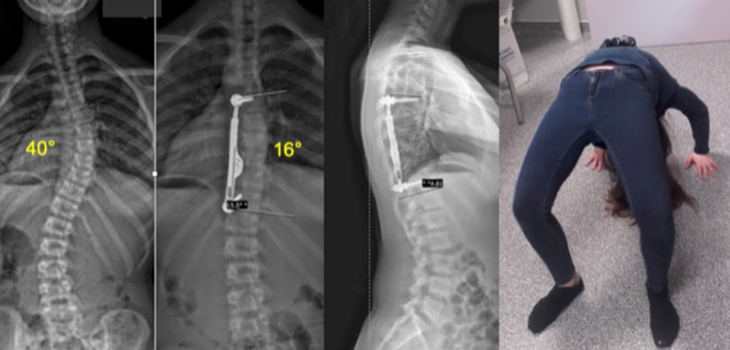
ApiFix Ltd. is the developer of the Minimally Invasive Deformity Correction (MID-C). The MID-C is a posterior dynamic deformity correction system that allows surgeons to provide permanent curve correction while retaining spine flexibility. This is done via a minimally invasive surgery. ApiFix Ltd. says patient recovery is “relatively pain-free and is measured in days, not months.”
The MID-C system works by acting as an “internal brace.” It has a patented unidirectional, self-adjusting rod mechanism and motion-preserving polyaxial joints, which allows additional post-operative correction over time. The system is also removable.
“Significant clinical data from treating patients over the past seven years demonstrates the clinical benefits of our less-invasive, non-fusion deformity correction system,” said ApiFix co-founder and Chief Medical Officer, Yizhar Floman, M.D. “We are excited to be on the cusp of broadly introducing a game-changing, patient-friendly treatment into the lives thousands of children and their families.”
The MID-C system has CE Mark approval and is available in Europe, Israel, Singapore and Canada.
Mraz told OTW, “Reviews of the extensive clinical experience with the MID-C system thus far, and our ongoing collection of data continue to underscore ApiFix’s positive results realized in patients with progressive spinal deformity. ApiFix and MID-C represent a game-changing opportunity for a meaningful percentage of AIS patients and families and a viable alternative to irreversible fusion procedures. We look forward to making this technology more widely available worldwide.”
Author
React:
Discussion
This is a fascinating development. In my practice we've seen similar outcomes with the revised protocol. The key differentiator seems to be patient selection criteria. Has anyone else noticed the correlation with BMI thresholds?
Great point. I'd push back slightly on the conclusion, the sample size in the cited study is too small to draw population-level inferences. That said, the directional signal is compelling and worth a larger RCT.
We implemented a similar approach last year. Early results are promising but we're still gathering 12-month follow-up data. Happy to share our protocol if anyone is interested.
Join the conversation
Orthopedic professionals are discussing this. Sign in and upgrade to read every comment and add your voice.