
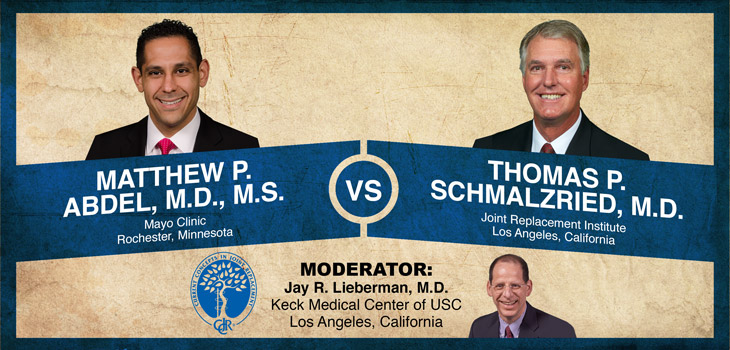
This week’s Orthopaedic Crossfire® debate was part of the 34th Annual Current Concepts in Joint Replacement® (CCJR®), Winter meeting, which took place in Orlando. This week’s topic is “Abdel v. Schmalzried: The Cementless Knee: Emergent Game Changer.” Affirming is Matthew P. Abdel, M.D., M.S., Mayo Clinic, Rochester, Minnesota. Opposing is Thomas P. Schmalzried, M.D., Joint Replacement Institute, Los Angeles, California. Moderating is Jay R. Lieberman, M.D., Keck Medical Center of USC, Los Angeles, California.
Abdel v. Schmalzried: The Cementless Knee: Emergent Game Changer
8 min read Premium comments
Great Debates#matthewabdel#cementlessknee#thomasschmalzried
Dr. Abdel: I’m going to talking about the cementless knee in the affirmative.
We’re all aware that the literature for cemented total knee replacements reports good long-term results with 90% survivorship at 15 years. However, if you really look at that, we’re talking about patients over 65 years of age, usually females, BMI [body mass index] under 30 and not highly active.
Today, this is not our patient population and we need long-term biologic fixation.
There are multiple differences in our patient populations compared to this historical, institutional and registry-based information. Our patients are younger, more active and living longer. Obesity is a worldwide epidemic. The CDC reports that the United States by the year 2030, 51% of the U.S. population will be considered obese.
That is not what the reported literature is discussing.
Finally, why the longevity differences between hip and knee? In North America, hip uncemented components are standard, but not in the knee. I would contend that, today, we have different materials, manufacturing, and designs that allow us to have cementless fixation in the knee.
Why is cementless fixation in the knee attractive? Multiple reasons. First, our patients are younger and we need improved longevity. Second, obesity is here and it’s only going to increase. And finally, cost. The decreased operative time and supplies help your workflow and save money.
Why now? We’ve had innovations like highly porous metals, designs that focus on the keels and pegs for biologic fixation with rigid initial fixation, and 3D printing that allows us to do this more precisely, more accurately, and more reliably.
So, let’s go through some of these points in greater detail.
Longevity. I’ll draw your attention to one article by Nakama, et al. (Cochrane Database Syst Rev 2012); 5 randomized controlled trials (RCT) in 297 patients. The risk of future aseptic loosening with cementless fixation was half of cemented fixation. One study included Ritter and Meneghini (J Arthroplasty 2010) with a 20-year survivorship of 98% for cementless fixation. Multiple studies with 98% survivorship at 10-20 years, with historical designs reporting 95% survivorship.
What about cemented fixation? Our own internal Mayo Clinic data shows that cemented fixation starts out great but decreases over time to 80% at 20 years in thinner, less active patients. In the Australian National Joint Registry, at 5, 6 and 7 years you can see increased loosening and lysis in young patients. A disaster.
Contemporary implant designs can mitigate this. We looked at a Level I clinical trial completed between 2003 and 2006 which took a randomized look at cemented modular, uncemented monoblock and cemented monoblock designs (Pulido, et al. CORR 2015). The data showed no difference in survivorship at 5 years. You say, “Okay, no difference.” But, remember, we anticipate the cement fixation to only get worse from the first, to second, to third decade of use. By contrast, biologic fixation minimizes early failures and you get that ingrowth which, we anticipate, will last the lifetime of the patient.
What about obese patients? We’ve previously shown that there is a two-fold increased risk and failure in this cohort of patients (Abdel, et al., J Arthroplasty 2015). We also report that aseptic tibial loosening increases in obese patients with a BMI of 35 or greater …all with cemented fixation.
Is cementless fixation reliable in obese patients? I’ll draw your attention a publication by Bagsby and Malkani (J Arthroplasty 2016) which looked at 292 total knee arthroplasties in morbidly obese patients. All with a BMI greater than 40. Equally divided between cemented and cementless fixation. Impressive data. Revision was 13% for cemented but less than 1% in the cementless group. Revision for loosening, 6% in the cemented group, but 0% in cementless group.
Finally, we have improved protheses (biomaterials, manufacturing and design) that allow us to more reliably and reproducibly provide cementless fixation to our patients. There are multiple materials now available on the market that help with the process and multiple improvements in the design, particularly on the tibial side with keel and peg designs allowing for rigid initial fixation and biologic ingrowth.
Finally, what about the 3D printing? 3D printing is here, it’s available and allows us to do this in a rapid fashion. Denis Nam, et al. (J Arthroplasty 2017), looked at 3D printed cemented knees (n=62), cementless knees (n=66). No revision at 2 years.
In summary, I would argue that there is excellent historical long-term data and contemporary literature for cementless fixation.
Dr. Schmalzried: He’s really good. I almost believed that myself. That was incredible.
This is a timeless debate. There are many causes of TKA revision and, no question, younger people are at greater risk.
Now, you can improve fixation…better cementless, for example. And, there’s this tendency where something doesn’t work for you, you blame the technology. I’m going to suggest that we look at ourselves. Can we do better surgery? And can we do better cementing? Are we going to go for new improved or new and unproven?
In this debate the burden of proof remains on the cementless side. We all cherry pick registry data and I’m going to cherry pick. There are more revisions of cementless knees in the Australian Joint Registry—when it’s risk-adjusted for age and gender. The lower revision rate is in the cemented knees.
What’s the difference? The difference is that alignment matters.
We’ve got to look at ourselves. When you get the alignment right, especially when the patient is obese, you can get good survivorship. But, if you’re going to operate on obese people and you don’t get your alignment right, don’t be surprised if you get loosening, especially with a varus deformity.
Tibial debonding is a suggested cause for revision. That’s debonding between the metallic tibial baseplate and the cement. It is associated with lysis. We first reported this in 2001 (Mikulak, et al., JBJS-Am), with a titanium matte-finish baseplate and rotational loosening in this Posterior Stabilized design with box-post impingement.
But other people observed this with other knees. From the Mayo Clinic…it was the most frequent cause for revision in their report, representing 1.9% of 1,300 knees (Arsoy, et al, CORR 2013). They warmed the Simplex cement in order to speed the curing.
Their failures, like everybody else’s, were associated with a more varus mechanical axis. What’s interesting to me is that there were 8 surgeons that contributed cases. One surgeon never had this type of loosening in his hands and another surgeon had it happen 4.5%.
If that doesn’t scream for some technical variability, I don’t know what does. But they blamed the implant.
Tibial debonding has also been associated with high viscosity cement in 2 other reports. Hazelwood, et al. (Knee) in 2015 and Kopinski, et al. (J Arthroplasty) in 2016. There’s something going on with how you use the cement.
So, we did a study. We used 48 of the same size cemented total knee components. Cobalt chrome with a heavy grit-blast undersurface. We cemented these into an acrylic mold, and we compared Simplex and Palacos with 3 different cementing times. We looked at the results when you put it on early, so it’s kind of wet cement. We looked at it per the manufacturer’s instructions, which is more of a medium viscosity. And we looked at it late when it was kind of dry and doughy. And we looked at cementing the plateau only versus the plateau and keel. We tried to control temperature and humidity and we did a push-out test on an MTS.
We also did a little fat contamination to simulate something getting into the interface when you are putting the keel down into the bone and maybe some residual fluid, blood, water, fat, whatever gets into the interface.
The highlights of the study are:
Late cementing reduced the interface strength of Simplex by 47% and Palacos, the doughier one to begin with, by 63%.
Early cementing increased interface strength of Simplex by 48% and Palacos by 139%. Fat contamination of the metal-cement interface reduced the interface strength to practically 0% with Simplex and -91% with Palacos. Cement pre-coating of the metal, prior to fat contamination, the bond strengths were -65% with Simplex and -1.6% for Palacos.
So, there IS variability in that initial cement-metal bond strength in the lab when we’ve got as controlled conditions as we can. Dry cement gives a weaker bond. Palacos is more sensitive to cementing time because it doughs up sooner. Contamination of the interface creates a weaker bond – which you’re not going to see as you’re seating the component in that keel region because you’re blinded by the baseplate.
My recommendations…thoroughly dry the bone. Beware of dry cement. Put wet cement directly on the implant to get the best metal-cement bond that you can.
You can blame the implant and change of technology, or you can get better.
Moderator Lieberman: Tom, we’re going to start with you. What would make you consider doing some cementless knees?
Dr. Schmalzried: I’ve got nothing against cementless. If I’ve got something in my hands at this stage of my career that works well, I’m hesitant to change.
Moderator Lieberman: Matt, what are the indications for a cementless knee?
Dr. Abdel: There are several but to narrow the scope, patients who need additional fixation due to bone quality, age (very elderly), increase in constraint are not the cases. My typical patient would be a 55-year-old gentleman, very active, good bone. In my practice I’m about 25% cementless; 75% cemented. So, I think we’re still kind of defining the indications and roles for the patients.
Dr. Schmalzried: I’m going to say what Matt said but in a different way. If you’re going to do something different, you do it in patients most likely to need it. I think young, active male would be a good place for me to start if I was going to try cementless.
Moderator Lieberman: What about PS knees, Matt, with a cementless design. People worry that too much constraint will affect fixation on the tibia.
Dr. Abdel: Good question Jay. I do think 3D printing has helped us get better designs—particularly in the tibia. That will be the kind of keel-peg mechanism where you get rigid fixation even with the PS design. And really what we’re talking about here is 8, 9, 10 weeks of rigid fixation to get that long-term biologic ingrowth. 3D printing has allowed us to get rigid fixation to promote long-term biologic ingrowth.
Moderator Lieberman: Matt, let’s say you’re doing a cementless total knee and you’re a little off on the chamfer cuts and look at the tibia and there is a little space there. How tight does it have to be and what’s the bailout? In the system you use do you just switch to a different tibia or different femur and then cement it in place?
Dr. Abdel: Your cuts have to be pristine. Your preparation has to be accurate. I don’t tolerate much deviation from pristine cuts on that. Now if you do need to bailout…say the bone quality is poor or you don’t like your cuts…my bailout is the same system with the cemented version. Just like cemented fixation, there’s a finite technique when doing a cementless fixation and pristine bone cuts are important.
Moderator Lieberman: You guys did a spectacular job. Gentlemen, terrific. Let’s give them a round of applause.
Please visit www.CCJR.com to register for the 2019 CCJR Winter Meeting, – December 11 – 14 in Orlando.
React:
Discussion
This is a fascinating development. In my practice we've seen similar outcomes with the revised protocol. The key differentiator seems to be patient selection criteria. Has anyone else noticed the correlation with BMI thresholds?
Great point. I'd push back slightly on the conclusion, the sample size in the cited study is too small to draw population-level inferences. That said, the directional signal is compelling and worth a larger RCT.
We implemented a similar approach last year. Early results are promising but we're still gathering 12-month follow-up data. Happy to share our protocol if anyone is interested.
Join the conversation
Orthopedic professionals are discussing this. Sign in and upgrade to read every comment and add your voice.