
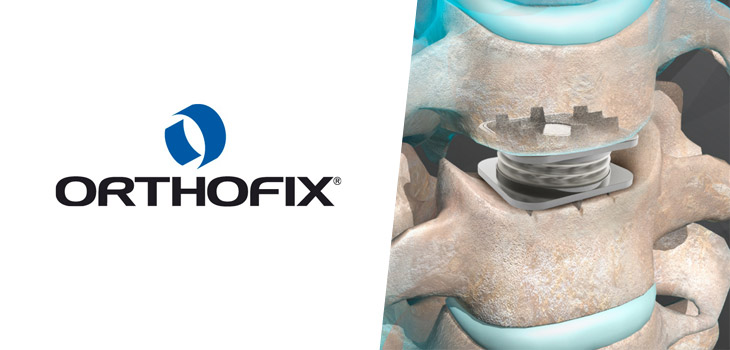
Two-year follow up data from Orthofix Medical Inc.’s U.S. Investigational Device Exemption (IDE) study of its M6-C artificial cervical disc, which was long anticipated following the FDA approval of the device in January, was released at the International Society for the Advancement of Spine Surgery (ISASS) annual meeting by Jack Zigler, M.D., an orthopedic spine surgeon at Texas Back Institute and an investigator in the study.
2-Year Data Released for M6-C Artificial Cervical Disc
2 min read Premium comments
#orthofixSecondary#anteriorcervicaldiscectomyandfusion#neckdisabilityindex
A prospective, non-randomized, concurrently controlled clinical trial, the M6-C IDE study was conducted at 23 sites in the United States with an average patient age of 44 years.
The study’s investigators reported results from the M6-C cervical disc IDE study:
- “Patients who’d received the M6-C demonstrated statistically significant improvement in the Neck Disability Index as measured at week six and months three, six, 12 and 24.
- 91.2% of M6-C patients reported an improvement in neck pain versus 77.9% of the ACDF (anterior cervical discectomy and fusion) patients.
- 90.5% of M6-C patients reported improvement in arm pain scores versus 79.9% of ACDF patients.
- Prior to surgery, 80.6% M6-C disc patients and 85.7% ACDF patients were taking some type of pain medication for the treatment of their cervical spine condition. At 24 months, the rate of M6-C patients who were still taking some type of pain medication dropped to 14.0% compared to 38.2% of ACDF patients.
- Of these, there was a 7X higher rate of opioid use among the ACDF patients than M6-C patients.
- Average surgery time for M6-C patients was 74.5 minutes versus 120.2 minutes for ACDF patients.
- Average hospital stay was 0.61 days for the M6-C patients versus 1.10 days for ACDF patients.
- Re-surgery at the treated level was 1.9% for M6-C patients versus 4.8% for ACDF patients.
- There were no device migrations reported in the study.
- M6-C disc reported a 92% satisfaction rate and 93% said they would have the surgery again.
There were 3.8% percent serious adverse events among the M6-C disc group versus 6.1% in the ACDF group.”
Dr. Zigler told OTW, “In this study, compared to ACDF, the M-6 patients spent less time in surgery and less time in the hospital. And although they showed significant decreases in overall use of NSAIDs and pain medication, the most dramatic finding was a seven-times decrease in the use of opioids at two years (only 2% of M-6 patients versus 15% of ACDF patients).”
“M-6 is the true next-generation in cervical artificial disc technology. Its design mimics natural anatomy, and its laboratory biomechanics almost exactly match the natural disc’s function. By adding the ability to absorb compression and move its center of rotation in response to cervical segmental motion, it establishes a new benchmark in replacing a degenerated natural structure with an implant that is a near-exact functional replacement.”
Author
React:
Discussion
This is a fascinating development. In my practice we've seen similar outcomes with the revised protocol. The key differentiator seems to be patient selection criteria. Has anyone else noticed the correlation with BMI thresholds?
Great point. I'd push back slightly on the conclusion, the sample size in the cited study is too small to draw population-level inferences. That said, the directional signal is compelling and worth a larger RCT.
We implemented a similar approach last year. Early results are promising but we're still gathering 12-month follow-up data. Happy to share our protocol if anyone is interested.
Join the conversation
Orthopedic professionals are discussing this. Sign in and upgrade to read every comment and add your voice.