
UK-based Victrex, a supplier of PAEK/PEEK [Polyetherether ketone] implants, has purchased a several million Euro stake in Bond High Performance 3D Technology BV, a Netherlands-based company with differentiated 3D printing (Additive Manufacturing, AM) machinery and software.
Victrex Buys Ownership Stake in Bond High Performance 3D
2 min read Premium comments
Secondary#3dtechnology#invibiobiomaterialsolutions#victrex
Together, the two firms intend to use their respective technologies to produce high strength parts from existing grades of PAEK/PEEK.
“Our investment in Bond’s 3D technology is a logical way to accelerate 3D printed PAEK/PEEK parts to market,” Jakob Sigurdsson, Victrex CEO explained.
“We need to ensure that all the key elements, including material, process, and hardware are aligned to fulfil our goal of enabling our customers to manufacture 3D printed PAEK components for critical high-performance applications. We’re now at a stage where the technology is sufficiently developed to embark on exciting development programs.”
Gerald Holtvlüwer, CEO of Bond High Performance 3D Technology, stated, “We’re excited to partner with a world leader in PAEK polymer-based solutions. Victrex’s material know-how and their strong marketing and sales activities, are a perfect channel to market for us and a complement to our pioneering technology.”
John Devine, Ph.D. is medical business director at Invibio Biomaterial Solutions.
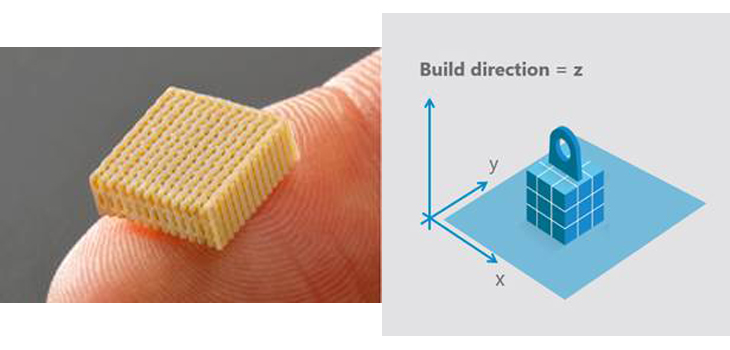
Asked for details on the importance of printing parts in the z-direction, Dr. Devine told OTW, “3D printing is a process that produces parts by carefully positioning layers of material one on top of the other. This ‘additive manufacturing’ differs from traditional processes (reductive manufacturing) in which parts are made by precisely removing material for a preformed shape.”
“The direction in which the layers of polymer are stacked is referred to as the “z direction,” or in other words the build direction. The strength in this direction is highly reliant on careful management of the printer processing conditions. Significant efforts have been required to achieve 3D printed parts with appropriate z direction strength and to achieve overall mechanical integrity, which is obviously a critical requirement for orthopedic implants, particularly for load bearing applications. The combination of PEEK-OPTIMA polymer with the Bond technology has yielded z direction strengths that are intended to allow deployment of 3D printed parts in orthopedic applications including spinal cage and CMF reconstruction.”
Asked about the development plan for upscaling and installing additional 3D printing machines, Dr. Devine added, “We are excited by the potential to work with customers to develop spine cages with optimal ongrowth, ingrowth, imaging and modulus. 3D printing provides design freedom that allows the incorporation of porosity at the end plates and in the graft space to optimize bone ingrowth in spinal cages.”
“We are at an early stage, but we have a great track record of collaborating with third parties to grow our supply chain and deliver exceptional levels of service and that’s the intention here. In the future we are looking to incorporate innovative materials such as PEEK-OPTIMA HA [hydroxyapatite] enhanced in 3D printed cages and to also explore other areas where porous load bearing metals are used.”
Author
React:
Discussion
This is a fascinating development. In my practice we've seen similar outcomes with the revised protocol. The key differentiator seems to be patient selection criteria. Has anyone else noticed the correlation with BMI thresholds?
Great point. I'd push back slightly on the conclusion, the sample size in the cited study is too small to draw population-level inferences. That said, the directional signal is compelling and worth a larger RCT.
We implemented a similar approach last year. Early results are promising but we're still gathering 12-month follow-up data. Happy to share our protocol if anyone is interested.
Join the conversation
Orthopedic professionals are discussing this. Sign in and upgrade to read every comment and add your voice.