
New work presented at the 2019 Annual Meeting of the American Academy of Orthopaedic Surgeons has found that tele-rehabilitation doesn’t have to mean that patients end up back in the hospital.
THE #1 Advantage for THA or TKA Tele-Rehabilitation
2 min read Premium comments
#totalkneearthroplasty#totalhiparthroplastySecondary#telerehabilitation
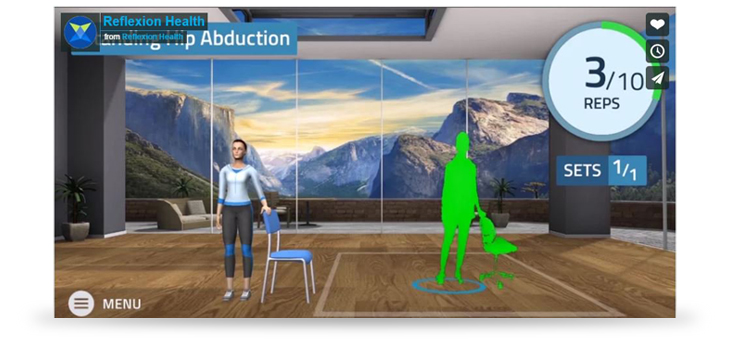
The study, “Tele-Rehabilitation for Total Hip and Knee Arthroplasty Patients: No Increase in Readmissions,” followed 40 patients who underwent total hip arthroplasty (THA) and total knee arthroplasty (TKA) but then, in addition to four to six traditional/face-to-face physical therapy sessions, did rehab sessions at home with an animated avatar called VERA (virtual exercise rehabilitation assistant).
The tele-rehabilitation patient outcomes were compared to 614 patients who were discharged to home and underwent home or outpatient physical therapy following THA or TKA.
The tele-rehabilitation group had essentially the same low 30 day to 90-day readmission rates that were recorded for patients that had traditional home or outpatient physical therapy.
The tele-rehab group had the following readmission statistics—30 day, 2.5% vs. 4.2% (for traditional rehab patients); 90 day, 2.5% vs. 5.7% (traditional).
The researchers also found that there was a near identical rate of emergency department visits at 90 days (tele-rehabilitation, 10%; traditional, 9.8%).
Among the research findings:
- Patients had high rates of accuracy in performing exercises—93% for the TKA group and 90% for the THA group.
- None of the TKA tele-rehabilitation patients required manipulation.
- Cost analysis showed a minimum cost savings of $1,000 with tele-rehabilitation.
Asked to describe the avatar exercise process, co-author Mary I. O’Connor, M.D., director of the Center for Musculoskeletal Care and Professor of Orthopaedics and Rehabilitation, Yale School of Medicine, told OTW, “The patient turns on the system—they are looking at a computer screen. VERA comes on and speaks to the patient and directs them to start the exercises.”
“The type of exercises (e.g., squats, knee extension, knee flexion) and the number of repetitions per set and number of sets is programed by the patient’s physical therapist. These exercises are modified as the patient progresses with postoperative rehabilitation. The number of reps and sets is electronically transmitted to the patient’s physical therapists who can check that the patient is doing their exercises at home. The physical therapist can also do live virtual visits with the patient through the device.”
“We have found an extremely high patient satisfaction rating with this system. Patients cite convenience—they don’t have to have someone drive them to therapy, there are no co-pays, they don’t have to have the house or themselves presentable for when the therapist comes for the home visit, they don’t have to worry about putting the dog in another room for when the home therapist arrives….”
“I would ask my orthopaedic surgery colleagues to consider use of this technology. We have to find ways of delivering high-quality healthcare at lower costs. In our experience this tele-rehabilitation program does just that. We still need physical therapists. Our protocol does not eliminate physical therapists but simply decreases the number of face-to-face visits between the physical therapist and the patient. And our patients have really enjoyed it.”
Author
React:
Discussion
This is a fascinating development. In my practice we've seen similar outcomes with the revised protocol. The key differentiator seems to be patient selection criteria. Has anyone else noticed the correlation with BMI thresholds?
Great point. I'd push back slightly on the conclusion, the sample size in the cited study is too small to draw population-level inferences. That said, the directional signal is compelling and worth a larger RCT.
We implemented a similar approach last year. Early results are promising but we're still gathering 12-month follow-up data. Happy to share our protocol if anyone is interested.
Join the conversation
Orthopedic professionals are discussing this. Sign in and upgrade to read every comment and add your voice.