
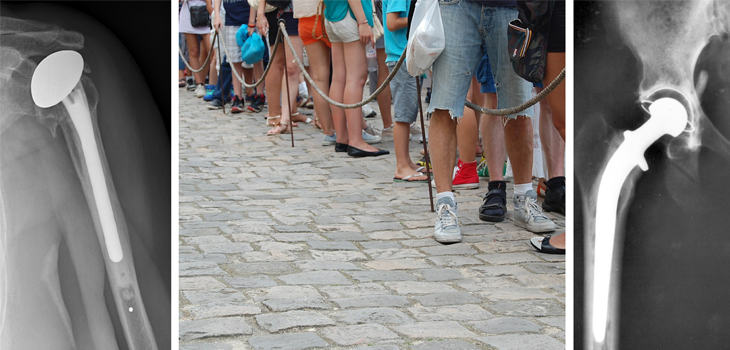
Researchers at the University of Rochester in New York have taken a deep look into the connection between the volume of revision total joint arthroplasty (TJA) surgeries and patient outcomes.
New Data Links High Volume TJA to Patient Outcomes
1 min read Premium comments
#totaljointarthroplastySecondary#hospitalvolume
The study, “Association Between Hospital Volume and Outcomes After Revision Total Joint Arthroplasty: A Study of 29,948 Cases,” is in press at Clinical Orthopedics and Related Research.
Co-author Benjamin Ricciardi, M.D. explained to OTW why this connection is especially important. “The association between hospital volume and primary total joint replacement has been well established but has not been studied extensively in revision total joint replacement. Revision surgery is more complicated than primary surgery, and we hypothesized that hospitals with higher volume would have improved early outcomes relative to lower volume hospitals.”
The researchers looked at records from 29,948 inpatient stays for revision TJA from 2008 to 2014 in the Statewide Planning and Research Cooperative System (SPARCS) database for New York State. They looked at the relationship between hospital revision volumes by quartile and the associated patient outcomes. The researchers also examined the top 5 percentile of hospitals as a separate cohort.
Dr. Ricciardi summarized the study results to OTW, “The most important results were hospitals in the highest 5% by volume for revision total joint replacement had lower 90-day readmissions relative to lower volume hospitals. Additionally, hospitals in the lowest quartile by volume had higher 90-day complications relative to higher volume hospital categories.”
“The results of this study suggest that regionalizing revision services to higher volume hospitals may be beneficial to early revision total joint replacement outcomes, however, further studies are needed to examine any negative impact on access to care that these policies may cause and define longer term outcomes of revision total joint replacement relative to hospital volume.”
According to the authors, “Disadvantages of regionalization include reduced access to care, increased patient travel distances, and possible capacity issues at receiving centers. Further studies are needed to evaluate the benefits and negative consequences of regionalizing revision TJA services to higher-volume revision TJA institutions.”
Author
React:
Discussion
This is a fascinating development. In my practice we've seen similar outcomes with the revised protocol. The key differentiator seems to be patient selection criteria. Has anyone else noticed the correlation with BMI thresholds?
Great point. I'd push back slightly on the conclusion, the sample size in the cited study is too small to draw population-level inferences. That said, the directional signal is compelling and worth a larger RCT.
We implemented a similar approach last year. Early results are promising but we're still gathering 12-month follow-up data. Happy to share our protocol if anyone is interested.
Join the conversation
Orthopedic professionals are discussing this. Sign in and upgrade to read every comment and add your voice.