
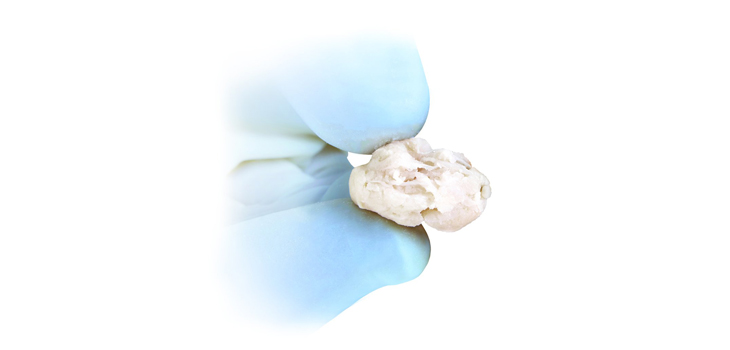
MTF Biologics recently introduced a new cartilage treatment, CartiMax, which combines live, viable cartilage cells with putty-like handling properties to treat defects in the knee, foot and ankle.
New Cartilage Treatment Makes Filling Defects Easier
2 min read Premium comments
Secondary#mtfbiologics#cartilagetreatment#cartimax#chondraldefects
The new treatment, according to MTF Biologics, enables surgeons to fill defects of different shapes and sizes easier, without the need for templates or anchors. And by eliminating the typical two-stage procedure used in other cartilage treatment, patients are able to resume their normal activities a lot quicker.
CartiMax provides functioning viable chondrocytes and an extracellular matrix that contains type II collagen, proteoglycans and endogenous growth factors, the building blocks for cartilage repair.
Preclinical studies on the “Cellular Characterization of CartiMax,” “CartiMax Retention in a Cadaver Knee Model,” and “Viability Characterization of CartiMax,” respectively, have confirmed the efficacy of the new treatment.
Data collected for “Cellular Characterization of CartiMax” confirmed that the isolated cells from cryopreserved viable cartilage fibers expressed CD44 and CD49e cell surface markers, and did not express CD45.
“CartiMax Retention in a Cadaver Knee Model” was a mechanical testing study where two types of chondral defects were examined and created using a mini-open surgical technique. The researchers found that even after extensive cyclic testing, CartiMax remains solidly in place without the use of fibrin glue.
And finally, “Viability Characterization of CartiMax” evaluated the shelf-life of CartiMax. Samples of cryopreserved viable cartilage fibers were stored for six months in vapor phase liquid nitrogen followed by six months in a -70˚C freezer. The samples were then studied for cell migration and cell expansion. According to the results, CartiMax has a shelf-life of up to one year.
A MTF Biologics spokesperson told OTW that CartiMax is fully available to orthopedic, sports medicine, foot and ankle and extremities surgeons.
“CartiMax can be used in a variety of knee, foot and ankle, and joint procedures. Efficacy may be limited to oversized lesions and to patients with subchondral bone damage, who may then benefit from an osteochondral graft.”
“These grafts have been studied in a small number of patients and preliminary outcomes (up to 6 months) are very promising with early indications of decrease in pain and increase in IKDC [International Knee Documentation Committee] and KOOS [Knee Injury and Osteoarthritis Outcome Score] scores, no significant bone edema or graft delamination, and early observation of complete fill and excellent incorporation. We continue to collect data and plan to publish clinical results in the coming months.”
Author
React:
Discussion
This is a fascinating development. In my practice we've seen similar outcomes with the revised protocol. The key differentiator seems to be patient selection criteria. Has anyone else noticed the correlation with BMI thresholds?
Great point. I'd push back slightly on the conclusion, the sample size in the cited study is too small to draw population-level inferences. That said, the directional signal is compelling and worth a larger RCT.
We implemented a similar approach last year. Early results are promising but we're still gathering 12-month follow-up data. Happy to share our protocol if anyone is interested.
Join the conversation
Orthopedic professionals are discussing this. Sign in and upgrade to read every comment and add your voice.