
Bob Brosnahan, COO of Additive Implants, Inc., says failure to achieve sagittal alignment due to hardware design limitations still exists in ACDF (anterior cervical discectomy and fusion) procedures.
FDA Clears Additive Implants’ Cervical Spacer
2 min read Premium comments
Secondary#sagittalalignment#additiveimplants#cervicalspacer
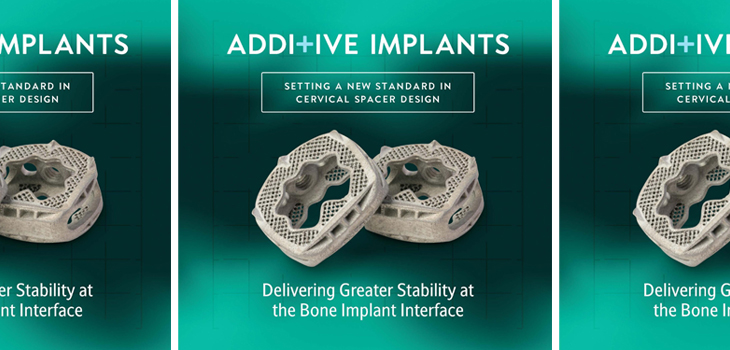
The company’s recently FDA 510(k) cleared SureMAX Cervical Spacer “was engineered with that stability in mind,” added Brosnahan. The company submitted its clearance notification on September 10, 2018 and the FDA granted clearance January 28, 2019.
Device Description
According to FDA documents, the spacer is an additively manufactured interbody device. “These cervical implants have basic keystone shape and an open architecture. A variety of height, length, width and anteroposterior angulation combinations are available to accommodate the anatomic requirements of individual patients.” The spacers are provided sterile only.
Indications for Use
“The spacer is intended for anterior intervertebral body fusion in skeletally mature patients who have had at least six weeks of non-operative treatment…and indicated to treat cervical disc degeneration and/or cervical spinal instability, as confirmed by imaging studies (radiographs, CT, MRI), that results in radiculopathy, myelopathy, and/or pain at multiple contiguous levels from C2-T1.”
The spacer “…is to be used with supplemental fixation; the hyperlordotic implants (≥10°) are required to be used with an anterior cervical plate. The implants are designed for use with autogenous and/or allogeneic bone graft comprised of cancellous and/or corticocancellous bone to facilitate fusion.”
Brosnahan said the company has learned “through extensive research with high volume cervical surgeons that stability at the bone-implant interface throughout the healing process may hold the key to better sagittal alignment and improved outcomes.”
Jeff Horn, the company’s VP Commercialization, said, “We’ve achieved something special with the SureMAX spacer.”
He told OTW, “The intervertebral spacer market is currently focused on surface technologies including porous PEEK, nano-surface texturing, and 3D printed porous titanium. While all these surfaces might be osteoconductive, if the implant design does not provide immediate and secure fixation, the result will likely be a pseudoarthrosis or a malaligned fusion.”
“We believe the unique, patent pending, design features of the SureMAX Cervical Spacer will enhance the stability of the implant and provide for a quicker, better aligned athrodesis.”
A March 12, 2019 company announcement stated the 3D printed, titanium alloy spacer, “offers a roughened porous surface with several unique features on the superior, inferior, and lateral aspects of the implant, designed to effectively engage bone on the vertebral endplates. These features combine to provide an ideal environment for fusion while also helping to resist rotational forces throughout the healing process.”
Finally, the company stated their system offers a “comprehensive suite of footprints and heights available in 7° lordotic and 14° hyperlordotic options that will provide surgeons seeking sagittal balance a solution for any patient pathology.”
The FDA found Additive Implants’ spacer substantially equivalent to K2M Inc.’s Cascadia Interbody System.
Author
React:
Discussion
This is a fascinating development. In my practice we've seen similar outcomes with the revised protocol. The key differentiator seems to be patient selection criteria. Has anyone else noticed the correlation with BMI thresholds?
Great point. I'd push back slightly on the conclusion, the sample size in the cited study is too small to draw population-level inferences. That said, the directional signal is compelling and worth a larger RCT.
We implemented a similar approach last year. Early results are promising but we're still gathering 12-month follow-up data. Happy to share our protocol if anyone is interested.
Join the conversation
Orthopedic professionals are discussing this. Sign in and upgrade to read every comment and add your voice.