
Tiger Woods made an historic and jaw-dropping comeback at this year’s Masters Tournament in Augusta, Georgia, winning his fifth green jacket and his 15th major title.
Credit Guyer and Texas Back for Tiger Wood’s Historic Comeback
2 min read Premium comments
Secondary#texasbackinstitute#tigerwoods#richardguyer
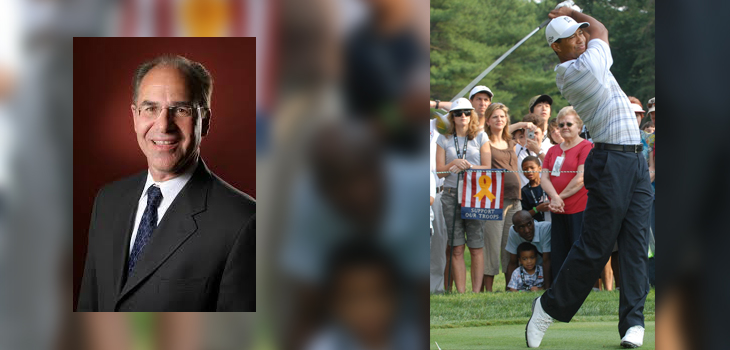
Two years ago, probably the only person on planet earth who might have dared dream that Tiger Woods would be back at the top of his profession was…Dr. Richard Guyer of The Texas Back Institute.
Dr. Guyer, like thousands of other dedicated spine and neuro surgeons, understands how to give their patients their lives back. Only one patient ever bounced back after spine fusion surgery to win the Masters, but other patients bounce back to star in their own versions of the Masters—pick up their grandchildren, return to work, church, life.
For Woods, however, even picking up his own children was not a possibility. He was done. His words. After years of intense conservative therapy followed by multiple back surgeries, injections, nerve block and other interventions, Tiger Woods, one of the most dominating professional golf players in history, was still in pain 24/7.
At his lowest point, he had resigned himself to retire permanently from the game he loved.
The final straw came spring of 2017 at that year’s Masters Champions Dinner. Just to be able to walk into the room he had to have an injection, a nerve block. Woods, the great athlete, was virtually an invalid.
He shared his story at the annual Golf Writers Association of America (GWAA) awards dinner where he received the GWAA’s Ben Hogan Award in a video from the event.
“It meant so much to me to be a part of the Masters and the Champions Dinner. I didn’t want to miss it.”)
Then he found Dr. Richard Guyer at the Texas Back Institute.
Richard Guyer, M.D., is one of the best-known spine surgeons in America and chairman of the Texas Back Institute Research Foundation. After examining Tiger Woods, he recommended a minimally invasive anterior lumbar interbody fusion (MIS ALIF) at L5-S1.
Woods agreed. The operation went very well. And Guyer started to guide Woods through his recovery.
According to Tiger Woods, after the surgery at Texas Back, “I was able to start to walk again. I was able to participate in life. I was able to be around my kids again, go to their games and practices, take them to school. These were the things that I couldn’t do for a long time. Golf wasn’t in my near future or even distant future.”
As time passed, Woods started to consider the possibility of playing competitive golf. He checked with Guyer and under his guidance, began to swing the club, starting with putting, then chipping and finally to the full swing required for a long drive.
Roughly one year later, Tiger Woods won the Master’s tournament in what will be remembered for the ages as one of the greatest achievements—of both a surgeon and patient.
Author
React:
Discussion
This is a fascinating development. In my practice we've seen similar outcomes with the revised protocol. The key differentiator seems to be patient selection criteria. Has anyone else noticed the correlation with BMI thresholds?
Great point. I'd push back slightly on the conclusion, the sample size in the cited study is too small to draw population-level inferences. That said, the directional signal is compelling and worth a larger RCT.
We implemented a similar approach last year. Early results are promising but we're still gathering 12-month follow-up data. Happy to share our protocol if anyone is interested.
Join the conversation
Orthopedic professionals are discussing this. Sign in and upgrade to read every comment and add your voice.