
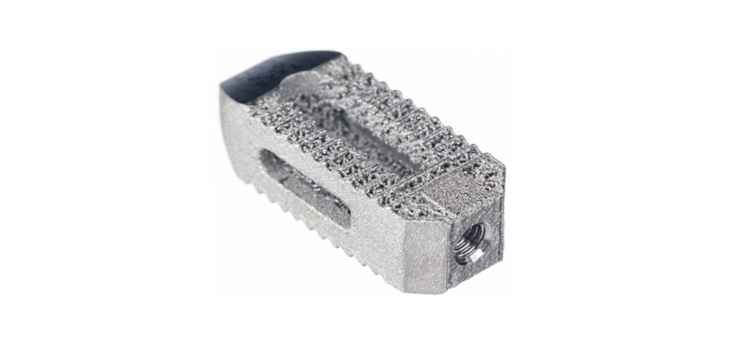
On November 28, 2018, Stryker Corporation’s Howmedica Osteonics subsidiary issued a Class 2 recall regarding its 3D-printed Tritanium PL lumbar cage.
Updating IFU’s for Stryker’s 3D Tritanium Implant
8 min read Premium comments
#stryker#posteriorlumbarcage#tritanium
As part of the recall, Stryker updated the Instructions for Use (IFU) for its 3D-printed cage as follows:
- “Do not twist, cantilever or rotate to achieve final position. This may result in damage to the implant,” and it included three color illustrations. The original IFU didn’t have a warning that twisting, cantilevering, or rotating the device during insertion could cause problems. Two spine surgeons told us that twisting, cantilevering, and rotating actions are normal procedure when inserting solid titanium cages.
- The company added two pages with instructions to surgeons regarding sizing the disk space for the implant.
- The instructions for distraction of the implant space was also changed.
- For example, the original IFU said: “Minimal distraction may be required to insert the interbody implant.” (It then goes on to list tools used for distraction but has no warnings.) The updated IFU now says: “Effective distraction aids in removal of the superior articular process, decompression of the neuroforamen, preparation of the disc space and insertion of the Tritanium PL Cage.”
- Furthermore, in a highlighted callout, the updated IFU says: “Note: Always assess the need for distraction, even if minimal, to evaluate the disc space.” And, “Particularly in patients with less than ideal bone quality, it might be useful to size the interspace with paddle distractors, reamer distractors or trials before locking the distraction down through the pedicle screws. Interspace distraction helps provide a sense of restoration of annular tension and helps to avoid pedicle screw pre-loading (which may cause post-operative loosening).”
- Finally, in another callout, the updated IFU says: “Precaution: Do not use the implant as the sole method for distraction, as this may cause damage to the implant.”
- Stryker also changed the procedure for intra-operative removal if necessary, adding a note saying that distraction should be done again if already withdrawn, using instruments other than the device itself.
Is This a “Canary in the Coal Mine” Moment?
Are porous 3D-printed (a.k.a. additive-manufactured) implants in general strong enough, and is the Food and Drug Administration (FDA)-required testing sufficient? Do breakage reports signal a larger issue regarding porous 3D implants, or was this situation simply a matter of surgeons not taking steps which weren’t in the original Instructions For Use (IFU) but should have been?
The recall arose because some Tritanium PL cages were fracturing or even crumbling into pieces during implantation and afterward. The recall was not of the device, but solely of the original IFU.
In checking with surgeons who use 3D-printed spinal implants, we were told by one that if a broken piece didn’t impinge on nerves or blood vessels, he’d be inclined to leave it there and let bone grow over it because of the risks of harm to the patient when removing it.
FDA MAUDE Reports
When we checked the FDA’s MAUDE (Manufacturer and User Facility Device Experience) reports, we found 43 from April 27, 2016 to December 19, 2018 regarding 3D-printed lumbar cages (all manufacturers, not just Stryker). As this article was being written, there were no new MAUDE reports of breakages since the November 28, 2018 recall.
As Stryker reported in the recall notice, 28,461 units of the Tritanium PL have been put in commerce (which means sent, not necessarily yet implanted) since the device was cleared for the market on November 19, 2015 under 510(k). The 43 MDRs (Medical Device Reporting Program) reports since then constitute a notably small percentage of the total in commercial circulation.
Critics say, however, that because MAUDE reports are voluntary, they likely represent only 5% to 20% of all incidents.
The content of some reports indicates that some surgeons who experienced the breakages think the problem is more than surgical insertion technique. A February 19, 2018 MAUDE report said in part:
“…Using standard surgical technique, I inserted the inter body device into the prepared l2-l3 disc space. The initial 50% of insertion was by manual pushing, and the final 50% of insertion by gentle tapping on the back end of the inserter device with a mallet. Once in place, a fluoroscopic image was taken, that demonstrated an abnormal slight obliquity to the device. Upon inspection, I discovered that the proximal (i.e., portion nearest the junction with the inserter) one third of the implant had separated (fractured) from the rest of the implant, and other parts of the implant had simply crumbled… Upon inquiring about this failure with stryker reps later that day, I was informed that stryker is aware of over 20 cases where a tritanium implant has fractured into pieces during surgical implantation. Obviously, I find this extremely alarming as a tritanium inter body implant should not break into pieces during insertion, and it furthermore makes me very concerned whether such tritanium devices will remain functional and in one pieces when subjected to constant loading cycles in an upright and ambulating pt.”
A report on a May 2, 2018 breakage:
“It was reported that upon insertion of the cage at the l5-s1 level broke in two pieces as the cage was advancing into the disc space. The surgeon was following correct insertion guidelines and was not handling it aggressively or using excessive force. The surgeon was able to distract the disc space enough to retrieve the broken piece….”
Not for Overweight or Obese Patients or Those Who Vigorously Exercise
Also, Stryker cautions against implanting the Tritanium PL in patients who are obese or who exercise frequently or vigorously:
“Obesity. An overweight or obese patient can produce loads on the spinal system which can lead to failure of the fixation or to failure of the device itself.”
“Patients involved in an occupation or activity that applies excessive loading upon the implant (e.g. substantial walking, running, lifting or muscle strain) may be at risk for failure of the fusion and/or the device.”
These contraindications and cautions about who should not receive the device are available online if you look in the right document. They’re not on the Tritanium PL microsite or in a product brochure or a technical summary, but they are in the online “Surgical Technique” document, on page 26 of the original and page 29 of the latest update.
One of the surgeons we interviewed told OTW, “More than half the U.S. population is obese and most of our patients have surgery to return to physical activities such as walking or running.” The other also questioned whom the device is for, if overweight and obese people and those who exercise significantly are contraindicated.
Rising Awareness of Issues With 3D-Printed Spinal Implants
The earliest MDR we found for the Tritanium PL was received by MAUDE April 26, 2016, regarding an April 1, 2016 incident:
“It was reported that the doctor was inserting the cage into the disc space. He was malleting the cage in and the cage split in half. Half the cage was in the disc space and half was still on the inserter. Normal steps were taken to prepare the disc space; shavers, paddles, and trials.”
Stryker commented at the bottom of that report:
“Correspondence with the sales rep confirmed that distraction off of the screws was not performed initially and that the space was “pretty tight.” conclusion: this suggests that the most likely cause of the customer reported event is inadequate distraction of the disk space prior to insertion.”
There is no indication of which version of the IFU the surgeon used. For this news report, we reviewed only the first version and the post-recall version, which, from a filename, appears to be the fourth edition.
Orthopedics This Week sought an interview with Stryker officials over the recall and surgeons’ criticism. Through an outside media representative, Stryker had us submit written questions. This is Stryker’s full response to our several questions:
“The quality of our products for patients and caregivers is our top priority. Stryker updated the Tritanium PL Surgical Technique Guide to warn against using surgical techniques that are outside the approved instructions for use. As a point of clarification: FDA’s definition of a recall includes a firm’s removal or correction of a product. In this instance, the update to the labeling (Surgical Technique Guide) is considered a correction. This action does not require the physical removal of any Tritanium PL products.”
Stryker’s Tritanium technology (which the company also uses in knee and hip implants) is not the only porous implant structure on the market. Stryker’s marketing literature describes it as a unique lattice structure designed to “mimic” or “imitate” cancellous bone.
The Tritanium PL has been tested for bone in-growth in sheep. Stryker cites those tests in a Technical Summary as evidence that the porous Tritanium lattice promotes greater integration of bone with the device than competitors’ products.
Stryker has received 510(k)s for two similar implants, the Tritanium TL, a curved cage, and the Tritanium C, a cage for the cervical spine. Neither of those implants was subject to the recall.
200 Predicate Devices
The FDA lists 200 previous “intervertebral fusion device with bone graft, lumbar” devices in its FDA database which are substantially equivalent to the Tritanium PL implant. Those devices have accumulated 2,395 problem reports in the FDA database from 2004 through February 9, 2019 of which 705 are for reported breakage and 187 for fractures (the numbers aren’t additive, as some reports used both terms).
A study of census data put the number of lumbar fusion surgeries at 121,224 in 2004, 180,770 in 2012 and rising annually. Thus, 705 plus no more than 187 reported breakages or fractures for all predicate devices since 2004 adds up to no more than four per ten thousand.
We didn’t analyze or see any analysis of how many of those breakage reports were of non-porous titanium and how many were made of the biopolymer polyetheretherketone (PEEK). However, all the MDRs we saw for breakages in 2016-2019, other than the porous 3D titanium reports, were of PEEK cages.
Of these 200 prior devices, only 13 received pre-market approvals (PMAs), the latest of which was in 2006.
The Tritanium PL may have been only the second 3D lumbar cage on the market, after an August 20, 2015 clearance for the Cascadia Interbody System, which K2M, Inc. claims to have been the first.
Stryker acquired K2M August 30, 2018. It is not known whether Stryker intends to continue marketing both the Tritanium PL and the Cascadia cage. In our MAUDE searches since late 2015, we found only two reports of breakages for K2M’s Cascadia 3D porous cage.
The Tritanium material and the technology from which it is made have been in use in other implants for more than a decade. In a July 14, 2017 interview in Spinal News, John Mayer, who was vice president, Global Marketing for Stryker’s Spine division, said, “The material is the culmination of nearly 15 years of extensive research, development, and validation in material science and manufacturing, and it has been utilised clinically for more than 10 years—with more than 300,000 knee and hip devices implanted.”
Upcoming Related Stories
- FDA and ASTM International (formerly known as American Society for Testing and Materials) working on more vigorous tests for 3D porous cages
- Four studies of Stryker’s Tritanium acetabular cups
- Some Blue Cross-Blue Shield plans label porous 3D implants “investigational” or “experimental”
Author
React:
Discussion
This is a fascinating development. In my practice we've seen similar outcomes with the revised protocol. The key differentiator seems to be patient selection criteria. Has anyone else noticed the correlation with BMI thresholds?
Great point. I'd push back slightly on the conclusion, the sample size in the cited study is too small to draw population-level inferences. That said, the directional signal is compelling and worth a larger RCT.
We implemented a similar approach last year. Early results are promising but we're still gathering 12-month follow-up data. Happy to share our protocol if anyone is interested.
Join the conversation
Orthopedic professionals are discussing this. Sign in and upgrade to read every comment and add your voice.