
Kristy Weber, M.D., Chief of Orthopedic Oncology in the Department of Orthopaedic Surgery at the Perelman School of Medicine at the University of Pennsylvania, and director of the Sarcoma Program in Penn’s Abramson Cancer Center, is the new president of the American Academy of Orthopaedic Surgeons (AAOS).
Kristy Weber, M.D., Leads AAOS Transformation
7 min read Premium comments
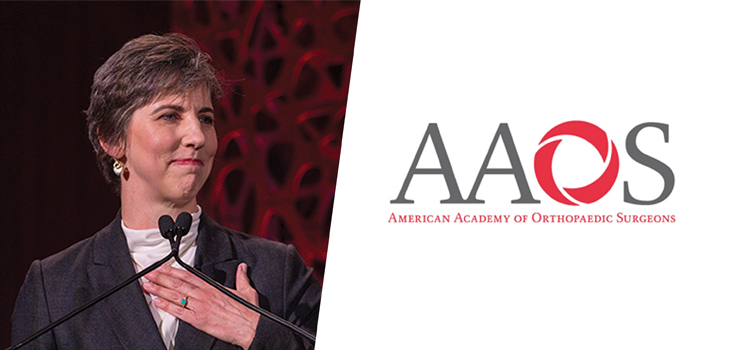
#aaos#kristyweber
In her new role, she will lead the world’s largest medical association of musculoskeletal specialists with approximately 39,000 members, 18,000 fellows, the largest orthopedic registry by annual procedures (1.4 million), 225 employees and the leading orthopaedic political action committee with $4 million in contributions in the last two-year cycle.
But, more importantly, as the President of AAOS, she sits at the pinnacle of the largest medical practice specialty in the world. The practice and business of treating musculoskeletal disease engages more physicians, clinics, hospitals, equipment suppliers to treat more patients than literally any other medical specialty.
Kristy Weber, M.D.
Dr. Weber’s daily practice is diagnosing and treating adults, adolescents and children with bone and soft tissue tumors, and she focuses on complex limb salvage techniques around the hip, knee, shoulder and pelvis.
Originally from St. Louis, Missouri, she earned a Bachelor of Science degree in Animal Science (Pre-Vet) and graduated Summa Cum Laude from the University of Missouri-Columbia. She earned her medical degree from the Johns Hopkins School of Medicine in Baltimore, Maryland, and then completed her orthopedic residency training at the University of Iowa in Iowa City and a two-year research/clinical fellowship in orthopedic oncology at the Mayo Clinic in Rochester, Minnesota.
She told attendees at the annual meeting that: “I was told that women couldn’t get into orthopedics when considering several different subspecialties in medical school during the late ’80s. You can bet that’s all I needed to hear to solidify my choice, and I am proud to be a woman in a profession that is currently 94% male. While my gender does not define me, I know that reducing barriers and embracing gender, ethnic and racial diversity in our field only stands to better our culture and better serve patients.”
Managing Change in Orthopedics
The list of change agents in orthopedics is extensive—robotics, treatment algorithms, shifting regulatory and reimbursement policies, pain management issues (read opioids) and innovations and the rise of more powerful biologic treatment modalities.
In her inaugural speech as President, Weber made it clear that she is on a mission to lead orthopedics into a future where relevance will be defined in new ways.
She told us that she wants to help her fellow orthopedic surgeons and all musculoskeletal professionals thrive in the technology age and work to keep her Academy relevant to future surgeons and patients by having the profession better reflect society.
Specifically, she said, “We’re changing the culture of the organization. We also took the last two years with outside consultants to overhaul our strategic plan. We weren’t just rearranging the deck chairs.”
Weber said the Academy identified three goals and every action will be tracked towards the plan. “This marks a change from where we’ve been before.”
“First, we will deliver a personalized and seamless member experience. We’ve fallen way behind from a digital standpoint. Our members want the Google experience.”
“I don’t want 10-20 academy emails per week about general products and offerings. I’m an orthopedic oncology surgeon and want to see something that’s going to help my practice. I don’t need information on techniques or products irrelevant to my particular work or interests.”
She said the Academy doesn’t know its members well enough to know what they want. Once the data acquisition is finished, then communications can start becoming personalized to each member.
“Secondly, equipping members to thrive in value-based environments is something that would not have been a goal ten years ago. People would have shied away from some of the things we’re going to have to measure.”
“We will really have to educate members on what we’re doing and get their buy in and feedback.”
“It’s also going to require collaboration with payers instead of calling them names. That’s a major shift and industry will have a role. We’re going to want to partner more.”
A Foundation of Clinical Practice Guidelines
Back in 2007 when Academy attention was focused on ethics, industry relations and U.S. Department of Justice prosecutions, Weber was quietly at work on the Council of Research and Quality as clinical practice guidelines were being developed. She became Chair of that council a year later.
It wasn’t an easy sell at first.
Surgeons, especially those close to retirement, didn’t like being told what to do.
“I took a lot of hits for that,” said Weber in an interview on February 26, 2019.
“A lot of people didn’t like clinical practice guidelines. We could have communicated better, but they were an unbiased compilation of the evidence. Sometimes people don’t want to see what the evidence is if they have a set way of doing something.”
“That was over 10 years ago, and we’ve come a long way.”
“And now it’s no big deal when the Academy board approves the next clinical practice guidelines. There isn’t even much discussion. The work’s been done, and we approve it. It’s very different.”
“People understand that this is where medicine and orthopedics is going. We are expected to look at what works and what doesn’t to try to get some idea of how to take care of patients with the best potential outcome.”
“The younger generation is very much engaged in this. I think there is a generational gap of what people are happy about and what they’re not.”
“The Academy wants to help members survive in this shift to quality.” From filling out the boxes on applications for a bundled payment plan or MIPS [Merit-based Incentive Payment System Overview-QPP] scores to accessing the latest educational videos on cell phones.
She told us the Academy has to get people the actual data in a meaningful and personalized way. “There’s so much data and too much to keep up with.”
“We want to provide data at the point of care—digitally on your phone that’s been collated and developed by the Academy. We are moving to that. For instance, Ortho Guidelines is an app that allows appropriate use guidelines to be at the point of care.”
Reducing Reporting Burdens
We asked Weber about physician burnout which has accompanied the demand for collecting massive amounts of data and checking boxes for bundled payments and various alternate payments systems driven by Centers for Medicare and Medicaid Services (CMS) and followed by private payers.
She told us she spends “an immense amount of time” documenting things related to patients. “Seems like too many clicks for me. We have to do better. It’s been shown that if we don’t pay attention to the wellness of providers, patient care suffers. They are related.”
Matching performance measures with the Academy’s Registry efforts, which look at outcomes and safety issues related to implants, is “going to be huge.”
“This is the next iteration of the Academy’s quality vision, and I think it’s going to bring us more data that’s going to inform some of the other products we provide, whether it’s clinical practice guidelines or performance measures…we are going to be able to inform them through the data set.”
“If you participate in the Registry, you will be able to count that toward the requirements for CMS payment systems and for maintenance of certification (MOC).”
“Ideally, we want to be able to provide that feedback to providers, back to surgeons so they can continuously improve their practices. Our vision is that we will be able to reduce the reporting burden.”
Independent Surgeons
“AAOS has to represent all surgeons, some employed, some academic, but mostly these are private practitioners…boots on the ground. Really critical advocacy efforts for that population. Many are becoming employed and that trend will continue.”
“Our advocacy staff in D.C. are trying to keep the issues that are front and center for our private practice colleagues, whether its physician-owned hospitals or access to specialty care…we just passed a big sports measure that allows sports docs to go across state lines. (Sports Medicine Licensure Clarity Act)”
“The focus on private practitioners has not gone away. It’s a critical majority of our members.”
Dancing With Spine
“Is the Academy targeting spine?” we asked.
“We have had conversations with our colleagues at SRS, NASS, CSRS, etc.…it’s complicated because the spine groups are increasingly international and multi-disciplinary. Neurosurgeons and pain specialists are involved. We’d like to maintain that orthopedic core of those societies, but still understand they will be multi-disciplinary in terms of providing best patient care and represent interests of overall spine surgeons.”
“How do we align and support the various spine groups? Where is the value to them in involvement with the Academy?”
“We think the value remains in the quality and advocacy areas.”
Cultural Improvement
And finally, the culture and governance of the Academy’s Board and volunteer structure is going to evolve to become strategic, innovative and diverse, said Weber.
“Defining core values is of great interest to me. You lead into values from the top. I plan to lead in setting an appropriate tone and culture. The Board will define those core values over next few months and will use those to define how the Academy makes decisions, how we behave.”
“It’s not a shock to hear that the culture of orthopedics could use some improvement…talking primarily about gender.”
“I love my work, colleagues, caring for patients, but there’s some work that needs to be done given the disparity in gender (94% men); in terms of color and gender, we don’t reflect society.”
She said data clearly shows a connection with good outcomes.
“I can’t change the culture of the field, but I can change the culture of the leadership for my year in the Chair. We have to change our expectations of what is and what is not tolerated.”
“The younger generation is growing up in a different world. So, the organization risks becoming irrelevant if we can’t set a higher bar.”
“Teamwork is getting to be more important. If we want to be leaders of the team, we’re going to have to earn that.”
“We just keep moving upward, don’t we?”
It might be too early to call Weber a transformational leader, but she is the first AAOS President to give her inaugural speech in high heels.
Author
React:
Discussion
This is a fascinating development. In my practice we've seen similar outcomes with the revised protocol. The key differentiator seems to be patient selection criteria. Has anyone else noticed the correlation with BMI thresholds?
Great point. I'd push back slightly on the conclusion, the sample size in the cited study is too small to draw population-level inferences. That said, the directional signal is compelling and worth a larger RCT.
We implemented a similar approach last year. Early results are promising but we're still gathering 12-month follow-up data. Happy to share our protocol if anyone is interested.
Join the conversation
Orthopedic professionals are discussing this. Sign in and upgrade to read every comment and add your voice.