
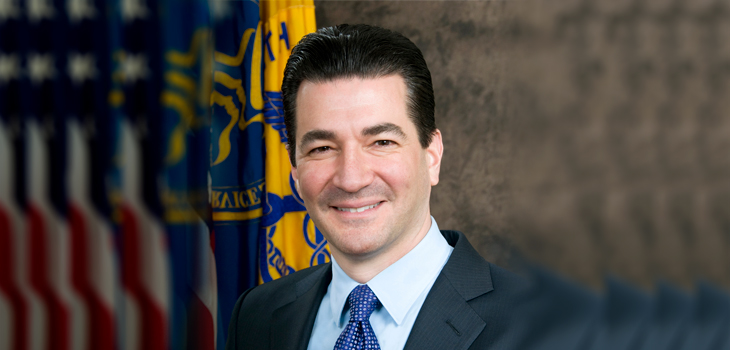
The Washington Post reported on March 5, 2019 that Food and Drug Administration (FDA) Commissioner Scott Gottlieb, M.D., will leave his job “in about a month” to spend more time with his family.
FDA Head, Scott Gottlieb, Resigning. What’s Next?
7 min read Premium comments
#fda#medicaldevices#scottgottlieb
He was picked to lead the agency in March 2017, and he was confirmed by the Senate a couple of months later.
Gottlieb, a former physician, was Deputy FDA Commissioner under President George W. Bush. Before taking the FDA reins, he was a healthcare investor and consultant who sat on multiple company boards.
Gottlieb was arguably one of the most respected and effective political appointees of the Trump Administration, receiving bipartisan praise from lawmakers on Capitol Hill. He was also well received by the media due to his constant presence on Twitter and voluminous communications regarding FDA activities.
The Commissioner’s primary job is to run the agency entrusted to “promote and protect” public health. How he fared in accomplishing those goals will not be known until long after he’s left his position. Daniel Carpenter, a Harvard University professor of government, reportedly said we may not know the full story of Gottlieb’s FDA legacy for a few years until the appointments he made and the draft rules that he fashioned are studied. “I think the jury is still out.”
Legacy
Gottlieb’s tenure will be largely remembered for dealing with the opioid crisis, regulating electronic cigarettes, challenging pharmaceutical drug pricing and guiding the agency through the longest U.S. government shutdown in history.
In his resignation letter to HHS (Health and Human Services) Secretary Alex Azar, Gottlieb named a list of accomplishments, including accelerating the approval of generic drugs and modernizing the process for handling novel gene and precision therapies to treat those with cancer and other diseases. He said the agency was “strong in moments of crisis,” including its work in Puerto Rico to remedy drug and medical device shortages after Hurricane Maria in 2017.
Last year, the agency approved a record 971 generic drugs. He also began posting lists of drugs that aren’t protected by patents, inviting applications from generic manufacturers, and sharply criticized brand-name companies for stifling generic competition.
Gottlieb made his strongest public statements on tobacco. With 480,000 Americans dying every year from smoking-related causes, he frequently said curbing tobacco use was the No. 1 way to improve public health. His comments caused some tobacco-control activists to say that he had potential to become the most important commissioner since David Kessler, who began efforts to regulate cigarettes as a drug in the 1990s.
Medical Devices on the Docket
But for medical device makers, his embrace of a major overhaul of the 510(k)-clearance program is likely to have the most lasting impact. Approximately 82% of all medical devices reach patients under that program.
As we reported last December, the device industry should get ready for “increased product complexity and risk aversion” from the FDA. It’s top regulators, said regulatory attorney Mark DuVal, “disdain” the 510(k) clearance program and are intent on sweeping changes.
On November 26, 2018, Gottlieb and Center for Device and Radiological Health (CDRH) Director, Jeff Shuren, M.D., announced plans to formally propose a major overhaul of the 510(k) process by eliminating the use of predicate devices older than 10 years and publishing a list of newly cleared devices which used older predicates.
Essentially, said DuVal, the FDA wants to publicly “shame” the makers of those devices.
“Don’t get me wrong,” DuVal told us after the resignation announcement, “Dr. Gottlieb didn’t do a bad job, but his focus was on very big-ticket items, like the opioid crisis, vaping by teens, and drug pricing. CDRH got very little attention. We had hoped that by being appointed by a regulatory reform-minded president, he would have reformed FDA’s inability to clear and approve devices in a reasonable time frame without a mountain of unnecessary data for some fairly innocuous devices.
“The problem with FDA is that when industry argues for a Least Burdensome approach as required by statute, FDA pays lip service to it, waves the banner of patient-safety to justify any and all data requests, and they are immunized from criticism.
“Reviewers today are hired as scientists, not regulatory affairs specialists. As a result, they turn every device into a science project and management goes along to get along. They get more and more granular. As a result, they mis-prioritize things by focusing an inordinate amount of resources on devices that don’t require the level of time and attention they give them.”
“The bottom line is Gottlieb had a chance to critically review CDRH’s performance and make it better, more timely, and less burdensome and he didn’t do it. In fact, the trend line is going horribly in the other direction. My hope is that the Trump Administration and the next Commissioner will devote time to reforming CDRH.”
MAUDE Overhaul
Under Gottlieb’s leadership, the FDA also addressed the MAUDE (Manufacturer and User Facility Device Experience) database, which Gottlieb called an incomplete and clumsy system.
He championed a pilot of the National Evaluation System for Health Technology (NEST), calling it a “faster, more real-world post-market adverse event reporting system.” The system has entered into agreements with 12 organizations that represent more than 195 hospitals and almost 4,000 outpatient clinics with access to more than 495 million patient records.
NEST is intended to accept not only reports from patients and caregivers, but also extract medical device problems from such sources as Medicare reimbursement procedure data—a gigantic, rich data mine. In the long run, a portion of higher medical device user fees would help pay for it.
In September, Gottlieb asked Congress for $46 million in fiscal year 2019 to build up NEST and to investigate post-market problems with individual devices.
Interestingly, shortly after announcing his resignation, Kaiser Health News published a blockbuster expose focusing on surgical staplers, entitled, “Hidden FDA Reports Detail Harm Caused By Scores Of Medical Devices.” The story stated the FDA has let medical device companies file thousands of reports of injuries and malfunctions outside MAUDE, leaving doctors in the dark.
The Good and the Bad
While there was some criticism, there was lots of praise about his leadership style.
Ed Silverman of STAT News wrote on March 6, 2019:
“He is chatty to the point of being loquacious. Not just in private, but publicly as well.”
“Anyone who has encountered Gottlieb knows that he is a highly effective communicator and adept at getting out a message, a talent that he honed by regularly penning columns for Forbes and appearing on numerous industry panels before rejoining the FDA in May 2017.”
“He is extremely comfortable with social media and made FDA more relatable and understandable,” said Dr. Josh Sharfstein, a former FDA deputy commissioner and now vice dean for public health practice at Johns Hopkins University. “He jumped into all sorts of topics and spoke his mind on things.”
Last year, for instance he issued 126 commissioner statements, and those followed 36 that were issued in 2017, a year in which he ran the agency for eight months, according to Mark Senak, a senior vice president and partner at the FleishmanHillard public relations firm who writes the Eye on FDA blog.
“I’m confident in saying no other commissioner has issued as many statements as he has,” Senak told me. “But more important, I think he set a new bar for having a commissioner that has a grasp of the issues and was able to artfully and comprehensively weave together so much for the public.”
“The Trump administration just lost its most effective health policy salesman.”
Robert Califf, M.D., Gottlieb’s predecessor as commissioner, said Gottlieb did “a great job” and followed through on Obama administration efforts, such as encouraging the use of “real-world evidence” to augment clinical trials.
Scott Whitaker, the head of AdvaMed, said that during his tenure as FDA commissioner, “Dr. Gottlieb has been a tireless advocate for improved patient care and for promoting innovative solutions to our most pressing health challenges, including greater use of medtech to combat the opioid crises.”
The public advocacy group, Public Citizen, which had described his nomination in 2017 as “entangled in an unprecedented web of Big Pharma ties,” was not quite as generous.
“Not surprisingly, his tenure as commissioner was marked by regulatory decision-making regarding medications and medical devices that tilted further in favor of industry’s financial interests rather than the interests of public health,” said Dr. Michael Carome, director of Public Citizen’s health research group.”
What comes next for Gottlieb and the agency is unclear. He may return to his private work as a venture capitalist and consultant to drug and health-care companies. He was also a resident fellow at the American Enterprise Institute, a conservative think tank that supports deregulation.
Next Commissioner
The next FDA Commissioner is certain to be an Acting Commissioner followed by a nomination for a permanent replacement. It’s not unlikely the position will remain “Acting” until after the 2020 elections.
A number of names surfaced in various published reports as a replacement, including:
Amy Abernethy, formerly the chief medical officer at health data firm Flatiron Health, which is now part of Roche. She became Gottlieb’s principal deputy commissioner early this year. In a note to investors, analysts at Cowen call her “the likely interim leader.” Abernethy was brought on board to rethink how the FDA handles the streams of data pouring out from new, digital approaches to medicine.
Janet Woodcock, who heads the FDA’s Center for Drug Evaluation and Research, where she’s worked since 1986.
Norman Sharpless, director of the National Cancer Institute.
Brett Giroir, assistant secretary at HHS. Giroir has been the senior adviser to Azar for HHS efforts to fight the opioid crisis.
Jim O’Neill, a former HHS principal associate deputy secretary. He is a staunch libertarian who has said that the FDA shouldn’t require drug companies to prove new medicines are effective before approving them. He doesn’t have any medical training or scientific expertise, but he is aligned with billionaire investor Peter Thiel, who was an adviser to Trump back in 2016 when O’Neill was on the short list for FDA commissioner.
Back to Connecticut
For now, Gottlieb will return home to Westport, Connecticut, where he lives with his wife and three daughters—9-year-old twins and a 5-year-old.
“It was a very hard decision,” Gottlieb said in an interview. “This is the best job I will ever have. I’m leaving because I need to spend time with my family. I get home late Friday, work on weekends and come back to Washington on Sunday. I did the job 100 percent.”
Author
React:
Discussion
This is a fascinating development. In my practice we've seen similar outcomes with the revised protocol. The key differentiator seems to be patient selection criteria. Has anyone else noticed the correlation with BMI thresholds?
Great point. I'd push back slightly on the conclusion, the sample size in the cited study is too small to draw population-level inferences. That said, the directional signal is compelling and worth a larger RCT.
We implemented a similar approach last year. Early results are promising but we're still gathering 12-month follow-up data. Happy to share our protocol if anyone is interested.
Join the conversation
Orthopedic professionals are discussing this. Sign in and upgrade to read every comment and add your voice.