
Back in 2013, a study funded by Stryker Corporation reported that all (100%) enrolled patients receiving its porous, 3D-manufactured primary Tritanium acetabular cup were experiencing no problems and the cups were performing well two to four+ years postoperatively.
3 Recent Studies Question Tritanium Acetabular Cup Survival Rate
5 min read Premium comments
#peekSecondary#acetabular#strykertritanium
That was then. Here’s now.
Three independent studies published between February 2017 and November 2018 raise questions about the long-term osseointegration and survival of this implant.
A fifth study, of Tritanium revision cups, which are said to use a different manufacturing process than the primary cups, concluded that the revision cups have excellent 6- to 10-year survival results.
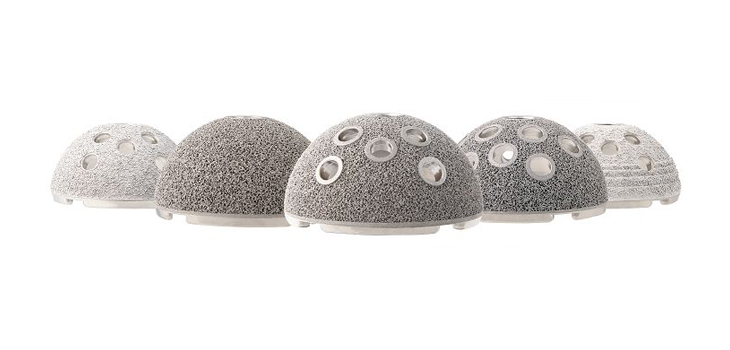
Stryker’s porous Trident 3D-printed Tritanium acetabular cups were introduced in 2008. Stryker announced a next generation version in March 2018.
The 2013 Primary Cup Study and the Study of the Revision Cup
The Stryker-funded 2013 study of 252 patients who had received a total of 288 hip arthroplasties using the Tritanium technology, “Excellent Results of Primary THA Using a Highly Porous Titanium Cup,” concluded that 100% of the 288 implants were still successful as of 24-56 months (mean 36 months) after surgery.
In that study, the surgeries were all performed by three of the study’s authors, who all reported receiving royalties from Stryker and had other financial relationships with Stryker. The study doesn’t say how the 252 subjects were selected, such as whether they were all patients who’d received the implants from the three surgeons or a chosen subset of all. The postoperative time period was fairly short—two to four+ years—and the study says a longer time period is needed to draw firm conclusions.
The independent study of the Tritanium revision cups, “Tritanium Acetabular Cup in Revision Hip Replacement: A Six to Ten Years of Follow-Up Study,” published in August 2018 in the Journal of Arthroplasty, followed 62 patients. It reports, “The acetabular cup aseptic survivorship was 98.4% at a mean follow-up of 87.6 months. The mean Oxford Hip Score improved from 14.5 (3-31) preoperatively to 38.5 (12-48) at the final follow-up. Two cups were revised (3.2%): 1 for aseptic loosening and 1 for infection.”
That’s just one bad result out of 62 for aseptic loosening, which is the issue raised by the three not-so-positive studies cited below. The authors, who report no financial conflicts or funding from Stryker, conclude that “Tritanium revision acetabular cup has shown excellent mid-term to long-term clinical and radiographic results with low failure rate and minimal complications. Longer term follow-up would be of value.”
However, the revision cup is apparently manufactured differently.
Three Studies Question Long-Term Viability
The other three independent studies all raise questions about the long-term effectiveness of bone in-growth in primary (not revision) Tritanium acetabular cups.
“Short to Midterm Follow-Up of the Tritanium Primary Acetabular Component: A Cause for Concern,” a study of 109 hips in 95 patients published in February 2017 in the Journal of Arthroplasty, said, “At an average 4.24 + 1.49 years, implant survivorship of the Tritanium primary cup was 98.2%, with 2 cups revised for failure of osseointegration”—ostensibly, a high success rate.
However, the study found a high number of signs of future failure: “Despite adequate implant survivorship, over one-third of Tritanium primary cups had 2 or more zone radiolucency at minimum 5-year follow-up with associated lower Harris hip scores.” None of these 109 surgeries had hip screws implanted with the cups.
The group studied was a cohort of 118 patients who had the surgery at New York’s Hospital for Special Surgery in 2008 and 2009, Alberto Carli, M.D. FRCSC, the chief author, told Orthopedics This Week. Seven dropped out, one died, and one had revision surgery due to infection. Dr. Carli said the team hopes to do another follow-up next year.
A second study of five revision patients at NYU Langone Orthopedic Hospital, New York, published in June 2018 in Arthroplasty Today, “Early aseptic loosening of the Tritanium primary acetabular component with screw fixation,” found that bone in-growth had failed even when the surgeons had added screws as their “preference” rather than a specific medical reason, in five hip revision patients who had undergone their original hip arthroplasties between 2011 and 2016.
This study says, “In contrast to the Tritanium primary cups, we have not noticed similar loosening in the revision Tritanium acetabular cups.” This study describes very different manufacturing processes for the primary vs. revision Tritanium cups, adding, “It is likely that the Tritanium primary cup loosening is at least in part due to these differences in manufacturing processes. Specifically, the pore structure and polymeric binding agent used in the Tritanium primary cup may be directly related to its increased tendency to fail in comparison with the revision cup.”
If the authors, William J. Long M.D.,FRCSC; Samir Nayyar, M.D., Kevin Chen. M.A., David Novikov, B.S., Roy I. Davidovitch, M.D., and Jonathan M. Vigdorchik, M.D., are correct in this conclusion, then their paper gives rise to this question: Why didn’t Stryker just make all its porous Tritanium acetabular cups using the latter process?
The newest study, titled, “Comparison of a highly porous titanium cup (Tritanium) and a conventional hydroxyapatite-coated porous titanium cup: A retrospective analysis of clinical and radiological outcomes in hip arthroplasty among Japanese patients,” was published in the November 2018 issue of the Journal of Orthopaedic Science.
This retrospective study compares aseptic loosening in 130 consecutive cases in 118 patients using the porous Tritanium primary acetabular cup as compared to 130 cases (130 patients) using a conventional Stryker cup, the Trident HA, between January 2011 and December 2014.
The mean follow-up duration was 41.3 months for the Tritanium cups and 38.1 months for the hydroxyapatite-coated cups.
“There were significant differences between the groups for radiolucent lines, cup abduction angle, and cup-center-edge angle. There were no significant differences in the clinical results,” the study concluded.
“Radiolucent lines increased in the Tritanium group (36.1% at 3 months and 60.7% at final follow-up), whereas they decreased in the Trident group (2.5% at 3 months and 0.8% at final follow-up). The occurrence of radiolucent lines was significantly higher in the Tritanium group than in the Trident group at each follow-up period.”
One cup loosening in the Tritanium group was identified at the final follow-up evaluation.
The study concluded, “the Tritanium group had a significantly higher rate of radiolucent line occurrence around the cups than did the Trident group. Thus, radiolucent lines can occur when using highly porous titanium cups; these lines indicate the possibility of future cup loosening. Longer follow-up and assessment of the results of using this implant are necessary.”
Orthopedics This Week provided the URLs of all the studies cited above to Stryker and requested comments for a follow-up report.
Author
React:
Discussion
This is a fascinating development. In my practice we've seen similar outcomes with the revised protocol. The key differentiator seems to be patient selection criteria. Has anyone else noticed the correlation with BMI thresholds?
Great point. I'd push back slightly on the conclusion, the sample size in the cited study is too small to draw population-level inferences. That said, the directional signal is compelling and worth a larger RCT.
We implemented a similar approach last year. Early results are promising but we're still gathering 12-month follow-up data. Happy to share our protocol if anyone is interested.
Join the conversation
Orthopedic professionals are discussing this. Sign in and upgrade to read every comment and add your voice.