
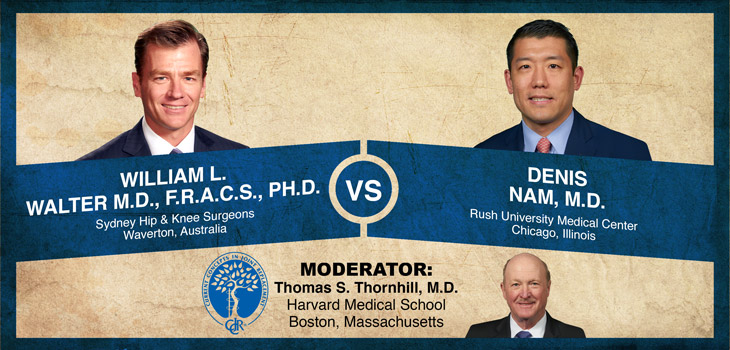
This week’s Orthopaedic Crossfire® debate was part of the 34th Annual Current Concepts in Joint Replacement® (CCJR®), Winter meeting, which took place in Orlando. This week’s topic is “Medial Pivot Designs Avoid the Need for Ligament Balancing” For is William L. Walter M.D., F.R.A.C.S., Ph.D., Sydney Hip & Knee Surgeons, Waverton, Australia. Opposing is Denis Nam, M.D., Rush University Medical Center, Chicago, Illinois. Moderating is Thomas S. Thornhill, M.D., Harvard Medical School, Boston, Massachusetts.
Walter v. Nam: Medial Pivot Designs Avoid the Need for Ligament Balancing
10 min read Premium comments
#medialpivotGreat Debates#denisnam#ligamentbalancing#williamwalter
Dr. Walter: The survival rate for total knee arthroplasty at 15 years is very good at over 95%. Can we improve things further? Well, of course, the problem is satisfaction with only 80% of patients being satisfied.
Medial ball and socket knees or medial pivot knees have something unique. They have sagittal stability and patella mechanics that are different from other knee designs and I think that this helps improve patient satisfaction.
Mike Freeman, who recently passed away, and Vera Pinskerova looked at a series of MRI scans and projected the centers of rotation of the femur onto the tibia and found that the medial side doesn’t move much but the lateral side translates as a voluntarily but not obligatory rotation.
In full extension, there’s no rotation. In the mid-range there’s an optional rotation of 20-30 degrees of the knee—and this occurs around the medial side.
The knee really has two degrees of freedom.
It has a flexion axis, which we all know about, but it also has a rotation axis which goes through the medial compartment, through the medial femoral condyle.
The medial pivot concept takes this concept and puts it into a knee design with a spherical medial condyle. The lateral side which is a conforming cylinder which permits some laxity and rotation and acts like an outrigger. The medial ball and socket knee is stable throughout a full range of motion and does not allow any anterior translation on the medial side.
The other thing is that it’s fully conforming throughout a full range of motion, so you have full contact throughout a full range of flexion up until the posterior flange leaves and then it reduces a bit. It has this stability not just in parts of the rotation but in a full rotation range and it’s the anterior and posterior lips that give it the stability.
What about the other types of knee design?
We have posterior stabilized knee designs which have a cam and post, but these only engage in deep flexion, so in functional positions such as 30-50 degrees of flexion, there is no anterior/posterior stability.
We have cruciate retaining types which are a round on flat. We have mobile bearings, bi-cruciate substituting which is the same as posterior stabilized, and the medial rotation knee.
I’m going to do a little bit of basic high school physics and imagine that the force is coming down onto the tibia at about 30 degrees (such as when the patient’s walking down a step) with a medial ball and socket, a cruciate retaining, and a cam and post knee design. The medial ball and socket knee is inherently stable in its articulation, but the cruciate retaining and the cam and post are unstable.
So, the force, instead of being normal to the articular surface, is at an angle, let’s say 30 degrees, which means some of the force is shear and some of the force is normal. Whereas in the medial ball and socket, we have zero shear and in the other designs we have a shear force.
If you’ve got ligaments that are well balanced, you have a stable knee. If you have a poorly balanced knee, with ligaments that are loose, the cruciate retaining and the cam and post knees will become unstable, but the medial ball and socket knee will still be stable because it’s an inheritably stable design. This also has implications for contact stress.
The registry results of medial ball and socket knees are all equal to or better than the total knees on the Australian registry. So, my conclusion is that ligament balancing is not critical in a medial ball and socket knee, because the bearing is inheritably stable.
Dr. Nam: We are not discussing whether medial pivot designs are relevant. We are talking about ligament balancing. It doesn’t matter what kind of insert you put in, if it’s not balanced, it’s not going to pivot around the medial side.
We all know that balance in knee replacement is crucial; the goal is to create symmetric and equal flexion and extension gaps and to have ligament and soft tissue balance. Regardless of your technique, whether you do gap balancing or measured resection or some type of hybrid, you want a balanced, stable knee.
Inadequate balancing has several consequences including abnormal kinematics, difficulties with range of motion, instability and recurrent diffusions, and also polyethylene wear because you can get condylar liftoff which can accelerate your wear. You need to have balance in the sagittal and coronal planes, and we know that instability remains a leading cause of early failure after total knee arthroplasty.
Even if you’re using implants with increased intraarticular constraint or even a hinge prosthesis, I would go as far to argue that you still want to try to balance this knee and balance the soft tissues.
So, it’s hard to believe that simply putting an insert with more congruency in the medial side of the knee would obviate the need for ligament balancing.
As Dr. Walter alluded to, the medial compartment is ultra-congruent in this ball and socket design, it allows translation of the lateral condyle, and the goal is to avoid paradoxical anterior slide. This is contrary to the four-bar linkage theory in which the femur symmetrically rolls back on the tibia both medially and laterally.
In theory, this should enhance quad power and improve physiologic kinematics, and I agree there have been encouraging results in several studies demonstrating excellent survivorship, good Knee Society Scores and also potential improvement versus other design concepts.
But I think it’s important for us to determine what these studies show and how they got to these results. If we go to Dr. Walter’s website, looking at knee replacement design concepts, he says that medial pivot designs do better.
A study by Professor Fares Haddad (CORR 2011) compared medial pivot and posterior stabilized knees and showed that medial pivots had improved range of motion and total knee function scores but there is no difference in Knee Society, WOMAC, or Oxford scores.
Looking at the surgical technique, Haddad and his colleagues utilized the mechanical alignment technique. They externally rotated their femoral components, and if you look at the methods of how they achieved these results, they specifically say, soft tissue balance was assessed in flexion and extension using the implant’s respective supplied spacer device and flexion and extension gaps were equalized in all cases using a sequential approach, so they balanced their knee replacements.
Looking at another study which demonstrated excellent long-term survival (Macheras, et al., Knee 2017). The study authors balance the flexion gap based on the tightness of the PCL, they resected it in some and retained it in others. They checked coronal stability with varus-valgus stress tests. They checked sagittal stability with a flexion distraction test and thus they balanced the knee. So the reported results of the medial pivot knee have shown that in the methods of these studies, you still need to balance your knee for this to work.
If you look at some other studies (Kim, et al, J Arhtroplasty 2017 – a study looking at 182 simultaneous bilateral knee replacements, randomized one to a medial pivot, and the other to a cruciate retaining knee) the authors found that Knee Society, WOMAC, and range of motion were all worse in the medial pivot knee. There was 93% satisfaction with the cruciate retaining device versus 75% with the medial pivot—but no difference in long-term survivorship.
The authors concluded that the medial pivot actually performed worse.
A recent study (Meneghini, et al, J Arthroplasty 2017), looking at 140 primary knee replacements. Meneghini and his colleagues used sensor-embedded trials, they used CR, CS, and PS versions of the same implant design and assessed the range of motion and kinematic pattern. They found no difference in one-year Knee Society and UCLA activity scores whether or not these patients exhibited the medial pivot kinematic pattern.
I think that medial pivot designs do have good results. There is some merit to it. I think the concept makes sense, but all knee replacements require balance to have success.
If you’re not balanced, you’re not going to pivot around that medial side, you can even lift off that medial side despite the congruency that is present. I think it comes down to what’s best in your hands, what technique works for you, what implant works for you.
Moderator Thornhill: Bill, let’s start with you. What should drive the kinematics of a replaced knee? Should it be the prosthesis, or should it be the soft tissues?
Dr. Walter: That’s a good question. I think as with all the other designs it’s the soft tissues. With the medial ball and socket knee, the design actually drives the kinematics.
Moderator Thornhill: Denis, what should drive the kinematics of a total knee?
Dr. Nam: I think it should be both implant design and soft tissue. A medial congruent knee is a little more forgiving, but I would say you still have to balance it. If you overly externally rotate your component and you’re loose medially or you over-release the medial soft tissue envelope, I still don’t think you’re going to pivot around the medial side of that knee.
Moderator Thornhill: Bill, do you think the medial pivot knee more closely resembles the kinematics of the normal knee?
Dr. Walter: I do.
Moderator Thornhill: But you know the normal knee has menisci, they move, it has articular cartilage, we’re using a hard bearing. If you look at the fluoroscopic data from Rick Komistek of normal knees, they’re all over the place.
Dr. Walter: I mean if you think of a hip, hips are ball and socket and the center of rotation is constrained. The muscles act, the center of rotation stays where it is, and the muscles can produce a movement. With a knee, if it’s unstable the muscles act and the knee just slides. If you can constrain the femur on the tibia so that it doesn’t slide anteriorly, the quadriceps can act the way it should, it doesn’t need the hamstring to co-contract to try to stabilize the knee. I think it’s a better kinematic situation if you have a stable knee than if you have an unstable knee that’s sliding backwards and forwards.
Dr. Nam: I think Dr. Thornhill brings up a good point though that there’s such variability in how every patient’s knee moves and especially in the arthritic situation, we don’t know the way they’ve been for potentially several decades. Some patients will have a medial pivot kinematic pattern, some people will have a dual pivot, some people’s lateral condyle will slide anteriorly slightly when they’re in full extension. I don’t know if we know what’s best, similar to hip targets and alignments, I don’t know if we know what’s best for each knee replacement and that’s why I think we kind of shoot for the middle and say, “What’s going to work best for us,” when we do the surgery itself. I agree, I think there is variability, I don’t think every knee needs to move that way.
Moderator Thornhill: There’s also the concern of the landing zone where you have a certain target for a knee and some implants narrow the target zone. Do you think the medial pivot does that?
Dr. Nam: I don’t see that as being a big difference. I think that your surgical technique right up until the end of the surgery is essentially the same, whether you’re doing a medial pivot knee or whether you’re doing a cruciate retaining or an ultra-congruent knee. Does your surgical technique change when you do a medial pivot knee versus a cruciate retaining?
Dr. Walter: So, I think that that’s a very good question. Some aspects to a medial ball and socket knee narrow the landing strip. I’d say tibial rotation is one of those things and that’s because tibial rotation is not important if you’re using a rotating platform for example. When you have to get your tibial rotation right with a medial ball and socket knee or it won’t work, but there’s also some areas where the landing zone is wider and that is with the tension. I think you can afford to have it a little bit looser or a little bit tighter and it will still work. Whereas if you are using a cruciate retaining design, if it’s looser, the patient will be unhappy.
Moderator Thornhill: Okay good. So, Denis, Bill said that his results of his total knees are equivalent to his total hips and they’re both at 95%. Why do you think that Bill’s hips are equivalent to his knees?
Dr. Nam: Well that’s a great question, I mean maybe he’s a good surgeon who does a good knee replacement and gets those same results. I don’t see that, and I don’t know if any other surgeon in the U.S. that I’ve spoken to would report the same type of results in terms of satisfaction. I think the knee is inherently going to be a little bit more difficult to recover from, it’s a kinematically more complex joint. The knee is superficial, it’s right underneath the skin. It’s a longer recovery in my hands.
Moderator Thornhill: What do you think is the major reason only 80% of people are fully satisfied with their knee?
Dr. Walter: I think it’s because they don’t like an unstable knee. They don’t like a knee that slides forwards and backwards.
Dr. Nam: I think it’s patent expectations. I don’t think we educate our patients what to expect after surgery, after knee replacement. I think it’s hard to recover from it. I think we have to let them know that it’s not a normal knee especially in our younger patients, that we are not giving them a 20-year-old knee, so I think it’s completely patient expectations.
Moderator Thornhill: This was a great debate and I want to congratulate both of you.
Please visit www.CCJR.com to register for the 2019 CCJR Spring Meeting, – May 8 – 11 in Cleveland, Ohio.
React:
Discussion
This is a fascinating development. In my practice we've seen similar outcomes with the revised protocol. The key differentiator seems to be patient selection criteria. Has anyone else noticed the correlation with BMI thresholds?
Great point. I'd push back slightly on the conclusion, the sample size in the cited study is too small to draw population-level inferences. That said, the directional signal is compelling and worth a larger RCT.
We implemented a similar approach last year. Early results are promising but we're still gathering 12-month follow-up data. Happy to share our protocol if anyone is interested.
Join the conversation
Orthopedic professionals are discussing this. Sign in and upgrade to read every comment and add your voice.