
How accurately can radiographic imaging assess anterior cervical fusion?
Unexpectedly, THIS Image Best Indicator of Pseudoarthrosis
1 min read Premium comments
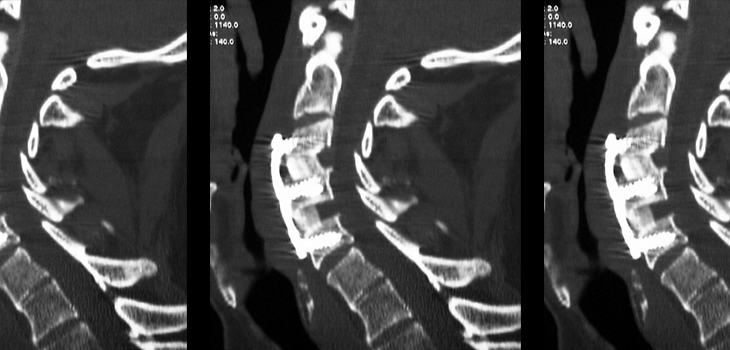
Secondary#pseudarthrosis#anteriorcervicaldiscectomyandfusion#conventionalbridgingbone
Researchers from the U.S. and the Republic of Korea tackled that problem with a new study which looked at radiographic accuracy in 5 ways:
- extragraft bone bridging (ExGBB)
- intragraft bridging bone (InGBB)
- interspinous motion (ISM)
- superjacent ISM
- conventional bridging bone.
The researchers looked at radiographic images for 82 patients and 151 cervical segments. The study, “What is the most accurate radiographic criterion to determine anterior cervical fusion?” appears in the March 2019 edition of The Spine Journal.
Daniel Riew, M.D., director of cervical spine surgery at Columbia University in New York and one of the study authors, explained the reasoning behind this study to OTW, “Pseudoarthrosis following an ACDF [anterior cervical discectomy and fusion] done by another surgeon is the most common reason for a reoperation in my practice.”
“What is amazing to me is that in a large percentage of these cases, the first surgeon did not recognize the pseudarthrosis. We did this study to determine which radiographic criteria is best for determining a pseudarthrosis and found that bridging bone outside of the graft or cage had the best intra- and inter-observer reliability, as well as the highest correlation with surgical exploration.”
“Intra-spinous process motion of <1mm with at least 4mm at a non-fused level on dynamic plain radiographs was next highest and was as accurate as just looking at bridging bone within the graft.”
“The most surprising finding and one that is very important to highlight is that for cases where a cage was used, bridging bone inside of the cage was inaccurate at determining fusion status and should no longer be used, since guessing was better than using this criterion.”
“Since most publications and surgeons use this criterion for judging fusion status, it is very important to highlight the inaccuracy of this criterion.”
Author
React:
Discussion
This is a fascinating development. In my practice we've seen similar outcomes with the revised protocol. The key differentiator seems to be patient selection criteria. Has anyone else noticed the correlation with BMI thresholds?
Great point. I'd push back slightly on the conclusion, the sample size in the cited study is too small to draw population-level inferences. That said, the directional signal is compelling and worth a larger RCT.
We implemented a similar approach last year. Early results are promising but we're still gathering 12-month follow-up data. Happy to share our protocol if anyone is interested.
Join the conversation
Orthopedic professionals are discussing this. Sign in and upgrade to read every comment and add your voice.