
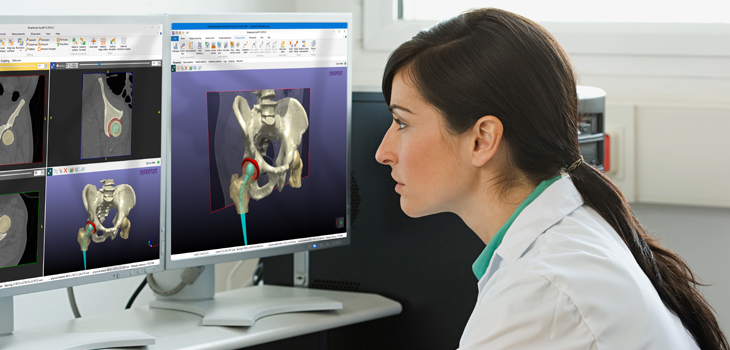
Synopsys, based in Mountain View, California, has announced the release of its new 3D medical image processing platform—Synopsys Simpleware ScanIP Medical edition. The system has FDA 510(k) clearance and CE and ISO 13485:2016 certification.
Simpleware ScanIP Medical: New 3D Image Processing Platform
1 min read Premium comments
Secondary#implantdesign#3dmedicalimaging#simplewarescanip
From Synopsys, here are some of the systems key features and benefits.
Workflow Highlights:
- “Import and anonymize patient DICOM tags from PACS server (DICOM 3.0 compliant)
- Combine CAD and imaging data for patient-specific analysis
- Rapidly segment and process medical images with easy-to-use interface
- Obtain reliable data for complex anatomical analysis using measurement and statistics tools
- Export geometrically accurate models for pre-surgical planning”
Key Benefits
- “Intuitive, fully supported user interface tested by medical professionals
- Compliant with privacy standards for handling patient data
- Achieve ideal surgical outcomes based on insights from imaging data
- Improve understanding of patient anatomy when designing unique medical devices
- Streamline software resources with complete medical image processing platform for your R&D workstation, radiology department, or other clinical work environments
- Build confidence in surgical decision-making by simplifying time—consuming workflows”
Philippe Young, Simpleware Software engineering director, expanded on the system’s features to OTW, “The software is ideal for those in the orthopedic community who want to work with 3D imaging to virtually evaluate implant designs before surgery. We have designed the software to make it straightforward to go from MRI and CT to 3D models that simulate how medical devices affect the body, and to help with pre-surgical planning.”
Author
React:
Discussion
This is a fascinating development. In my practice we've seen similar outcomes with the revised protocol. The key differentiator seems to be patient selection criteria. Has anyone else noticed the correlation with BMI thresholds?
Great point. I'd push back slightly on the conclusion, the sample size in the cited study is too small to draw population-level inferences. That said, the directional signal is compelling and worth a larger RCT.
We implemented a similar approach last year. Early results are promising but we're still gathering 12-month follow-up data. Happy to share our protocol if anyone is interested.
Join the conversation
Orthopedic professionals are discussing this. Sign in and upgrade to read every comment and add your voice.