
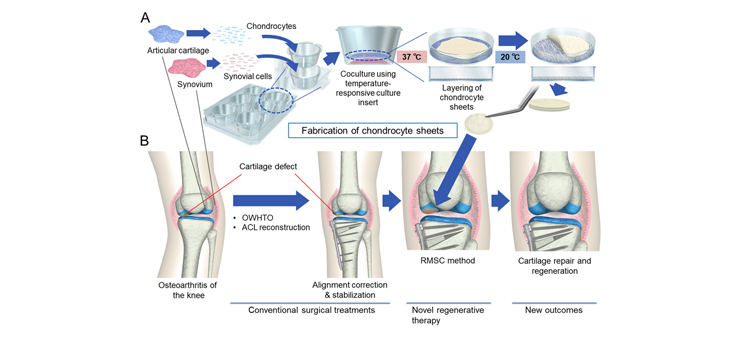
Researchers from Japan have used a combination therapy on eight patients with knee osteoarthritis (OA) utilizing traditional surgical treatment followed by autologous chondrocyte sheet transplantation for cartilage repair.
One Small Step for Man, One Giant Leap for OA Treatment
2 min read Premium comments
#osteoarthritisSecondary#cartilagerepair#lysholmkneescore
More interestingly, the research team demonstrated that the expression of selected marker gene sets in autologous transplanted chondrocyte sheets derived from each patient may be effective predictors of the clinical and structural outcomes of this new therapy for OA.
Their work, “Combined surgery and chondrocyte cell-sheet transplantation improves clinical and structural outcomes in knee osteoarthritis,” appears in the February 21, 2019 edition of npj Regenerative Medicine.
Co-author Masato Sato, M.D., Ph.D., professor of Orthopaedic Surgery at Tokai University School of Medicine in Japan, explained the background for the study to OTW, “OA is a heterogeneous disease characterized by variable clinical features, biochemical and genetic characteristics, and responses to treatments. If a control group is used for a comparative study, it always includes individuals with heterogeneous conditions.”
“OA-related cartilage defects develop over many years and often require multiple therapies to treat coexisting pathological conditions such as malalignment and ligamentous and meniscal disorders. Therefore, complying with regulations that require clear evidence of the add-on effect of each treatment makes the development of new therapies particularly challenging.”
“A rigorous evaluation protocol was designed to assess the endpoints of safety and efficacy of the therapy and to evaluate the clinical and structural outcomes. The properties of the transplanted chondrocyte sheets were also evaluated thoroughly using gene expression analysis to investigate their potential use for predicting the clinical and structural outcomes of the therapy.”
“In this small initial longitudinal case series, we wanted to determine whether expression of specific marker gene sets in autologous transplanted chondrocyte sheets derived from each patient could be used to predict the outcomes of this new therapy for OA.”
“Scores for the individual subscales of the Knee injury and Osteoarthritis Outcome Score (KOOS) continued to improve up to 36 months postoperatively. The Lysholm Knee Score (LKS) continued to improve up to 24 months postoperatively and was maintained thereafter. Predictive gene marker sets for postoperative clinical and structural outcomes were identified based on correlation coefficient analysis.”
“In this small initial longitudinal case series, we demonstrated that the expression of selected marker gene sets in autologous transplanted chondrocyte sheets derived from each patient may be effective predictors of the clinical and structural outcomes of this new therapy for OA.”
“The gene sets that would be used to predict the structural outcomes of histological scores may provide alternative markers for evaluating OA treatment and predicting the long-term prognosis of the therapy. Although the method used in our clinical study is challenging for the regulatory authorities, we believe it is essential to continue investigating the outcomes in more patients with OA.”
Author
React:
Discussion
This is a fascinating development. In my practice we've seen similar outcomes with the revised protocol. The key differentiator seems to be patient selection criteria. Has anyone else noticed the correlation with BMI thresholds?
Great point. I'd push back slightly on the conclusion, the sample size in the cited study is too small to draw population-level inferences. That said, the directional signal is compelling and worth a larger RCT.
We implemented a similar approach last year. Early results are promising but we're still gathering 12-month follow-up data. Happy to share our protocol if anyone is interested.
Join the conversation
Orthopedic professionals are discussing this. Sign in and upgrade to read every comment and add your voice.